Thursday, September 23, 2010

DPS Lotus 138


DPS 138 track at Alpental.


http://www.youtube.com/watch?v=c6shC1i-D54


http://www.youtube.com/watch?v=0Zd2lMAVwnk


http://www.youtube.com/watch?v=CBFmRl2nwFA


I use to patrol on a great little mtn in Idaho in the late '70s and early '80s. Heli skied and guided some into the late'80s.


Two years ago I had a chance to buy any ski I wanted. I ended up with several skis. But the one "dream" ski I really wanted was a pure pow "toooool". The real luxury ski. The one ski you'd use on BIG mtns. BIG heli days, like 20K vert plus. The one ski i'd want on my old mtn for the hUGE storm days after the area had been closed mid week.


I did a ton of research and ended up with a pair of DPS Pure 138.

Likely a half dozen big skis out there that are similar. These are just the ones I picked from that crowd. My 192cm 138sweigh 9# total with no binding. No clue where Stephen and Marshal get the 8#s they keep quoting in the videos. May be in the shorter 182 version but I am skeptical. A I said mine are 9# even for the pair and that is drilledfor a set of Dynafits! Still a light weight ski for the width involved.


This is what the DPS web site lists which is much more accurate using myski as the example.


DPS 138 Pure (per one ski) 182cm 4.41#, 192cm 4.63#, 200cm 4.85#


Couple of weeks ago I had the chance to ski these on a big Idaho storm day @ in my old area where it was laying down well over an inch per hour on top of a foot of fresh. By days' end we were easily knee deep or more every where. The 138s as fun as they have been were even better than expected. I was skiing stuff steep enough that required out running my own sluffs. And stuff steep and mank enough to give me some trouble in the old days when I was 30 years younger and 10 lbs lighter and admittedly a much more accomplished skier. The 138s aren't that much fun on groomed snow but they are manageable there if required. But holy chit they will let you ski ANYTHING, easily!


Every penny spent on those skis was repaid ten fold in just one day....and on only half a dozen runs top to bottom on uncut 2200' of steep to moderate knee deep pow.


I may not heli ski again (knock on wood that I do) but the 138s make me want to chase a few big storm tracks across the northern tier next winter. And I am now watching for the last of the big storm tracks this winter :) The 138s are in reality a dream more than a ski for me. But they allow that dream to become reality so, so easily :)


Happy man, Spring '12.

Sunday, September 19, 2010

Shipwreck


This is what is left of the Peter Iredale that ran aground October 25, 1906. I had seen it before in .. but there was more of it showing this time. About all that is left is the metal parts of the ship and just a few of the pieces of wood under the top part where they are a little bit more protected. It is one of the few shipwrecks that people are alowed to right up to and explore around it and as you can see in the photo even on it. There were some young men who climbed up on top and sat there while we took photos. They were having a great time and I envied them their ability to get up there.

Wednesday, September 15, 2010

Update from Salt Lake City :: One Month

Yep! A month ago today I arrived in Salt Lake City. The time has literally flown by. A lot has been accomplished – over 300 microfilms and 40 books (and 1 microfiche) have been pulled and viewed. Of course some of them only for a few minutes and others for a longer period of time, depending upon what the film contained. It's been exhilarating and exasperating – depending upon what was found or not found.


Various documents (wills, estate records, deed records, tax records, baptism records, etc.) on 25 different surnames – not all types of documents for every surname, more on some than others, but something for each surname. Some things were expected (I “knew” about them) but some new things have been found too. I'm at the point now where the “low hanging fruit” has been obtained and will be entering “new” territory next week, exploring surnames and locations that I've not done much research on previously.


One of the earliest documents found is the 1739 Land Warrant issued to Andreas Brinker. Born on July 9, 1699 in Rümikon-Elsau, Zürich, Switzerland as Andreas Brungger, he was married to Regula Hester in 1721 and they had six children, five of whom were born in Swizerland. On June 28, 1735 Andreas and his family arrived in Philadelphia onboard the ship “Mary” having sailed from Liverpool, England. They settled in Saucon, Bucks County in what would become Lower Saucon Township, Northampton County, Pennsylvania. Andreas and Regula are my 7th great grandparents.


Land Warrant of Andreas Brinker, Bucks County, Pennsylvania. Family History Library microfilm 021686 scanned November 1, ...

By the Proprietaries.

Pennsylvania, SS. Whereas Andreas Brinker of the County of Bucks hath requested that We would allow him to take up Fifty acres of Land Situate between to Hills adjoining George Hertzley at Sacoon in the said County of Bucks for which he agrees to pay to our Use, within the Term of six Months from the Date hereof, at the Rate of Fifteen Pounds Ten Shillings, current Money of this Province, for every Hundred Acres; and also to pay the yearly Quit-rent of one Half-penny Sterling for every Acre thereof, to us, our Heirs and Assigns for ever: These are there to authorize and require you to survey, or cause to be surveyed unto the said Andreas Brinker at the Place aforesaid, according to the Method of Townships appointed, the said Quantity of Fifty Acres, if not already surveyed or appropriated, and make Return thereof into the Secretary's Office, in order for Confirmation; for which this shall be your sufficient Warrant: Which Warrant and Survey, in case the said Andreas Brinker fulfil the above Agreement within six Months from the Date hereof, shall be valid, otherwise void. Given under my Hand, and the Seal of the Land-Office, by Virtue of certain Powers from the said Proprietaries, at Philadelphia, this Fifth Day of March Anno Domini One Thousand Seven Hundred and thirty nine. Signed Thos Penn


To Benj Eastburn, Surveyor General.
[Written on the left side]

To George Palmer DS

Execute this and make Return of Survey into the Surv Gen'l office as Soon as possible.

for John Sukins Esq

Edw Lynch


Tuesday, September 14, 2010

Ice tool umbilicals? *repost*

A repost of myfirst blog entry, from Jan 29


The Joke Slinger, on the BD Spinner leash, Jan. , the Cascades.


With the invention and popularity of leashless climbing, a once condemmed and decades old climbing tool has come back. While they are not mandatory, they are in vogue. It has been over 35 years since I saw the first pair of umbilicals in use.


Author's umbilicals of 9/16" webbing being used on a quick ascent of Polar Circus in the winter of 1979.


Gregg Cronn photo


Back in the late '70s and into the early '80s umbilicals were looked upon as a weak man's crutch. Mostly thought of as something the Canadians used (but never really did much) to aid sections of rotten, cold and really steep ice. We can blame all that on Bugs McKeith inventing the idea of ice aid while putting up some of today's modern classics, like Nemisis and Polar Circus. Just two among his many, many difficult ice climbs. Most visiting American climbers thought they were way ahead of the game by not using umbilicals while running up the first "free" ascents of the Canadian test pieces. Few outside Canada really made the "first free" ascents many claimed. Canadians had already been there on most of them and didn't fight back the cat calls.


No Internet back in the day so info was often sketchy and incomplete or just a fubar rumor. It was hard to keep track. Of course not every one used umbilicals even back then. But a few did. 1st and 2nd ascents of Slipstream did.


Jim Elzinga photo of John Lauchlan on the 1st ascent of Slipstream


They were not used for aid or for hanging to place screws. Although when required you could do either. The real use was to save your ass if you happen to fall. Hopefully an umbilical would keep you on the ice. BITD leads were long and run out. Ice screws could be hard, difficult or just plain impossible to get in, depending on the ice and out side temps. Weighting your umbilicals is a way to save the 2nd's strength while pulling screws if you can deal with that idea ethically today.


No one sane thought the idea of falling with tools and crampons OK. Falling on the old gear generally required a hospital stay or worse.


Once I switched from Chouinard curved tools to a set of Terrodactyls for technical ice I seldom climbed without at least one umbilical attached to my harness or swami. As the tools changed the old umbilicals generally went straight on the new tools. Big jumps from Terros, Clog, Chacal, Pulsar.


Pretty simple change as mine were just a set of tied 9/16" nylon tube webbing.


The first manufactured umbilicals I saw..years later ('05) ... where done up by Grivel. The "Grivel, Double Sping Leash" with a mini wire gate "biner" specifically designed for the task. While leashless tools really hadn't caught up with the possibilities yet, Grivel umbilicals were seen on some pretty amazing climbs often used by climbers sponsored by competing tool companies. The umbilical had finally "arrived". But no one outside a tiny circle of hardcore alpine climbers really knew it yet. A quick Goggle Images search will get you photos of Steve House, Marko Prezelj, Raphael Slawinski and a host of others using both the Grivel and BD umbilicals on hard alpine climbs all through the new millenium.


I worry more about dropping a leashless tool, than I do falling off. But when you can protect yourself from both mistakes it makes sense to ante up and use that protection. More than one really good climber has poked fun at me because of my support of umbilicals. More climbs and climbers I admire used umbilicals and have been suggesting you do as well.


Ueli Steck, Grand Jorasses, record speed solo, Jan '09. Jon Griffin photos


Easiest way to get yourself a pair of umbilicals is by reading Dave's web site and making your own. Good stuff!!


http://www.alpinedave.com/leashless_rig.htm


Alpine Dave photo


The second way is buy a pair of the commercially made ones.


Grivel offers several versions, Blue Ice in Chamonix offers a simple version and Black Diamond offers their "Spinner" unit.


For what it costs to make a "good" pair of umbilicals all three, Blue Ice, Black Diamond and Grivel offer real value imo.


Here is some detail on what I use and my observations.


Grivel was my first commercial set. I was lucky enough to get the original Grivel 3KN mini biner version with a girth hitch atatchment. Not a big fan of the mini locking version out now. Or a biner attachment to the harness. Good elastic and webbing that attaches to the harness by a girth hitch (small loop is passed through harness belay loop and tails are feed back through and out the small loop cinching tight on the belay loop) Very simple. Length is shorter than some seem to like but if I sit down on the leashes (6'1 and normal ape index) at full extention for both tools the Grivel leash will allow my tools to be out of reach. Just barely so, but still out of reach. It is durable.


Black Diamond had dozens of Spinner Leash prototypes out the last couple of years for real world testing and feedback. Again I was lucky enough to get a pair of those and used them a lot. Better yet for good feedback, I let all my partners use them.


Only thing I can see that has changed in the Spinner leash is the over all length has been shortened on the current version. I've seen current reviews commenting that the BD Spinner leash set up is now too short. Trust me? The Spinner IS NOT too short for anyone under 6'8" and a huge ape index that I know! The "too short" comment doesn't make sense unless the reviewer is mistakenly writing about a short early prototype? Mine on full extention are a full 2 feet past what I can reach.


If you happen to fall on the Spinner you'll have some work cut out for you getting back to your tools. The Grivel set up is managable but only just. The Spinner will make you work for a living it you weight it unprepared. But if you are using the most modern ice climbing techniques you should be stacking your tools on top of each other which should help. You'll need the extra reach to accomplish that and still have only a short fall for your Spinner to catch. It is a tough balancing act to get the right umbilical length and still get it to do everything required of it.


If you need to weight your tools intentionally, you had better stack them or you'll not be able to reach a tool using either brand name.


While I like simple and wasn't impressed with the swivel of the Spinner originally, everyone else that used mine was. I've come to accept its advantages over time. And no question having a leash set up that avoids all the tangles and twists that will come with umbilicals is an advantage. Grivel no longer offers their 3KN wire gate mini biner version. On the other hand BD took notes and then used them on all the details. BD uses a proprietary hydrophobic webbing, a over built mini swivel and mini wire gate biner that will fit most tools head and spikes. It is a good piece of kit. And would cost a small fortune to duplicate in the same quality.


A reader once again pointed out the Boa Leash from Blue Ice to me today. Thank you! I have not climbed with the Blue Ice version yet but will shortly. It is more akin to what I like generally like in gear, simple, maybe no "biner" required, and easily replaceable if damaged. I'll add more to this blog post once I have had a chance to use a set. $32.00 US seems reasonable though for the effort and materials involved if they attach easily and are the "right size" in actual use.


Blue Ice Boa Leash below:


I try to climb smart and if a technical ice tool goes in my pack so does a umbilical system. See ya out there!


Steve House on the top of the Italian Route, Taulliraju (5830m), first free ascent, three-day roundtrip, with Marko Prezel 2005 (Prezel photo)

Wednesday, September 8, 2010

Wispy Sunset over Iceberg Bay


Last night's sunset may not have had a large color palette, but the streaks of clouds and the floating icebergs sure were nice! Yesterday morning at this location there was a brisk wind and a nice swell rolling in off the lake, and there were a lot of ice plates floating around. Last night the swells were still coming in off the lake but the wind was gone and so were the plates of ice. The ice was actually still there, but it was all ground up into small chunks that were floating everywhere in between the larger "icebergs" that you see here. Without the wind the "tinkling" sound of the ice rolling around in the waves was quite loud and fascinating. This calm preceded a winter storm that we are getting today. There still isn't any wind, but snow has been falling steadily since about 9:00 this morning. We have had a few inches already and they say we may end up with 7 inches by the time it's done. One thing's for sure... it sure is a beautiful winter wonderland of white out there today!

Redbud and Sandias


Here is one of our redbud trees with a view of the Sandia Mountains behind it.

Monday, September 6, 2010

Life Goes On


(Photo: X-Ray showing my broken ankle. Diagnosis: fracture- ankle, medial malleolus, closed.)

One year ago today, I broke my ankle rock climbing.

In part, I started this little blog in order to force myself to write about it. But I've been struggling with what to say about it for a year now, and I'm afraid that struggle isn't over.

My accidenthappened on a Gunks climb called Insuhlation (5.9). I fell justafter the final crux roof. I pulled over the roof with no problems, but there was a wet hold above the roof that I suppose I failed to use well. Or maybe my foot popped, I'm not sure. Truthfully, I don't know exactly why I fell. I had my right hand on the semi-jug above the wet hold. I was looking around for pro; my last piece was a green Alien a few feet below the roof. And then I was off.

I recall with vivid clarity the sensation of falling. Time suddenly slowed to a crawl, and I saw my half ropesin a parabolic arcabove me as I flew back outward from the rock. It seemed as if I had a good long time in midair to consider that this might not end well. I remember thinking "this is it!" ...but I'm not sure what I had "it" in mind to be. I yelled out "falling," and then things sped up considerably. I flipped upside-down and then the rope came tight on the green Alien, which held, and I came to a stop, hanging in the air with my head where my feet should have been.

As I righted myself, I realized I was injured. I couldn't understand why I'd flipped over. The rope wasn't behind my leg. And I hadn't felt a thing. There was no impact at all that I had sensed. So why was my ankle tender and starting to swell? I asked my partner N to lower me to the ledge. The pair climbing next to us onObstacle Delusion retrieved my gear on rappel and filledus in on what had happened. "You flipped over when your ankle hit the rock," one of them said. So it seemed there was an impact, but in the adrenaline-pumped moment I hadn't felt it. At least itall made sense now, even if the explanation didn't jibe with what my mind had allowed me to experience.

Thinking it was just a sprain, I hobbled the whole way from the High Exposure access trail back to the steel bridge, refusing numerous offers of assistance from concerned strangers. The best and the worst of the Trapps in autumn were on display. People were kind and supportive, but there were far too many of them. At one point I stopped to rest in the Uberfall area and counted over thirty climbers in my immediate field of vision, all of them looking at me in a pitying way that made me very uncomfortable. N thought we shouldsummon the rangers, but I insisted that if I could evacuate myselfwe shouldn't initiate a rescue. I now recognize that this was a stupidmistake. I really don't think it made my ankle any worse, but if I'd listened to N, we would have had the benefit of the advice of first responders, and I would likely have been taken to a hospital for an x-ray right away instead of waiting 24 hoursand only thenfinding out the ankle was broken and required surgery. It also would have put much less pressure on N, who ended up having the sole responsibility of babying me all the way back to Brooklyn.

In the aftermath of the accidentI was overwhelmed with guilty feelings. The source of these feelings was hard to pin down. I felt guilty about inconveniencing my wife.She'd have to pick up the kids every day and do all the cooking for months to come. I also felt guilty that I'd made whatever climbing mistake I must have made to get into this mess. I blamed myself for the accident, although I had a hard time deciding what it was I'd done wrong. I also felt a lot of guilt about imposing my injury on N. I entertained totally unfounded fears that she'd never climb with me again, and that all my other climbing partners might desert me as well.

Amidst all this I wondered if I really was feeling most guilty about climbing in the first place. Was I taking pains to find fault with my climbing on that fateful day because I needed to avoid confronting something harder to deal with? Was my accident really a reminderthat even if you do everything right when you climb, even if you place gear liberally and it holds, you can still get hurt? Was it a sign that I should quit,that climbing is unacceptably dangerous? Certainly a number of people, from my doctor to my mother to my wife's colleagues, assumed that my broken ankle would be thewake-up callI needed to make me come to my senses and stop this climbing nonsense, as any responsible husband and fatherwould.

I did not want to quit. Although I didn't know how I'd feel getting out there on the rock again, I was sure, as I sat around recovering and gaining twenty pounds, that I would missclimbing terribly if I stopped doing it. But I didn't want to be a bad husband and father. I had to ask myself if climbing could be done reasonably, or whetherthe dangers were such that no amount of rock climbingcould be consideredsane.

I read numerous classics of mountaineering literature searching for the answer, to no avail.Many great mountaineers have wrestled with the question of why we are drawn to climbing, and whether the dangers are worth it. Some embracethe risk, declaring danger to beat the verycore of the climbing experience. Othersfocus instead onthe many other wonderful aspects of the sport-- the scenery, the adventure, the physical and mental challenge, theconnectionwith nature-- but throw up their hands at the death toll and ultimately leave the question of whether it is all worthwhile to a higher power.

Of course, these writers are considering a different sport than the one in which I participate. They are writing about climbing real mountains and pushing the very limits of the possible. They choose to face objective hazards that cannot be managed, such as altitude sickness, avalanches, and sudden deadly changes in the weather. And in order toexpand the boundaries of what can be climbed, they deliberately go without reasonable protection on climbs that are incredibly risky,forging ahead on blank, smoothrock facesand through rotten bands of ice. These writers would think nothing of the climbing I do in the Gunks on a two hundred foot cliff that has been fully explored, with every route to the top exhaustively indexed by its difficulty and protection rating. To them the risks taken by a weekend warrior likemehardly qualify as risks at all.

And yet there are risks in any climbing environment, no matter how tame that environment is. In the Gunks, for instance, there have been very few fatalities over the years, but less than fatal accidents occurratherfrequently. Lapses in judgment lead climbers to forget crucial steps in the climbing process. Theyrappel off the ends of their ropes, or drop their partners. Objective hazards exist: rocks fall down. And no matter how much difficulty and protection grades may sanitize a climb, it is still easy to wander off route, to miss a crucial gear placement,or otherwiseto find oneself in territory where a fall could be disastrous. Gear that seems solid may pull out; it is hard even for experienced climbers to dependably judge placements of climbing gear. And finally, as my accident demonstrates, even if the gear is solid you can get hurt in any fall.

It is often pointed out by climbers that many sports carry dangers, and that climbing is actually less dangerous thancommon daily activities like driving a car. This may be true, but we are not forced to choose a dangerous sport in which to participate. We don't have to choose climbing just because it isn't as crazy as BASE jumping. We can shun all sports involving danger if it is the right thing to do. And while driving a car may wellbe more dangerous than climbing, we live in a world in which we can't escape the car. We have no choice about it. Climbing is different. It is a luxury we can well afford to drop.

But I couldn't bear to drop it.After my accident I was desperate to find a rationale for continuing to climb, a way to go forward but feel I was being reasonable and safe about it.

I wish I could tell you that I figured out the answer to this problem. I wish I could say thatI developed a calculus to determine how much danger is acceptable. I wish I could offer you a climbing plan that is 100 percent risk-free, or tell you that I located the perfect spot on the climbing danger continuum at which adventure is maximized but life-threatening hazards are minimized. But obviously I did none of these things.

Instead I decided to wade back into climbingslowly and to take it easy, minimizing risk by minimizing difficulty. Even this simple plan was a difficult one for me to execute, because I like to challenge myself. But aside from a few lapses I mostly stuck with it, avoiding leading harderclimbs all year, being willing to follow other folks' desires and ambitions more than my own, and repeating a bunch of favorite climbs instead of always seeking out new ones.

At first, I found that my accident had wreaked havoc with my lead head. I was tentative on the lead, becoming paralyzed at crux momentsI never would have worried about in the past. On more than one occasion this year I fell or took a hang because I simply couldn't commit to the move atthe crucial moment of a climb. The irony of this situation wasn't lost on me-- before the accident I pretty much never fell while climbing, but afterward, while trying to go easy and safe, I found myself falling or hanging on gear with some frequency. This seemed like madness, and made me wonder what the hell I was doing out there at all.

But I'm happy to report that over time my head improved (although not completely). I lost a good bit of the weight I gained and I alsotried through the year to become a better technical climber with a better awareness of balance and footwork than I had in the past. I see increased proficiency as a path towards feeling confident enough to progress back up the grades in the future. At some point this year I gave up on having any big climbing achievements in . It has been a rebuilding year.I haven't led a single pitch of trad 5.9 all year, and I'm fine with that. I recently followed a few, and they felt laughably easy. I take that as a good sign, and I plan to put that good feeling in my pocket for the winter, work really hard in the gym through the cold months, and emerge in the spring with confidence thatI can soon begin leadingharder climbsagain, breaking back into 5.9 and maybe even 5.10. And I hopethat whenI doso the climbs willfeel secure, and not beyond my limits.

So I have continued to climb, and life goes on. I can't assure anyone that I have made the right decision. But I can promise I'm more careful than I used to be, with the unfortunate side effect that I'm also more tentative. I am more willing to back off, and I will be much slower about working up the grades, more conscious of my limits. On the whole I believe I'm moving in the right direction. And that's the best balance I thinkI can achieve.

Friday, September 3, 2010

Smoke From Fires


These are photos I took this evening when the wind blew the smoke in again after almost a week of this. The smoke from the forest fires in Arizona is coming into New Mexico and causing a lot of air quality problems here. That is smoke in our skies here not clouds as it may look like in the photo. We haven't seen a blue sky in over a week. The machine that tests air quality normally reads about a 30 (what ever the scale may mean) and is reading about 200 when smoke is at it's worst right now. I have head that some of this smoke has been tracked all the way to Iowa. But at least we are not right on the edge of the fire as those that live near it are.


Thursday, September 2, 2010

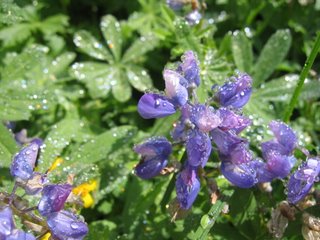
Comet Falls Mist on Lupine


Mist-covered blue lupine in Mt. Rainier National Park.

Sleeping Giant


The 14,411-foot dormant volcano Mt. Rainier rises dramatically from the surrounding landscape.