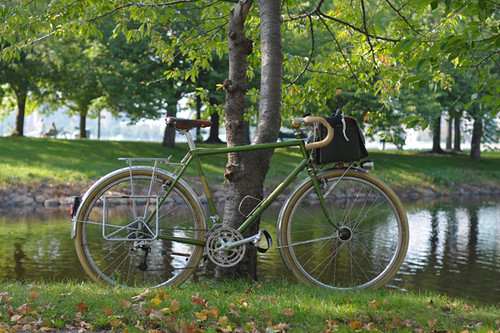
It has now been nearly 2 years since I began riding my Rivendell Sam Hillborne and it seems a retrospective is overdue.Myinitial reviewof the bike was written in the Fall of after 6 months of ownership, and it was basically a celebration of what this bicycle did for me over the course of that time. I had not been able to master riding a roadbike with drop bars until I got the Sam, and so this bike opened up a whole new world to me and made me very happy. Two summers later, I am a different cyclist than I was back then, and my main roadbike is currently a racing bike with skinny tires. So while the Rivendell Sam Hillborne has not changed over the time I have owned it, my perspective has changed dramatically and it is only natural that this review will reflect that.
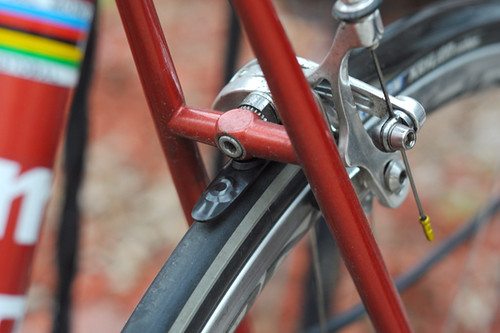
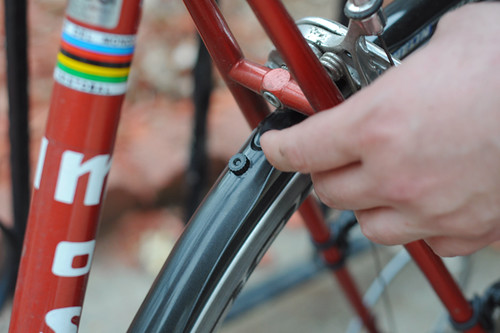
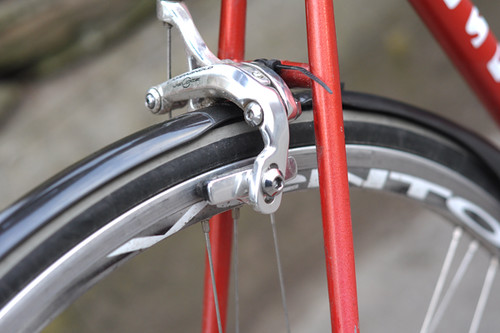
In its essence the Rivendell Sam Hillborne is a road-to-trail bicycle optimised to fit fat tires and to carry a good amount of weight. Smaller sized Sams are designed for 650B wheels and larger ones are designed for 700C wheels. The frames are made with cantilever brake bosses, eyelets for fenders and racks, braze-ons for two water bottle cages, a kickstand plate and a pump peg. The lugged steel frame is built with oversized tubing that is somewhere in the middle on the heavy-duty scale as far as Rivendell models go. A good way to describe this bike would be as a touring bike with off road capacity. It can also be set up as a transportation bicycle, since it can be fitted with either drop or upright handlebars. The current price for a Taiwan-built frame is $1,050 - almost half the price of most other Rivendell models. It is worth noting that "back in the day" when I got the bike, it was the pre-2TT era and this model came standard with just a single top tube. Now the larger sizes have double top tubes.
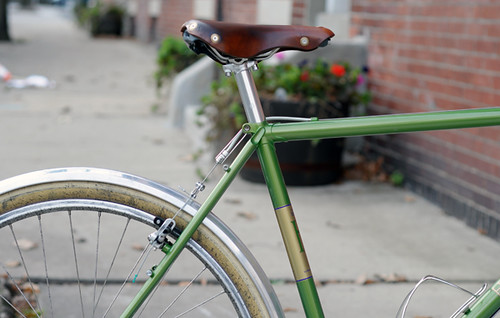
The frame geometry is relaxed(71.5° seat tube angle) and "expanded," with a 6°sloping top tube. The Rivendellian concept of an expanded frame is the exact opposite of what in standard roadbike speak is known as a compact frame. A compact frame's sloping top tube is designed to have lots of seatpost showing and the handlebars low. An expanded frame's sloping top tube is designed to have little seatpost showing and the handlebars high. Unless I am completely misunderstanding these ideas, the compact frame and the expanded frame are in fact one and the same, only the sizing is determined differently. According to the compact philosophy, the size of the bike is determined by the top tube's virtual intersection with where the seat tube would have been, had the top tube been level. According to the expanded philosophy, the size of the bike is determined by the actual seat tube length. As such, by Rivendell's standards my Sam is a 52cm frame, and it is the size they recommend for a person of my height. However, a compact geometrist would consider my frame to be more like a 56cm given how tall the headtube is and how long the top tube (57.5cm).

Have I thoroughly confused some of you? Think of it this way: Rivendell's sizing guidelines assume that the rider wants their handlebars at or above saddle height. If that's what you want, go with their sizingguidelines. But if you want a more aggressive position with handlebars below saddle height, go smaller. Given my current riding style, technically the bike I own is now too big for me to set up exactly as I would prefer (ideally I'd like a longer stem and the bars several cm lower). On the other hand, Rivendell's philosophy is what enabled me to learn how to ride with dropbars in the first place. The fit and geometry of this frame size worked well for me two years ago and I was thankful for it.
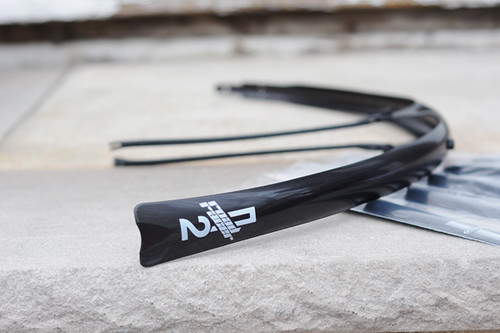
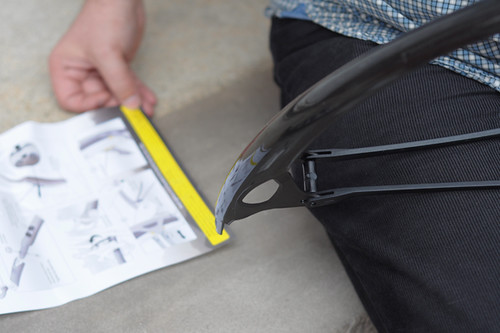
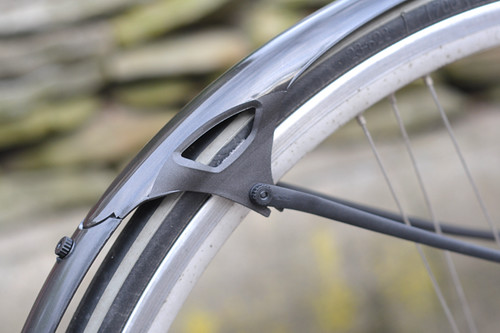
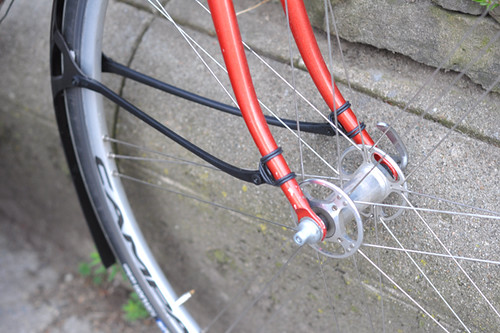
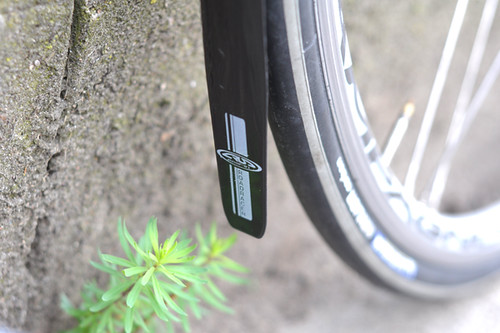
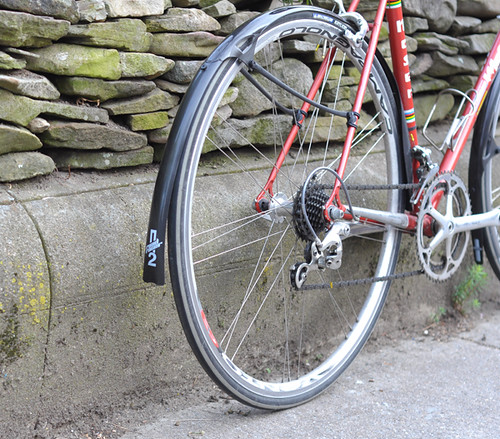
Currently my 52cm frame is fitted with a 70mm stem, a zero-setback seatpost, and bars 1cm or so below saddle height. The bike is set up with a Shimpagnolo drivetrain with a triple crankset, a 9 speed touring cassette and Veloce ergo levers. The 650B wheels were built with a dynamo hub in the front, which powers the headlight and tail light. The tires are 42mm Grand Bois Hetres. The bike is fitted with VO Zeppelin fenders, a Nitto front rack, and a large Ostrich handlebar bag. I also have a Nitto Campee rack with lowrider attachments that I use during loaded trips, but it is not part of the bike's usual setup.I use Power Grips as foot retention. This setup was arrived at gradually, but has remained stable since the middle of last summer. The complete bike weighs around 30lb, give and take depending on how it is set up.There is no toe overlap.
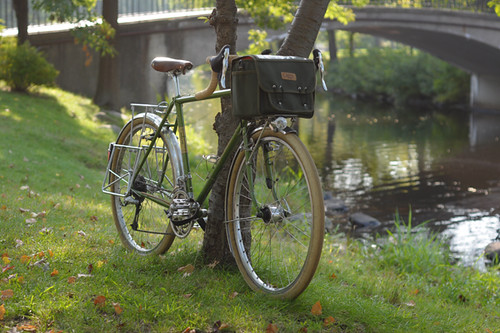
I am very pleased with the aesthetics and the construction quality of this bicycle. Rivendell is one of the few manufacturers that designs its own lugs instead of using commercially available lugsets, which I find really cool. You can see my close-up shots of the lugwork here. The frame is finished beautifully, with no imperfections. There is a couple of small chips in the paint after two years, but they are not noticeable unless you know where to look. I love the c. shimmery moss-green of my frame and the dark gold accents. I like the design of the headbadge and the decals. I like the fork crown design on my frame, which is slightly different from subsequent fork crowns on the same model (see the comparison here). I do not mind the6° top tube slope, though if given a choice I would prefer a level tube.
As far as weight, I do wish the bike were a bit lighter while retaining the characteristics that make it what it is - namely the fat tires, fenders, rack, handlebar bag anddynamo lighting - none of which I am willing to give up. However, I recognise that the 30lb range is a fairly typical weight for bikes of this style, built up in the same manner.
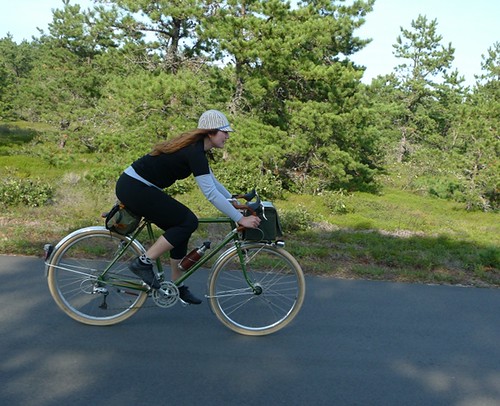
I will take a deep breath at this point and tackle the subject of speed. Over the past year, I have been test riding some racing bikes and a lightweight randonneur, and being that the Rivendell Sam Hillborne was my only basis for comparison at that point I described those bikes as "faster" than the Riv. The biggest difference I feel between the Sam Hillborne and the racier roadbikes is the acceleration: the Sam is not as quick to take off from a stop and not as quick to accelerate. All that said, I think it's important to note that those comparisons should be considered in context. The Rivendell is slower than racing bikes, because it is not a racing bike. It is a heavier, more relaxed machine, designed to perform a different function.It is reasonably fast for a touring bike.
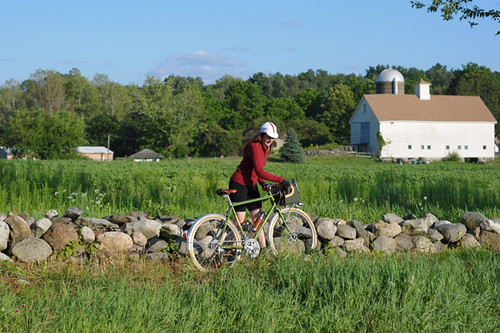
When it comes to handling, my favourite characteristic of the Rivendell Sam Hillborne is that it is stable and intuitive. In describing test ride reports often I'll mention that such and such a bike takes getting used to before it starts to feel "normal." By contrast, the Sam Hillborne does not require getting used to; it's intuitive from the beginning and remains so. Everything feels safe, neutral and predictable. It is stable at slow speeds and it is stable at high speeds. It is stable uphill and it is stable downhill. It turns easily and does not need to be "forced" to corner. Neither does it "over-react" on turns. The wide tires on my bike further enhance the stability, as well as contribute to the cushy ride quality. Once you've ridden on 650Bx42mm tires over pothole ridden roads and dirt trails, it is difficult to forget the ride quality.
My favourite rides on the Sam Hillborne are those best described as "exploring." Unstructured, rambling, with no time constraints or ideas about optimal speed. With my camera in the handlebar bag, a book, some food, maybe a notebook, a pen and some extra clothing, the bike feels likehome away from home.
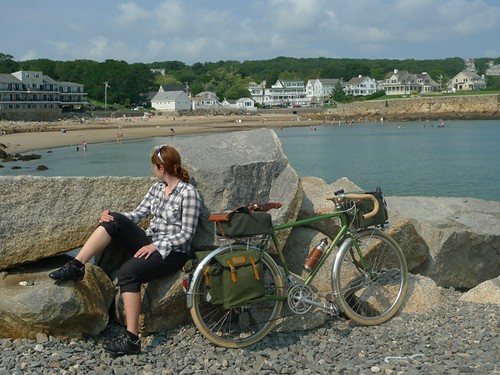
And perhaps the most definitive characteristic of the Sam Hillborne is its ability to carry weight. As I've mentioned previously, I ride this bike with a full handlebar bag and experience no adverse effects on speed or handling. The bike just does not care.
When we went on vacation last summer and did not want to bother renting a car, I carried most of our (2 weeks' worth of) thingson the Sam and it was great fun. Carrying weight on a bicycle is not merely a matter of attaching racks and strapping stuff on. Not all bikes do well under a front and/or rear load, and not all bikes have the proper clearances to carry panniers. The Sam Hillborne was designed specifically for things like this, optimised for the culture of "bike camping" that's so popular with Rivendell owners. The front end seems insensitive to properly supported weight, the chainstays are long enough for panniers without heel-strike, and the frame's tubing is robust enough to handle the weight itself. It is really a shame I do not take advantage of these characteristics more often.
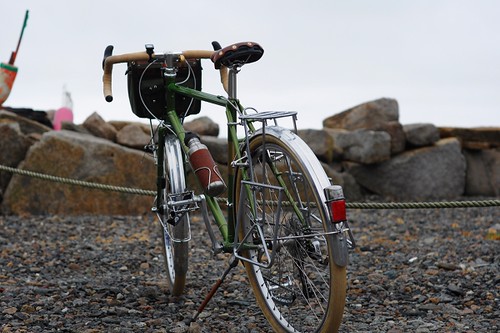
In my view, the Rivendell Sam Hillborne is a good choice for loaded touring, bike camping trips, commuting, exploring-by-bike, and all around casual riding - on paved and unpaved terrain. To get the most out of this bike, I would definitely recommend lights, fat tires, fenders, a rack, the whole nine yards - it's what makes it special. If, on the other hand, you are looking for an aggressive lightweight roadbike for training rides, competitive long distance events and such, this isn't it and was not meant to be (Rivendell does make a more aggressive and paired down model that may be more up that alley).
I have tried to put together my thoughts on this bicycle in a way that is fair and well-ballanced. For anyone deciding whether a Sam Hillborne is right for them, I suggest reading my original review and this review (if you can stomach that much of my writing, that is) in sequence: They are both sincere and accurately describe my impressions of the same bike at different points in time.


 This has to be one of my favorites (it's been cropped and enlarged to show their expressions). On the back is written: "Grandma with Phyllis Phend & Francis Palmer. They each weigh 20 pounds & my arms are nearly broke." The "Grandma" in the picture is my 2nd great grandmother Malissa Joslin Brubaker Bower and she would have been about 74 years old at the time, which I estimate to be the summer of 1923.
 August 1972 at the San Diego Zoo. My brother, Jack, got tired of me taking his picture. Just as I was about to snap one more, he decided to hide behind the booklet he was reading. I like how his ear and hairline blend in with the picture of the monkey (or baboon or whatever it is). Of course, this could be one of those instances where it is only funny if you were there ;-) but we always get a good chuckle out of it. And there are other good memories that go along with it too. We were both in the Navy, he was stationed on the West coast and I was on the East (at Bainbridge, Maryland). We both took leave and met at home in Indiana then he and I drove back to San Diego together. We were young, we had fun.


 Padre Island National Seashore







 rday the ice went from great to unsafe. Joel Torretti, Josh Hurst and I made the best of poor conditions. Josh came all this way to climb so we did. We even put him to work. We decided to equip a new line at Upper Meadow Amphitheater. A short ice start leads to steep roof climbing, from there leave the rock, punch the curtain and finish on the last 15' of the ice pillar to the top OR continue left passing 1 more bolt to the left hanging curtain. Despite a single attempt by Josh and numerous attempts by Joel and I the line still remains unclimbed. (Josh was feeling under the weather with a head cold and busted ribs from a fall on Caveman extension the previous day). If he weren't in bad shape I'm sure he'd fired the line with little trouble. The line is strenuous and powerful. When completed it could be the hardest mixed route in SWPA. With all the rain in the forecast I doubt the finishing ice pillar will still be upright, thus rendering a true ascent impossible until ice reforms at the lip. Dont let that deter you. The route stays day and can be worked on rain days. Keep the season
 alive, go give it a go. Today we went back to work the line some more and possibly equip another. Instead we were lucky enough to witness a very cool natural event. As the morning temperatures rose an ice dam broke further upstream. The small, tame Meadow Run became quite intimidating in less than 2 min. We quickly gathered our gear and headed for higher ground up in the ampitheater. we sat and watched in amazment. Large ice debris and class five rapids lasted for 20-30min. then slowly the water receded. Quite a cool thing to see happen. Even though it was warm and rained we still had a great weekend, climbed hard and laughed most of the time. (Hope your ribs are feeling better Josh)!


 The new 'green', energy efficient JVC II is architecturally designed to match its surroundings and the historical park style, referred to as 'Park Service Rustic'. The feeling of the building when you first enter is dictated mostly by the space, due to the height of the ceiling and massive windows that line the entirety of the wall, naturally lighting the surroundings. However, it could also have something to do with the weird climber want-to-be mannequin placed high atop the climbing display. A feeling of comfort is there too. Above you are post and beam rafters, held together with cast iron fixtures and signs made from a menagerie of dark metal and wood. Overall, I was impressed and I think the sentiment was shared by most.
  winter/holiday break from December 20th through January 4th. And as has been the tradition up at Paradise for many years, Ranger-led snowshoe walks will begin at the new JVC (snow permitting) on December 20th. The two public walks (12:30, 2:30) are approximately 1.5 miles in duration and last less than two hours and are moderate to strenuous. The walks are an amazing opportunity to experience the Park and Mountain in the wintertime. The adjacent photo was taken this past winter as I was returning from one of my group snowshoe walks - a beautiful view of the old JVC at sunset.