Sunday, March 25, 2012

Whitley County - A Place Some Ancestors Called Home

My grandmother, Hazlette Brubaker, was born in Lorain County, Ohio but her parents were born in Whitley County, Indiana. All four of her grandparents were either born in the county or came here as young children with their parents. Seven out of eight great-grandparents came to Whitley County as young adults; the eighth great-grandparent lived in Huntington County, which borders Whitley on the south. Of her sixteen great-great-grandparents, nine lived in Whitley County. In addition, three 3rd great-grandparents also lived in the county.

In 1823, the county of Allen was created in the relatively young state of Indiana. Within that territory was the land that would, in 1838, become Whitley County. Four years previous, it had been put under the jurisdiction of Huntington County. All of that area was once the domain of the Miami Indians. The earliest white settlers came to the area about 1827 and by 1838, the population had grown sufficiently enough to be allowed to govern themselves. The first tax assessment, made in 1838, included the names of 136 men. How many women and children were living here at that time is not known. By 1840, the number of households had grown by 60% as shown by the Federal Census that year, which listed 219 households, and the total population of 1,237 for the county, which was comprised of 338 square miles. To say that it was sparsely populated would be an understatement!

It was in August of 1838 that the first of my ancestors came to Whitley County. These were the Goodrich and Joslin families and they purchased land in the northwest portion of the county. About 1843, Grandma Jones came to Columbia City. With her were her parents, Conrad and Mary (Swigart) Helms, and several brothers (you can read about the brothers in the post on Hell's Half Acre). They settled in Columbia Township. Also coming to Columbia Township at about the same time were Henry and Anna Robison. And William Hamilton Dunfee. His parents, James and Sophia (Hazlett) Dunfee would follow a few years later though they lived in Jefferson Township on the eastern side of the county, bordering Allen county. By 1850 the population of the county had reached 5,190.

In 1851, eight year old William Brubaker came with his step-father and mother, George and Sarah (Foster) Parkison. The next year, Conrad and Indiana (Sisley) Stem arrived on the scene as did their daughter, Malissa, and her husband Jacob Wise. They lived in Thorncreek township, north of Columbia City. In addition to my grandmother's ancestors, my grandfather and his parents, Henry and Susie Phend, moved to Columbia City about 1898. In 1900, there were 17,328 people living in the county. As of .., the population was 30,707 which was predominantly white (98.37%). Native Americans constituted 0.36% while 0.19% were African Americans and 0.18% were Asian.

Of the actual homes of my ancestors, their physical houses, the only one that remains that I am aware of is the Brubaker home at the Goose Lake Farm. The old Scott School that my grandmother and her siblings attended is still standing, though abandoned long ago and now used for storage.

Whitley County has been, and still is for the most part, an agricultural community. There is some industry, mostly in Columbia City and along U.S. Hwy 30 which runs east-west through the center of the county. The other major highway is U. S. 33 which cuts through Churubusco in the northeast corner of the county connecting Fort Wayne with Goshen.

The landscape is nothing spectacular though it is quite pleasant. Rolling hills and flatlands, fields of corn and soybeans, along with lots of trees, wooded areas and a few lakes. I don't think there is a lot of tourism, other than people passing through on their way to someplace else. There are historical markers which note some events and people of the past, but there is really nothing to see at most of the markers, other than fields or trees.

Perhaps the most impressive landmark of the county is the courthouse in Columbia City, which was designed by Brentwood S. Tolan, of Fort Wayne. It was built about 1890 and was added to the National Register of Historic Places in 1979. The surrounding town square was added to the register in 1987.


Saturday, March 24, 2012

New speed ski record on Rainier!


Eric on his way to get some from the Muir snowfield.


Eric Carterhttp://coastmountainskiing.com/ Stano Faban http://www.skintrack.com/ and Nick Elsonhttp://infirmofpurpose.wordpress.com/ all from Vancouver BC currently, did the throw down this morning on Rainier. *Edit* A time of 4:19:12on DC! C2C @ Paradise. The full details and the pictures below came from fromEric's web site this morning.


Check out Stano's web site now as well as his TR is up.


photos courtesy of Eric's write up and web site this morning

http://coastmountainskiing.com/


Hopefully their own web site write ups will clarifythe actual details of their ascent. I saw literally only a few seconds of them coming and going. Of allthe races I have been in or witnessed only the professional peloton goingby isanything I haveto compare. And it was only three guys! In person they were all very casual about the whole thing. I course I had to bring up the SLC pace as a comparison. They wouldn't have, while knowing it to thesecond.


http://jasondorais.blogspot.ca//06/mt-rainier-speed-record-on-skis-50057.html


We could hear their skins coming from a few hundred yards away on the perfect snow conditionsas they literally blew past us. And Nick not even in Lycra or fully race kitted out for the style bonus points of the day ;-) Very fun for me to see it all unfold as they went up and then came ripping down.


Eric and Nick making it hard for me to even get a picture!


Dbl click on this one. Left to right, Stano , Eric and Nick 10 minutes or less from Muir.....and another hour for me!


Congrads guys! That is smokin!


Hello? Is this SLC? Mr. Dorias please? Either is fine, thank you.Hello? Hello! :-)

Be attentive when placing ice screws!

A Grivel Helix buried with some terrain protection..but it wasn't an intentional act.And until now I hadn't thought much about the issue. I wonder how many of us have?


The German DAV report and its pictures discussed in this entryare clear as to the issue but sadly I can't copythe context. If anyone finds a version I can copy and paste [thank you Joe for the jpegs]please let me know.


This from Magnus Råström @ Black Diamond Equipment AG


"There was a ice climbing accident last season, no one got hurt but it could have ended really bad and the ice climbers were using our (BD) Express screws. Christ Semmel working for DAV investigated the accident and attached is his report in German. I have below a short summary in English.


Course of Action:

2 Ice climbers doing a multipitch route in Austria, using Mammut double ropes, for protection BD Express Ice Screw with a Austria Alpin QD Easy Classic and for belay a reverso. The axe and crampons of the lead climber (belayed from below) did pull out and the climber fell 12 m without ice contact or injury, but the mantel ripped on one of the ropes (see photo page one, blue rope). Chris came to the conclusion that the rope ripped because it was pulled over the crank knob of the ice screw. The photo on page one, red rope is the rope which they have tested and pulled over a crank knob. Chris is not negative against our ice screw’s and the conclusion is that when ice climbing with ice screw’s with crank knobs it is important to fold them in after use. Also he recommends the use of ice screws with crank knobs that you can fold in.


All the best,

Magnus Råström / Black Diamond Equipment AG"


I use and like both the BD Express and Grivel Helix.


I do how ever use Grivel Helix in much of my own steep water ice climbing with an obvious crank knob that does not fold in. Worth noting the BD knobs are sharp in comparison. It should be pretty obvious you don't want a rope running over them that will take weight. The BD knob diameter at the small end is 9.5mm and the Grivel 15.5mm. The Grivel knob is a synthetic, likely Delrin and smooth. BD's knob is knurled aluminum and likely the last thing any of us want to run a rope over. I don't want my rope running overeither in a fall. But if given a choice...I'll take a folded knob overthe Grivel option.


But that isn't the total story. You need to know more.


The direction at which you clip the hangers should also be very different on the BD as opposed to the Grivel screws. The Grivel hanger offers a bit more play to set a screw and have the hanger flex on the screw to clear the ice. That allows the Grivel knob to be closer to the ice where the BD hanger will always be forced intentionally to the outside. Flip the BD knob down and you won't have a problem there. Not so on the Grivel as you have no option but to hide the know in the terrain. .


I disagree some what withMagnus' synopsis of the report and if that was accurate (and no reason to think it was not) the DAV report itself.


Here is why:

It you hang a rope on the Grivel hangerit is more likely to do one of two things in my opinon :

One: It will slide off to the outside of the hanger on theslick Delrin material


Two: Or depending on the hanger clearance from the ice get trapped behind the hanger and run on the 16.5mm screw body itself and or the horizontally positioned hanger body.


Either option I would prefer to knurled aluminum and a vertical positioned 2.5mm thick stainless hanger. So close your knobs on the BD Express screws! And I wouldn't usescrews with a fixed small diameter (knurled or not) knob that mimics BD's hanger design is what I take away fromthis. It is splitting hairs but important hairs I think.


It is all about the details,be careful out there!


A Grivel Helix with the black knob and two BD Express, red knob up and the yellow knob tucked in. Note the Grivel hanger is reversed compared to how it would actually be placed in the ice for this photo.


Obvious difference in the Grivel horizontal hanger and BD's vertical hanger. Thisis not the position the Grivel screw would normally be placed but 180 degrees reversed. Knob up on Grivel. Knob down for BD.


A long 2.7mm "blade" before you get to the knurled aluminum knob on the BD screw.


Beal 7.8 Ice twin on the BD knob which when left open caused a sheath failure in the fall.


I have no doubt you could catch a rope on the Grivel hanger, which you really do not want to do.Bottom line is be careful out there and think about each and every placement. For my money twin or dbl ropes on ice make a lot of sense.


Two pictures of the Grivel Helix in the position a rope would normally be caught from above. With the hanger totally at the end of its movement and the carabiner holeis to the inside,the knob is angled down so a rope would generally just slip off of it orthe rope will run behind the hanger and on to the screw tube body. This seems an unlikely event (but certainly possible) because only ice behind the knob end of the hanger would force it into this position.


If the hanger does have space behind it after the screw is placed no question you can easily hook the rope there in a fall.But again better a 17.5mm radius (Grivel's tube) to run your rope over than a 9.5mm radius (BD's knob) with the addition of several sharp edges to help the damage along.


Worth repeating I think.

For my money twin or dbl ropes on ice make a lot of sense.

Miles of vertical ice have been climbed with either style screw and hanger and as many miles with screws and hangersnot nearly as good. I'll continue to climb on both BD and Grivel screws and choose accordingly to whichfits my project best.I'm not suggesting panic here just that you keep your eyes and mind open to the possibilities.

Thursday, March 22, 2012

Avy Activity from Last Week

Last week was quite the occasion for avalanches. The pictures below are of some crowns that are still visible from activities on February 21 and 22. Good visibility yesterday allowed full views of the crowns. There was widespread avalanche activity elsewhere on the mountain as well as in the Tatoosh but many of the crowns have been altered by erosion.
Just below Panorama Point. The alternate/winter route experienced some activity.
Taken from the saddle of the Edith Creek Drainage below Panorama Point. Most of the upper Edith Basin is now covered by avalanche debris.

Another view from the saddle looking down at Mazama Ridge. Debris from slides off Mazama Ridge also swept the Paradise Valley road in several places.I hope your Monday was as good as mine. The forecasted 6-9" of new snow for tonight has started.

Wednesday, March 21, 2012

Great Blue Heron Rookery


This week we went to visit a Great Blue Heron rookery with 17 active nests. This was my first time seeing a heron rookery and I was fascinated by it. The birds were pretty active, with the adults changing places on the nests quite frequently. It wasn't until late in the evening when we finally noticed some babies in one of the nests. At one time we could see three individual baby heads sticking up out of this nest. It sure was a fun day watching these birds and I can't wait to hopefully go back in a couple of weeks and see the babies when they are bigger!


Above is a photo that shows almost the entire rookery which has 17
nests. If you look closely you can see several of the nests have herons
standing in them. This sure was a beautiful place to watch the sunset!


Tuesday, March 20, 2012

Cats in a Box


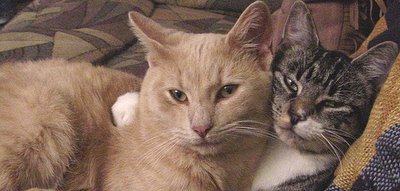
Last week we bought a new vacuum cleaner and the cats have had fun with the box. First Cassie crawled in the box and peaked out to see if anyone was watching her.


Then Murphy came and peaked in at her to see what she was doing.


Then Twinky came to see if Cassie was all right in that big box.


Twinky tried to get Cassie out like Murphy had done.(Murphy is solid black, and Twinky is black with white feet. Cassie is gray with white feet.)


Twinky got Cassie to come out so Cassie told Twinky to get in.


Twinky crawled in and peaked out to see if the other cats were watching her.


Cassie was watching and she thought Oh, good, I got Twinky now. and she stood on top of the box so Twinky couldn't get out.


And Wiley just laid near by and watched all the younger cats and the oldest one, (Murphy) playing with the box. Wiley decided he was to good to be playing with a box.

Liberty Ridge - Spring Ascent

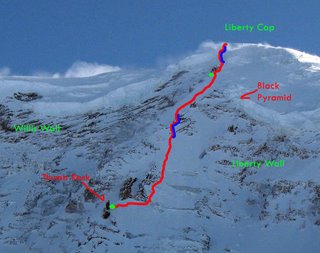
A team of 3 Midwest climbers set their sites on Liberty Ridge last week... and for the second reported time in 2006, climbers made it again to the summit of Rainier. Erik Beeler, Neal Mueller and Isaac Will pushed through deep snow, high winds, whiteouts, steep ice, 5th class rock and even a moonlit night so that they could top out of Mount Rainier's classic of line.

The wintry conditions took more out of the team than expected. In particular, areas of really deep snow became troubling and time consuming. They had intended to spend three nights on route, but needed FIVE and were forced to bivy near 13,000 feet.

In this close up image of the upper route, green dots represent the high camps and bivies and the blue sections represent areas of difficulty or belays. It's interesting to note that the team took the far right variation out of Thumb Rock.
Neal made it clear that "some deep snow" was not going to thwart their summit efforts. A mix of Midwest pride and fortitude pushed the men through the exhausting conditions. And yes, they did wonder about avalanches...

They started late the 1st day and spent the night along the trail in the snow. The 2nd night found them near the access to the Carbon, 7,200 feet. It was up to Thumb Rock for the 3rd and 4th night. Isaac stated that the extra night was needed because,
"As soon as we started to set up camp, my body started to let me know exactly what I had done to it... I threw up before I got in the tent, and... three more times before I could get some Power Gels and water to stay down. I didn't have a headache and I was not concerned it was AMS. The weather was not perfect and when we woke up at 0500. I said I could use another day to recover. They all agreed a rest day was in order so we stayed in the tent all day long."
After a recovery, the team climbed a major porition of the upper route. The 5th night was pitched at a bivy site above 13,000 feet. At that camp, Issac described setting anchors into the rock for fear of either being blown or avalanched off the mountain. Thankfully, neither happened.

They belayed two pitches of alpine ice (one was described as 15 fee of WI 4) to reach Liberty Cap. After finding a few crevasses the hard way between Liberty Cap and the summit, the team cautiously descended to Camp Schurman. They spent a final night in the hut, but only after digging it out. Somehow, the door had blown open during the winter and for the most part, the hut was filed with snow...

The team intends to post a trip report on summitpost and cascadeclimbers. You can also find information on Neal Mueller's website.

Successfully climbing Liberty Ridge is quite an achievement this time of year, congratulations and thanks for your help digging out the Camp Schurman hut! Also, thanks to Pandora for sharing her image here.

Thursday, March 15, 2012

Cuties


Recovering nicely from their operations.

Ginger (L) is the boy and George is the girl. Clearly, sexing kittens is not among our talents. They laugh at us at the vet's office.

"Ginger Baker!" I want to yell. "George Sand! Rebel cats who'll never conform to your archaic provincial notions of gender roles!"

Anyway, now they are both "fixed".

Looks like I'll be really busy between now and Christmas, filling soap orders. My dreams are filled with boxes and tape. Visions of shrinkwrap, bubble fill and packing peanuts dance in my head.

It doesn't feel normal, not having the time to write here or to visit other blogs. I miss being able to record the small things. It's been dry... it rained... but not enough... the swamp area is almost completely drained... there were four huge male turkeys in the backyard... I snuck out of the craft show to see part of the Veteran's Day parade and was surprised to become so emotional... Mom's been here, helping me wrap soap. See you later.

Saturday, March 10, 2012

Fresh Snow

Post Labor Day weekend storms have delivered new powder to the mountain. Big swings in freezing levels and large volumes of precipitation will bring dynamic conditions to the mountain. Come prepared for a variety of challenges.

Seven days of stormy weather and complex conditions have shut down both independent climbers and guided parties from reaching the summit. Check out updates to the DC and Muir Snowfield for photos and current conditions. Photo taken from Camp Muir during a stormy sunrise.

Friday, March 9, 2012

Excitement at Camp Muir

Camp Muir was a popular place this weekend, perhaps because the weather was so good and all of the extra promotion on this blog. On Saturday, there was a steady cadence of day hikers, climbers and skiers/boarders ascending the snowfield to give mountain-type praise to Rainier. Most, it seemed, left the park quite satisfied.

I spent the weekend at Camp Muir and checked out Rainier's primary climbing route. It had been a month since last I was there, and I kept hearing these crazy rumors about gnarly crevasse crossings involving sketchy ladders. Well, those rumors were indeed true. As you can see above, my friend Bob Murphy works his way across a downward leaning, left angling ladder that BARELY touched both sides of the crevasse. Our team ended up turning back at the next "laddered" crevasse crossing because the uphill end of the ladder didn't reach the snow on the other side - whoa... It was suspended mid-air, by tauntly-pulled cordage attached to snow pickets!

The important take-home news is that climbing the Disappointment Cleaver is over, for now... Most teams are reaching the summit from Camp Muir via the Emmons Glacier. This involves dropping climbers right from Ingraham Flats and traversing below the Cleaver onto the Emmons Glacier. There are some pros and cons to this "new" and longer route, but my thoughts are that this variation will come as welcome news to most of you. First off, the the route is quite scenic. Moreover, it doesn't include the DC rock scramble and avoids that wild crevasse network above the cleaver that appeared to me to be an accident waiting to happen.

Regarding accidents: there was another rescue this weekend and again the incident was minor and quickly resolved. While descending from the summit, an RMI client took a spill and dislocated his shoulder. Thankfully, he did not lose control or pull anyone into a crevasse. The accident led to a speedy lowering from the guides to roughy 11K, where a helicopter could evacuate the injured man.

I watched with unique interest as almost every climber in base camp paused and stared as the CH 47 Chinook Helicopter lumbered by enroute for the Ingraham Glacier. The pick-off went smoothly, largely due to the U.S. Army and the response from the RMI guides. That said, the sight of the Chinook was an interesting "shot across the bow" for many hopeful summiteers planning the next day's adventure.

Thank you Paul Charlton for stepping in yesterday... Photos by Mike Gauthier. 1. Bob Murphy crossing a crevasse near 12,400 feet above the DC; 2. Climbers approaching Ingraham Flats; 3. Gapping crevasses above the sea of clouds, as viewed from new Emmons variation of the DC route.