Thursday, September 27, 2012

In Memoriam - Teresa Wiseman Plybon (1954-)

My little sister, Teresa Jane Wiseman Ratcliff Plybon was born January 31, 1954 at Warsaw, Kosciusko County, Indiana and died February 18, .. at Daytona Beach, Volusia County, Florida. She had just celebrated her 53rd birthday. The picture below, of Terry and Mom, was taken March 11, .. on our last trip to Florida.

It's sad to say, but I didn't really know my sister. She was 6 years younger than I was and I was pretty much gone from home after I graduated from high school - she was 12 years old then. I moved to Fort Wayne, joined the Navy, went to college and when I returned home in 1982, she was all grown up, married, and divorced, with two daughters. Five years later she moved to Daytona Beach, Florida, with her second husband, where she lived the rest of her life. On January 19, 1989, she had another child, a son, Edgar Delano Plybon. He survives, as does her husband Edgar Lee Plybon, and her two daughters from her first marriage, Tami and Carrie, and four grandchildren.

I saw Terry four times during the 20 years she lived in Florida. So, my memories of her are fleeting, bits and pieces here and there. She was a good-natured kid, overweight most of her life, generous to a fault. She'd give you the shirt off her back if you needed it more than she did. She was always giving to others, even when she didn't have anything, which was most of the time. She did the best she could under the circumstances. She had an infectious laugh and a great sense of humor.

Carlos Buhler?

I had just asked, "Do you mind if we climb as a threesome?"

"Sure, no problem." was the answer.

It was a test question of sorts..just wasn't sure what I was testing. I HATE climbing as a threesome unless the climbers are really squared away and the terrain makes it safe and fast.

The other two climbers were very squared away, the terrain likely terrible for such antics. I was the obvious weak link.

"Carlos will be fun." I say offering little enthusiasm.

.............long silence......................

I'm thinking, may be Daniel is just humoring me.

Daniels is in his mid 20's. I am not totally shocked he doesn't recognise Carlos by simply..."Carlos". But a little disappointed as well. Just reminds me of how old I am. I climbed with a good climber a season or two back that had no clue who John Roskelly was. John and his 20 something year old son, Jesse, had just done Slipstream.......and that a few years after doing Everest together. I thought both were notable achievements and figured my new young friend might have recognised the name. He didn't. The WA climbing community use to be a lot smaller. My blatant name dropping and pathetic attempt at male bonding was failing fast. But I am digressing here.

"Do you know who Carlos...Carlos Buhler is?"

....another long silence...then, "No".

As least Daniel was gracious enough to not say, "should I?"

It is a weak flex and I know it. But the name dropping is going better this time around.

I chuckle to myself.... We'd met even earlier, in the last century actually. Before Carlos, at 27, had been part of an American team to put up a new route on Everest. More importantly he had been one of the few on the team who actually made the summit. And he was just getting started in the Greater Ranges. Not a lot of challenge left in our local play grounds by '83 for him.

"Before you get in the car, Google, Carlos Buhler", I say.

(for the readers if you don't know who Roskelly is, Google him as well. I don't want to embarrass myself again ;-)

Carlo's picture of Tato Esquiro leading on Teddy Bear's Picnic. One of three big rigs Carlos did last season while swinging leads.

Be sure to dbl click the photos for full effect.


Carlos and I climbed some together back in the early '80s. He was always stronger, smarter and had more courage. He also had more imagination than almost anyone I have met climbing. That imagination is what made Carlos stand out to me. His winter trilogy in Canada on the north faces of Temple, Deltaform and Kitchener early on hasn't been duplicated that I know of. But by his own account not worthy of even a casual mention in his bio.


Carlo is a kid really.....a full year younger than me :) But damn! He is still climbing hard!

More of Carlo's adventures and photos here:

http://carlosbuhler.wordpress.com/

http://carlosbuhler.blogspot.com/

http://www.carlosbuhler.com/biography.htm

http://blog.climb.dk/_02_01_archive.html


Carlos leading the hard mixed of THE REAL Big Drip, in the Ghost.


Postscript? We had a great time climbing as a threesome.


Daniel's photo.

Sunday, September 23, 2012

Revisiting Captain Cave Man M7+

Several days ago I heard from Joel Torretti. Joel is a talented PA ice/rock climber that moved away for several years and recently returned to PA and is living up near State College. He was looking to get out and do some tooled climbing. He was excited to be making his first outing of the season. He made the 2.5 hour drive down to our neck of the woods to see what we could do. We checked out the conditions at several of the local areas, SCII and the So. C'ville rod and gun club. Both being not of great condition, we opted to go check out Lower Meadow Run in Ohiopyle. Not to my surprise, the ice was dismal for pure ice climbing. Not a big deal, we opted to get on the great mixed lines. We started on Anger Managment M5 as our warm up. After pumping on that one, Joel tried the obvious "project" line out the center of the cave. Still a project and to all who have tried it, you know why... The next climb we go on was Captain Caveman M7+ a new line that I TRed at the end of last season in much fatter conditions. Joel went first solving the near iceless start to the line. He made it up through the opening moves only to have a crampon slip of and send him into the air. He passed the rope and I tied in for my attempt. I was happy to see Joel smooth the bottom moves (I was a little uncertain that it would go with so little ice). I moved up through the opening making it to the large ledge on the left. I was happy to throw a heel and get a rest. I proceeded to make my way up through the overhanging rockband to the much appreciated ice. The top posed the problem that it was delaminating from the rock like mad. I gently made my way through this section using various dry moves as well as several very insecure ice sticks. I was glad to get it first go. It took me several days of work to get it last year (in much fatter conditions). Joel tied in and took a second go working through the moves and getting a good pump in the process. After our goes on CCM, we went over and did a few laps each on the ever fun Season Finale M6. It was a blast revisiting Captain Cave Man with Joel. Since getting it no falls, first go on TR, I'm really motivated to give it a whirl on the sharp end before it gets wired. Possibly this upcoming week I'll grow a set and do it. I'll be sure to post how it goes. It was a great day climbing with an old friend, I look forward to many great days out this season.

Friday, September 21, 2012

Summit Trips and Road Access

Winter-like snowfall continues on Mt. Rainier, but you can feel the presence of spring and the coming summer in the air. Many climbers are planning summer trips; reservations are in full swing, and the guide services are working again on the mountain.

The best Mt. Rainier climbing news, of late, is the recent summit by two independent climbers. Tim Ryan (photo credit) and his partner (Erik) hiked in from the Nisqually Entrance (i.e. park boundary) up the Tahoma Creek drainage and to the summit via the Tahoma Glacier. Their trip report is here (almost verbatim).

Of interest to many is the updated list of road openings; there are no major surprises. Along those lines, the Nisqually to Paradise road is nearing completion. Park crews have reconstructed the embankments at Milespost's #5 and #9. In the next few weeks, the road crew hopes to complete the installation of two massive 12-foot culverts at Kautz Creek. They're still calling for a May 1 opening (barring unanticipated delays) and plan a "media day" once the major repairs are completed (just in case there wasn't enough press already).

A quick word on campgrounds... Cougar Rock Campground will be open May 18th, one week earlier, to help offset the loss of Sunshine Point. Otherwise, it's business as usual at the other locations (except for Ipsut Creek).

Thursday, September 20, 2012

Aspens and Sea Smoke


This photo was taken on a VERY cold morning in February . I think it was almost 20 below zero the morning I made this image. There was a lot of steam or "sea smoke" as people like to call it, rising off the lake. More common in early winter, it was a treat to see the steam in late February. My friend Roger and I had spent sunrise right along the water's edge taking photos of the rising sun and the ice on Grand Portage Bay.
To give you an idea of just how cold it was, while we were walking through some deep snow drifts to get to the water's edge, I tripped and fell in the snow. My tripod went right down under the snow, and was only in the snow for a few seconds. The tripod had been warm from being inside the car, and as soon as I pulled it up out of the snow it had ice on it. The snow had melted briefly when making contact with the warm tripod and as soon as I lifted the tripod up into the cold air it the melted snow that was on it froze instantly. I had a difficult time the rest of the morning adjusting my tripod legs due to the ice that now covered it.
After about 20 minutes in our first location we headed up to an overlook which looks down onto Lake Superior and Wauswaugoning Bay. From this elevated vantage point it was magical watching the sea smoke as it rose off the lake and drifted out away from shore. Roger has a Vari-ND filter which lets you block several stops of light and I thought this would be a perfect place to use it so I borrowed it for several exposures. The stationary trees and the edge of the ice combined with the moving steam made for a very compelling photo. Exposure time on this shot was 15 seconds, aperture f16, ISO 50. It was taken with my Canon EF 100-400mm lens.

Sunset Smoke Haze


Smoke from the Pagami Creek Fire near Ely, MN makes for a dramatic sunset over Lake Superior in Grand Portage, MN on September 13, . One thing's for sure... all this smoke in our sky makes for some pretty wild sunsets!


Friday, September 14, 2012

a date which will live in infamy


photo - remember December 7th poster
http://www.umkc.edu/lib/spec-col/ww2/aboutimages.htm#phposter

photo - USS Bennington
http://www.history.navy.mil/photos/images/u030000/u036055.jpg
The USS Bennington (CVA-20) passes the wreck of USS Arizona (BB-39) in Pearl Harbor, Hawaii, on Memorial Day, 31 May 1958. Bennington's crew is in formation on the flight deck, spelling out a tribute to the Arizona's crewmen who were lost in the 7 December 1941 Japanese attack on Pearl Harbor. Note the outline of Arizona's hull and the flow of oil from her fuel tanks. Official U.S. Navy Photograph.
  • University of Missouri - Kansas City Voices of World War II
  • USS Arizona (BB-39) Memorial at Pearl Harbor, Hawaii
  • National Park Service USS Arizona Memorial
  • USS Arizona Preservation Project
  • National Park Service Photo Gallery
  • The University of Arizona Library
  • USS Arizona and Pearl Harbor Remembered

Wednesday, September 12, 2012

Still Fighting With 5.9+: Jean (again)


(Photo: Trying to get psyched beneath the crux roof on Jean (5.9+), back in August.)


In my last post I wrote about my unexpected triumph over my first trad 5.10 lead, Beatle Brow Bulge. This was a great milestone for me. My onsight success climbing this soft 5.10 also made me wonder if the old rumor might actually be true:


Is 5.9+ in the Gunks harder than 5.10-?


Earlier that same day I found a reason to believe the rumor. The lesson came courtesy of my second attempt at Jean.


Back in August I'd attempted to lead Jean, but I hadn't liked the pro for the crux roof and I'd bailed without attempting to lead over the ceiling. I'd wanted a piece at the lip or above the roof but the best pro I'd been able to get was under the roof and to the right. I felt like a fall from just over the roof would result in a sideways landing onto the slab below the overhang, which would quite likely result in injury.


After giving up on the lead I'd tried the crux on toprope and found it to be not that difficult. Above the roof are a couple bad crimpers but then you get a great jug. I started to think that blowing it might not be so bad after all, because if you fell it would happen at those first couple of poor holds, before pulling over the roof and not too far from your gear.


I resolved to go back before the season ended to get redemption and conquer Jean.


Fast forward to November. With the end of the season coming quickly I figured if I was going to exorcise my Jean demons I had better get around to it soon.


But my memories from August were fading and I wondered if I'd really be any happier with the gear this time around. I decided to start a thread on Gunks.com asking about the appropriate gear for Jean. I'd read that there used to be a ball nut fixed right at the spot where you pull over the roof. I know nothing of ball nuts, but I thought maybe I could place one there myself, so I asked the wise climbers of Gunks.com which ball nut I should buy.


The consensus seemed to be that the cam off to the right is good enough, and that I should forget about the ball nut placement.


Armed with this information I felt somewhat reassured, but only somewhat. When our climbing day arrived I knew that I had to attack Jean right away or I was going to lose my nerve, so when we got to the Trapps parking lot I told Adrian that I wanted it to be our first climb of the day. We found it open and I went right at it.


(Photo: Here we go again. I'm hanging instead of trying the crux on Jean, this time in November.)


I felt strong as I got started. There is a cruxy little 5.8-ish move about halfway up that gets you established in the shallow corner system that leads to the roof. The pro for this move is totally solid, and while the move has pretty good hands, the feet are smeary. In August this move caused me much hesitation but this time, in November, I committed right away.


So far so good.


Then I got up to the pocket right under the roof and placed the key cam out right without too much strain. With this bomber pro in place, I should have been ready for the crux.


Determined to send, I reached up to the shitty crimper with my left hand...


and I couldn't make myself go for it.


Again.


The crimper felt so lousy. And I still didn't like the thought of that fall.


So I downclimbed a step and rested for a minute without weighting the rope. I still wanted this redpoint, in the worst way. I gathered my courage and tried again.


Such a bad hold! Was it this bad in August?


I chickened out for the second time and took a hang.


So much for that redpoint.


I must have repeated this routine once or twice more, going up, testing the hold, not liking it, retreating, and hanging.


Finally I decided to shorten the draw on my top piece of protection. I figured drag be damned, I need to reduce the potential fall. This decision gave me a certain amount of additional (and perhaps irrational) confidence. With the fall distance shortened by a foot or two I could commit to the moves and found them easier than I remembered. The bad crimper feels from below as though you'll pop right off it but once you crimp hard and commit, it isn't so bad. Shitty crimper left, shitty crimper right, then shelf, then jug and you're done. The crux is over in a few seconds.


I left Jean frustrated that I didn't get it clean. But I told myself I'd made progress. At least I finished it on lead this time. And my failure to redpoint had nothing to do with any inability to do the moves. It came down to a lack of faith caused by a combination of that crummy crimper hold and sub-optimal pro. Maybe my lack of faith was actually, in retrospect, completely justified. I wonder if that ball nut placement is necessary after all; theroof movemight bean ankle-breakerwithout it.


Even though I haven't conquered Jean, I don't thinkI need to go back to lead it again. I don't know what I would be trying to prove. And I might be risking a needless injury, unless I buy that ball nut...


IsJean a sandbag at 5.9+? I am torn. The climbing isn't easy. It isn't nearly as sustained as Beatle Brow Bulge. But those two crimps over the roof on Jean are less positive than any of the holds on Beatle Brow Bulge. Jean may require a little more technique, and a cooler head.

Monday, September 10, 2012

Old Friends and Fond Memories

Bob, Sandy, John, Gary, and Smitty. This photo was taken in December 1973, just a few weeks before I left Reykjavik, Iceland. It's really hard to believe that it was 35 years ago! My one-year tour of duty in Iceland was made much more pleasant because of their presence.
We stayed in touch for a while. . . Bob was onboard a ship heading for Japan about the time I left there in May 1979. I saw Sandy a couple of times before I went to Japan. John and his wife met me at the airport in Hawaii when I was on my way to Japan in May 1977 and I visited them in Seattle after my return. I have no idea what happened to Gary and Smitty. As often happens, we lost contact after a few years. I often wonder what became of them and some of the other friends I had while in the Navy. Occasionally I Google their names, but haven't found anything on them yet. I did get a couple of emails earlier this year from two of the girls with whom I went through bootcamp. They had found the posts on my letters from bootcamp. It was nice because I actually remembered who they were!

As my contribution to the 8th Edition of Smile For The Camera :: Stocking Stuffer, I would like to stuff this picture into the stockings of Bob, Sandy, John, Gary, and Smitty. Thanks for the memories!

Friday, September 7, 2012

No Paratrooper Training Required

Pashley Parabike

When I saw the Pashley Parabike and Penny at Interbike last year, I was not sure what to make of them. "What are they for and how do they ride?" were my questions. This summer Pashley sent a pair to Harris Cyclery for me to try, and I still struggle to find the words to describe them. One thing is certain: These bikes have little in common with the Roadster and Princess models the brand is known for. I will write about each separately (Penny review now posted here).


Pashley Parabike

In a sense the Pashley Parabike is a replica of the WWII-era BSA Parabike, also known as the Airborne. But unlike Pashley's remake, the original Parabike was a folder. Here is one I was lucky enough to see in person - hinged and cleverly constructed, albeit monstrously heavy. Paratroopers would jump out of planes with the bikes strapped to their backs, then re-assemble them once on the ground and ride away. They must have been very strong, those fellows.


Pashley Parabike

I'll be honest here: The fact that Pashley copied the look and even the military colour scheme of the Airborne but not the folding functionality, biased me against the new Parabike at the start. I suspected it was mostly decorative and intended for military paraphernalia enthusiasts. But as the bike went into distribution I started hearing positive things about it, and so I tried to keep an open mind.


Pashley Parabike

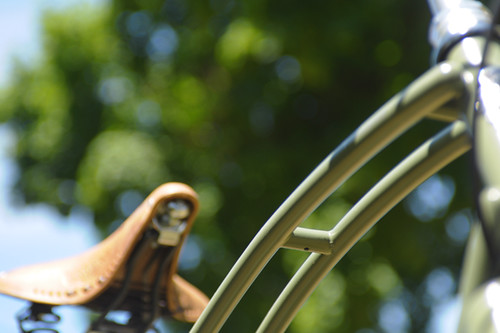
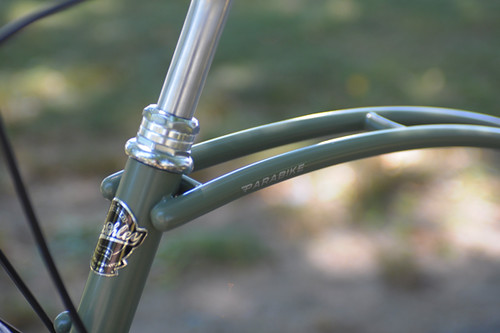
If I let go of my "but it doesn't fold like the original!" grudge, I have to admit the construction is interesting. Pashley calls this a "duplex-tube" frame. In place of the top tube and down tube are sets of twin stays, like on a mixte.The frame construction, from what I can tell, is very similar if not identical, to the Tube Rider and the (no longer produced?) Paramount models, save for the colour scheme.


Pashley Parabike

The upper and lower sets of stays curve away from each other, giving the frame a balloon-like appearance. The whole thing is brazed cro-moly steel.


Pashley Parabike
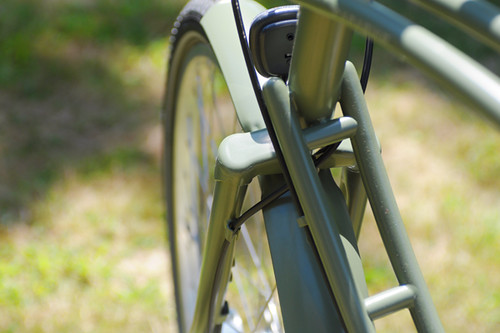
Lugged fork crown.


Pashley Parabike
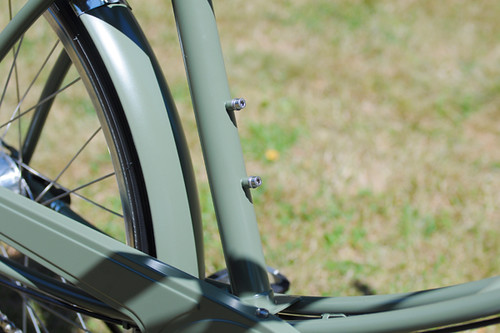
There are little bridges, connectors and braze-ons everywhere, arranged in a way that manages to not make the frame look busy.


Pashley Penny

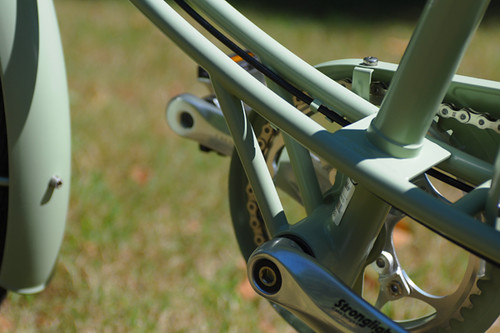
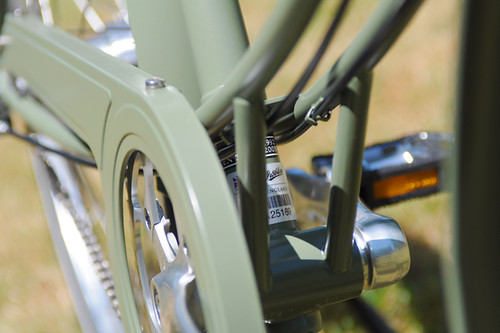
The construction around the bottom bracket is interesting and complicated.


Pashley Parabike

I am guessing the purpose is to provide extra support for the lower set of stays.


Pashley Parabike
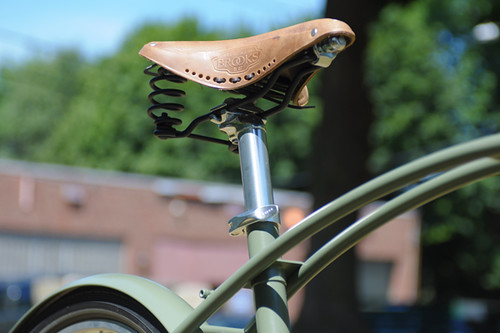
The seatpost is quick release. The aged Brooks B67 is the stock saddle. There are fenders and braze-ons for a rear rack, though no rack is included.


Pashley Parabike
Chainguard.


Pashley Parabike
Braze-ons for one water bottle cage.


Pashley Parabike
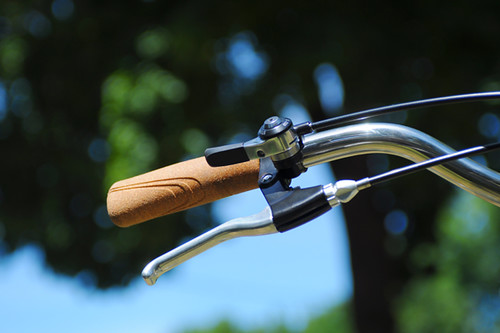
Mildly swept-back handlebars with short, raised stem.


Pashley Parabike

Faux cork grips, hub brakes, Sturmey-Archer 5-speed hub. I don't have a good close-up picture of this, but the frame has horizontal dropouts with a derailleur hanger.


Pashley Parabike
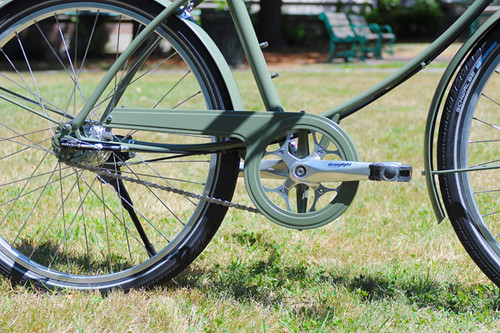
The Parabike is one size only, described as 19". The wheels are 26" with 1.75" Schwalbe Marathon tires. Basic Stronglight crankset with platform pedals. No toe overlap with my Eur 38 sized shoes.


Pashley Parabike in Action
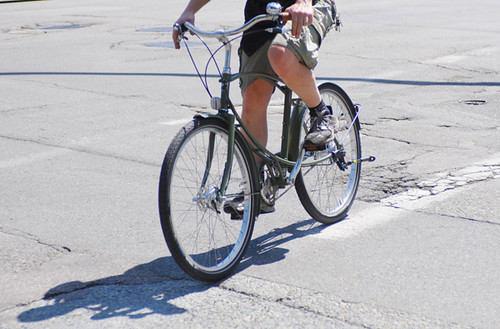
I test rode the Parabike over the course of several miles, and mechanic Jim (pictured here) rode it briefly as well. We agreed it is a cool bike, and we agreed that it's hard to describe. But let me try. Two main impressions stuck with me. One is the excellent ride quality over bumps - by far cushier than the Pashley Princess I used to own. Not that the Princess was harsh; it just wasn't impressively cushy compared to, say, Dutch bikes. The Parabike, on the other hand, felt like butter over potholes. While its tires are a bit wider, I don't think that is enough to account for the different feel. It could it be the springiness of the "duplex tubes." The other impression I was left with was that of maneuverability and zippiness. The handling is all together un-roadsterlike, with greater agility and what I think is a lower center of gravity. The bottom bracket is lower, the rider does not sit up as high, and overall the bike comes across as being rather compact. Of the bicycles I've tried so far, the Parabike rides most similarly to the city bikes with mountain bike heritagegroup. However, it is a more compact and lighter-weight bike.


Pashley Parabike & Penny
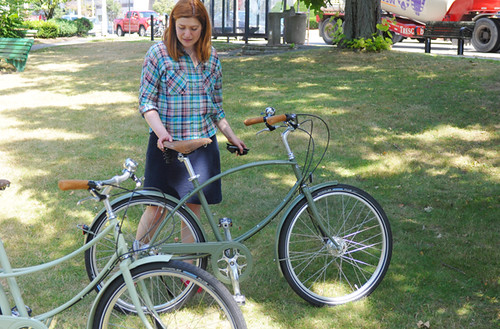
Stepping over the Parabike in a skirt wasn't elegant, but doable. With true diamond frames I tend to be clumsy in this regard, but the curve here makes it a bit easier to lean and step over without having to swing my leg over the back. The fit of the 19" frame felt pretty much ideal for me, though on my own bike I would lower the handlebars.


The main problem I see with the Pashley Parabike is its identity. I like how the bike rides, but I am still not sure what it is for. I think the handling and durability (hub brakes and gears, tough powdercoat) would make it a great transportation bike - including in winter climates and seaside locations. But for a transportation bike, it is missing the rather crucial lights and racks. Although eyelets for a rear rack are provided, it will be difficult to find a suitable model for a bike so unique-looking- a topic I'vecovered before. I wonder whether Pashley has plans to design a rack specifically for the Parabike, or at least to source one that looks appropriate. An option with dynamo lighting would also be welcome. Of course if the bike is intended mainly for recreation, these practical considerations are less important. But then the hub brakes and fenders and chainguard seem overkill to me - I'd be tempted to strip it down, lighten it up, and ride it on trails.


Pashley Parabike

Finally, to return to the Parabike's historical reference: Admittedly, I have not actually ridden an original BSA Airborne Parabike. But there is nothing about Pashley's remake that reminds me of a vintage bike other than the look. The ride quality feels distinctly modern - 90s mountain-bikey, in a good sort of way. It is a neat bike that is fun to ride, and the visual/historical aspect adds a layer to it that I don't quite know what to do with or where to fit into this write-up. It's as if the two things are entirely separate.


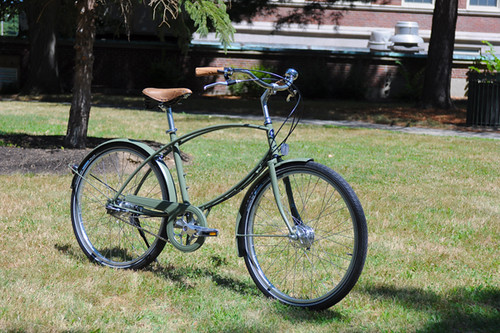
Pashley bikes are hand-built in Stratford-upon-Avon, England. The Parabike is available in "ash green" (shown here) or "dusk blue" - a dusty indigo. Current price is $1,195. Both the Parabike and Penny demo bikes are available for test rides at Harris Cyclery in West Newton, MA. A separate write-up about the Penny is forthcoming.

Wednesday, September 5, 2012

Tombstone Tuesday :: John Bray

John Bray is my one and only Revolutionary War ancestor who made it to Indiana. He is my 4th Great-Grandfather and is buried in McKay Cemetery, Craig Township, Switzerland County, Indiana.


John was born on April 28, 1761 probably in Maryland or Virginia to Henry and Cathryn Bray. According to other researchers, John's wife was Nancy Morgan, reportedly a sister of Nathan Morgan who also lived in Switzerland County. However, I have found no evidence to support those claims.

According to his pension record affidavit, John enlisted in 1777 in “Romley” Hampshire county, Virginia under Captain William Voss of the 12th Virginia regiment. He served three years and was honorably discharged at Yorktown, Pennsylvania by colonel Morgan. He was wounded in the battles of Brandywine (Delaware), Monmouth (New Jersey) and Stony Point (New York) and also participated in many other skirmishes.

In December 1784, John received a bounty land warrant for 100 acres of land for his three years of service and, with his father and several other siblings took up residence in what was then Nelson County, Virginia (it became Nelson County, Kentucky in 1792).

His first son, John Bray Jr. was born about 1787 so it has been assumed that he married his first wife about 1786 in Nelson County, Virginia but no record of the marriage has been found. It has been assumed that his first seven children were by this wife (presumed to be Nancy Morgan).

John and his children removed to Switzerland County, Indiana at about the time Indiana became a state (1816). On April 15, 1820 in Gallatin County, Kentucky (just across the Ohio River from Vevay) John was married to Mrs. Elizabeth Coones. They would have three (or four) children, the last one born just four years prior to John's death on June 10th 1832 at the age of 71.

John's will, dated June 26th 1832, names his beloved wife Elizabeth and children: the youngest son George Bray got the land. His three oldest sons (John, Daniel, and Samuel Bray) each received one dollar. The three oldest girls (Jane Ray, Elizabeth Cotton, and Nancy Culver) also received one dollar. The three younger girls (Pelina, Amealy, and Sophia Bray) were each given one bed and bedding.

George, Amelia, and Sophia were the children of his wife Elizabeth and perhaps, so was Pelina. We have no record of what became of her.

Much more information on John Bray as well as his siblings and children, can be found in my database on WorldConnect.

Tuesday, September 4, 2012

Mount Healy

After returning from Savage River, we decided to take another hike. The weather was similar to what we had left earlier in the day – cloudy skies with scattered sunshine. The trail started out easily enough leaving from the visitor center and going through the taiga forest. But this trek was more than a little strenuous with a 500 foot elevation gain in the first mile and 1200 foot gain in the second. After six weeks of no hiking, my legs and lungs were screaming “Stop!” but not wanting to admit defeat nor to be left behind by Sue and Fred, it was onward and upward.

Views like this is what makes it worth the effort! About half-way up to the top.

Sue and me on top of Mt. Healy.

The view from the top. The park entrance, Visitor Center, and Wilderness Access Center complexes are in the left foreground “beneath” the rocks.

Fred and Sue, heading back down.

A portion of the lower trail. Since the ground is frozen much of the year, the trees have shallow roots. I wonder, how many feet have trod over these roots? And yet, the tree still lives!

The top of Mt. Healy. We was up there!

While Fred and Sue fixed supper, I laid on the picnic table bench and watched the clouds pass by.

Turn Your Capris into Cycling Knickers

If you own a pair of capri pants that are comfortable to cycle in, but you don't like the way the bottoms flutter in the breeze or get caught in the drivetrain, then here is a quick and dirty way to turn them into cycling knickers:
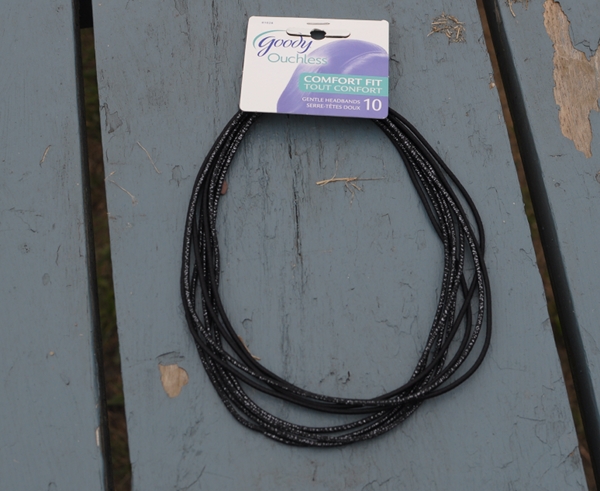


You will need a long elastic band, which can be purchased at a shop that sells sewing supplies. Alternatively, you can use narrow hairbands, as shown above (these come in a pack of 10 that costs around $2).


Check the hemming at the bottoms of the pant legs. Sometimes the manufacturer will leave an opening in the hemming, at the outer seam. If not, carefully create an opening. Don't cut into the actual fabric; just undo a small portion of the outer seam through which to thread the elastic. This was a quick and whimsical project, andI do not have a step-by-step photo documentation. But I hope these after-the-fact pictures adequately demonstrate what is involved.
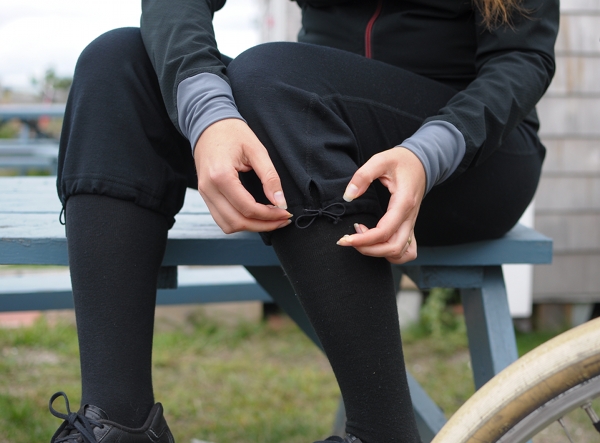


Once you have threaded the elastic through the hemming, simply tie it on the side so that it is snug, but not constricting. You can then choose to either hide the knot inside the seam and sew it back up, or leave the knot exposed. The benefit of the latter is that you can keep converting the pants back and forth between normal capris and cycling knickers.
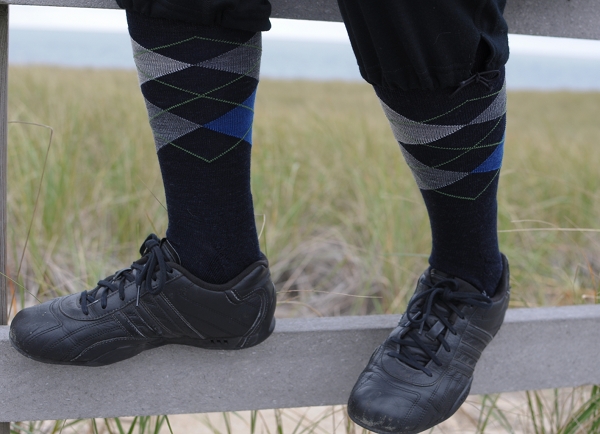


Aside from staying clear of the drivetrain, an additional benefit to these knickers is that you can continue to wear them in colder weather. Simply add long socks, and the elasticised bottoms will protect your legs from the wind. Cape Cod has greeted us with temperatures in the 50° F range, and it looks like I will be living in these for the next 2 weeks!

Monday, September 3, 2012

Covering Distance


Last week I did two 100 mile rides several days apart. The first I rode on my own bike, with my camera, stopping along the way. That was really nice. The second I did on an unfamiliar demo bike, riding the course straight through except for a lunch stop. That was really nice too. The rides didn't take all day and they didn't wipe me out, allowing me to work before and after.Had time been no object, I felt as if I could have kept going.


To me, it is this private moment of realisation that "I have it in me" to do this kind of distance, casually - that feels like an accomplishment. More so than, say, an official brevet finish. It is not that I don't value organised events and their objective measures of performance. It's more that when doing an event, I already know that I can do it; I would not attempt it otherwise with all the logistics involved. In that sense, it feels not unlike taking a test based on material I've already learned. It's the learning itself that's thrilling. That "A-ha!" moment. Doing well on the test? It's nice, and often necessary. But it's not the same as the learning itself.


Maybe this line of thinking just means that I am hopelessly non-competitive. Or maybe it is simply not a good analogy. In fact almost certainly not. But there's a grain of something in it, somewhere.


Covering new distance, covering new material. And along the way that feeling of having truly grasped, understood, internalised something new - something that had previously seemed unattainable.

Sunday, September 2, 2012

More northern lights images!


Here are a few more shots from the incredible auroras that I witnessed in the early morning hours of May 18, .