This is a boot Salewa first showed at the summer OR show in . It still hasn't hit the dealers shelves yet but thought it worth mentioning some of the things I know about it from the samples I have.
The most obvious it this little guy and flex adjustment for the sole.
And a closer look at the internals that make it possible
With my friend Eric giving us a tour of the boot at OR this summer.
What is missing here and easy to not see with all the new technology is the last and human engineering that has gone into this boot. To be honest most climbers are not into fluff. And it might be easy to pass off Salewa's newest technology as fluff in a hardcore mtn boot.
What impressed me even more (and surprised me as well) was the last (actually two lasts) of the new Salewa.
In long email conversations with one of Salewa's and Dynafit's boot designers, Federico Sbrissa it became clear as to why.
I easily saw the design, lastand fit similarities to the new TLT5 Dynafit ski boots and the new Pro Gaiter from Salewa. The emails back and forth to Federico Sbrissa just confirmed that guess on my part.
What I have here is the performance fit. It is tight and form fitting. I really like the fit but would prefer what I think will be a warmer boot the INSULATED PLUS FIT in this boot. Only because I know something of the Dynafit/Salewa design collaboration and trust the end results. Only time will tell if I am right.
But if I am correct the Pro Gaiter might well end up being a dominate player in full on technical boots just as the TLT has become in BC and touring boots. The TLT has done that so thoroughly that few are even in the same game right now. Salewa is betting a lot on this new technology.
The new Pro Gaiter isn't the lightest "super gaiter" style boot out there with even more to come from the major players, new and old. But if a boot truly fits well I am willing to give up a lot of things. And I suspect this boot is going to fit my foot exceptionally well. A few ounces being one of the things I am willing to accept for a perfect fit.
I am really looking forward to giving this boot and several others a real test.
A close up look at just two of the newest boots that will be available by early summer of .
For much of the past week the winds have been blowing in West Texas and Eastern New Mexico. On Sunday (April 10th), after wandering in the dry, arid desert, fighting the 25-35 mph winds (with gusts up to 60mph), seeing nothing but brown earth and beige colored skies, I did an “about face” and headed eastward.
Yes, I know. That's the opposite direction I've been going. But there is another reason for the about face – a doctor's appointment awaits me in Indiana in less than two weeks. It is one that was made in February as a follow-up to the sinus and ear infection I had after Mom's funeral and an appointment which I never canceled. So I knew that if I was going to keep it, I didn't want to get too far west and have a really long drive back. The wind, the brownness, and the wind were just the things that turned me back a little sooner than anticipated.
I had thought about canceling the doctor's appointment, but with the way my leg has been acting up, figured I had better take advantage of it to find out what is going on. I think it is just a pulled muscle, but who knows?
I will admit, I terribly missed the green that I left behind a week ago. I'm not sure why the desert conditions bothered me so easily this time. Last year I spent more than two months in Texas, Arizona and the deserts of California. Perhaps it was a part of my state of mind this time around – thinking a lot (too much) about my Aunt Phyllis, my Mother, and my friend Lorene. Realizing that I will never see them again...
So, I'm going back to Indiana. At least for as long as it takes to find out about what is going on with the leg. And then? Well, I'll let you know when I know! But "The Journey" isn't over yet!
Brantley Lake State Park, New Mexico. April 7th.
Driving conditions east of Amarillo on Sunday, April 10th. The sky was really much more beige colored than gray as this photo shows. This was typical of the drive on Sunday. I was just glad I was going east – the wind was coming from the west. The hundred miles or so that I had to drive north was a real challenge!
Great Plains State Park April 10th. Compliments of Mother Nature throwing a hissy fit – the sand and dust in the air makes for a great sunset filter!
Great Plains State Park April 10th. In southwestern Oklahoma on the shore of Lake Tom Steed, a reservoir that provides water for the area.
Four months ago today I embarked upon my second major scanning project for ... The first project was to sort and scan my mother's photograph albums which took from April through August. There is still one group of photos left with that project and, in my goals for .., I stated that I hope to have those done by the end of March.
The second project, sorting and scanning my genealogy files and documents, was started on September 22nd and I'm *EXTREMELY* happy (relieved, thrilled, pleased as punch, etc.) to report that it is *ALMOST* done! The last group of documents to be sorted and scanned are those that pertain to my ancestors, shown on the table in the photo above. The two tallest piles belong to the Brubaker and Phend families. These will be scanned to both jpg and pdf format. After being scanned, these documents will be put into protective pages and placed in three-ring binders.
Other files that were scanned and kept were put in folders and are being stored in small "bankers" boxes in the garage. Only about a third of the files that I had were kept. Everything else has been recycled, most of it scanned first, but not all. The binders on the shelves and the folders and in the filing cabinets consumed nearly 40 linear feet, while what was kept amounts to about 13 feet (9 bankers boxes 15.5" deep and the papers on the table).
Two empty filing cabinets. Now there is the "problem" of what to do with the 3-ring binders and hanging file folders that are no longer needed. As you can see below, the three tall bookcases have been removed. They were sold, at a very reasonable price ;-) to a friend.
The "before" photo, above, was taken November 13, ... And below is what it looks like now (photo taken yesterday).
Another view.
The "before" photo is above (taken November 13, ..) and what it looks like now is below.
How did I accomplish this feat in four months? It is due to several things actually, among which are:
Retirement. No way could I have gotten it done in four months if I was still working, maybe in four years, maybe!
Being single with no kids. Though I do have errands to run for my Mother and I have to make sure she gets to the doctor and other appointments.
A stubborn streak (perseverance) that was inherited from my Mother. I just made up my mind that it was going to get done, one way or another!
And finally, the Fujitsu ScanSnap S300 document scanner, which I heartily recommend. In four months of use and after sending nearly 30,000 pages through it, I had only a couple of paper jams and none of them seriously damaged the paper being scanned. I've definitely gotten my money's worth from this little gem. Thanks, Denise!
Of course, I still have to add file data and captions to all of those image and pdf files, but at least they are scanned and accessible on the computer. I've already had a need to access some of those files and I must say, it is much quicker to click through several pages of a pdf file than it was to find the binder they were in and flip through the pages. And yes, they are all backed up to the laptop and an external drive, though I haven't yet overcome my fear of "losing" all of those electronic files...
In the 05/06 winter, three separate climbing teams reported being caught in significant storms. Two were below Camp Muir, and one was higher on the Ingraham Glacier.
While getting lost or pinned down in a storm on Mount Rainier isn't that unusual given the time of year, it was interesting to note that all three teams retreated to snowcaves. Pure and simple, shovels are mandatory. And that means one for each person. One team said that they broke three of their shovels while digging. Thankfully, there were four of them!
These teams were helped by their size; two were 4-person, one was 5. It’s a lot easier to pull through a storm with extra people around. And as the storms relented, each team made their way back to Paradise without assistance, but not without some cost.
Two of the teams abandoned a significant amount of equipment; gear such as tents, bags, stoves and pads. Each stated that they could not retrieve all of the equipment because of the intensity of the storm and snow accumulation. Tents, for example, were nearly impossible to dig out. To them, it seemed safer to retreat; this is a tough decision to make.
It can’t be overstated, winter AND spring storms can be particularly fierce on Mount Rainier. If you’re pinned down and must abandon camp (high winds, snowfall, avalanche/icefall exposure), do all you can to retrieve at least your stove, pad, clothing and bag. One tip is to pack your pack before exiting the tent.
Though a rapid exodus to Paradise or Camp Muir may seem appealing given the current circumstances, it has also led to many notable accidents and fatalities. Caught on the mountain with only a shovel and few odds and ends is a downright brutal experience to live through.
[page 1] The fourteenth annual reunion of the Phend - Fisher family was held at the home of Jacob Phend north-west of Elkhart on Sunday Sep 2, 1923.
There were 61 members and 5 friends present. The forenoon was spent in a social way. Rev. J. H. Held gave thanks before serving dinner. Prayer and interesting talk by Rev. Held preceding business session after dinner.
Officers elected. Wm. Phend, Pres. Ralph Ernest, V. Pres. Reuben Pletcher, treas. Ed Phend, Sec'y.
A committee was appointed by the president to secure date and place for the next reunion, consisting of Fredrik Wherley Will Phend Fred Ernest
Music by Mrs. Ed Phend and La Mar. It was moved and seconded that Mr. and Mrs. John Waddels of
[page 2] Tippecanoe, Ind. should be recognized as members of the reunion. The[y] were unanimously elected as members.
Ice Cream was served before leaving for home. A collection was taken to defray expenses. Fred ErnestSec'y.
The Phend-Fisher families gathered for a reunion in Elkhart County, Indiana almost annually from 1909 until 1943. Usually held at Nappanee, the events of the day were recorded in an old ledger book. Spelling has been retained as it was in the original though some punctuation and paragraph breaks have been added. To view all articles in this series click on the "Phend-Fisher Reunion Ledger" label at the bottom of this post.
On Saturday it was nice for around here so I took the ponies over to the big pen and let them play followed by a good brushing. Here is Stormy playing and standing to be brushed.
Sunday, August 22nd - - It is about 90 miles from Tok to the Canadian Border on the Alaska Highway. To get where I'm going (Haines) you have to backtrack a bit. Because of the terrain, your route options are limited - there aren't all that many roads in Alaska! (Reference the map at the bottom of my previous post.)
On my first drive through the area, the skies were gray and gloomy and it didn't really look all that pretty. But with somewhat blue skies and sunshine, things looked different this time around. There are so many small lakes and ponds dotting the landscape and with the mountains in the distance, it was quite nice.
You are probably getting tired of seeing reflections of the sky in the water, but I just can't help myself! I am captivated by them... a narrow view between the trees.
Even with the sunshine, there occasionally were a few scattered showers. Once you get into Yukon Territory in Canada you are traveling on the absolute worst section of the Alaska highway! For nearly 100 miles you are jostled and jarred by dips and rises and jumbled pavement. If you are lucky you can get up to 45 mph in some sections but if you're not paying attention and you come to an area of bad pavement driving that fast you're in for an exciting ride!
I took several shots of the pavement but it just doesn't show what it was really like. See those yellow flags alongside the road? Those indicate dips in the highway. So while you are jostled from side to side with the uneven pavement, when you reach the dips you are also bouncing up and down. Throw in a few potholes and several really bad sections for a challenging ride! I was so happy to get through it unscathed.
I made it to the Lake Kluane (pronounced CLUE-AH-KNEE) area in late afternoon, and, remembering Sue's glowing report of the Cottonwood Campground, I stopped there for the night. It has to be one of the nicest campgrounds I've stayed in, not just on this Alaska trip, but anywhere!
The view from my campsite, looking south. Gorgeous. Forty-six miles long, Lake Kluane is the largest lake in Yukon Territory and the highway follows it on the west side for about half of its length.
A closeup of the mountains on the south side of the lake. The next morning, the wind was calm and the sun was shining. And, of course, the reflections in the lake were amazing.
From the bridge on the west side of the south end. This is actually a river that feeds the glacial water into the lake.
Looking east. A narrow peninsula juts out from the western side of the lake.
The highway is at the base of that mountain, following the shoreline. Ten miles north of that point is the Cottonwood Campground.
Friday, August 27th - - About half an hour after leaving the whales we started seeing small icebergs in the water. There was one in particular that was extremely large and Captain Steve said it was stuck on something as it had been in the same spot for several days.
It didn't look too impressive from a distance but Steve said it was worth taking a look at. He slowed the boat, went in close (very close), and cruised completely around it. The color was so intense and amazing, especially on the other side where the light was better. Incredible, actually.
And even more wondrous things were yet to be seen...
Chris Denny pretty much hits on all the high points of the new Arcteryx Aphix Hoodie in the video above. But you need to listen closely to what Chrisis saying and pay attention to the detailing he points out in the video to get the best impression from that 1 minute Arcteryx ad.
I am the first to tell you, I LOVE this new jacket. That doesn't happen often. I see a lot of expensive clothing. Few pieces really impress me or will I ever climb/ski in very much. The Aphix has impressed me. And I will be doing both climbing and skiing in this jacket. Not a common feat for any jackets I own.But I am also the first to tell you that the Aphix isNOT an Atom LT.I don't down hill ski in an Atom LT. It is not warm enough. I do use a Patagonia Nano Pullover skiing often enough though. Not being an Atom LTis both good and bad from my perspective depending on how you plan on usingthe Aphix.
There is no doubt the Aphix was specifically designed for something. You need to figure out where you canuse it best and if it was actually designed for you. Weird as that might sound. Unlike the Atom LT which just about anyone can appreciate right from the get-go. The uneducated (more like anyonepaying retail) might well hesitate on the Aphix for a few reasons.
This is what Arcteryz says on the hang tang if you bother to read it. "Intended use: a very warm mid layer for active use on frigid days."
Other tags say, "made in Bangladesh" and "this article contians NEW MATERIAL ONLY"."DWR treated for stand alone use." Seriously. Made in aMiddle East sweat shop by some really poor folk may be, but no recycled Primealoft Eco, milk bottles or pillows here!
"Lightweight insulated hoodie that can be used as a stand alone piece or as a cold weather mid layer. Inset panels of stretch fabric under the arms stop just above the hip for extended range of motion without compromising warmth. Stitched insulation is radiant Coreloft™ that traps heat. Well suited to cold dry conditions. Dropped hem positions jacket for maximum core protection; collar and hand pockets are insulated. Proficient at warmth and weather resistance."
From Arcteryx:
Technical Features
Breathable
Insulated
Compressible and packable
Wind resistant
Design
Stretchy side panels
Patterning
Articulated patterning for unrestricted mobility
Gusseted underarms
Hood Configuration
Insulated hood
Zippers & Fly Configuration
Webbing zipper pulls
Full front zip with insulated wind flap
Metal zipper pull on main zip
Cuff & Sleeves Configuration
Stretchy cuffs (ya, not really)
Hem Configuration
Drop back hem
Adjustable hem drawcord
Pocket Configuration
Internal chest pocket
Two hand pockets with zippers
But the REAL question is, "What specifically was the Aphix designed for?"
Arcteryx sez:
Style:
Mid-Layer-Sweaters Cold Weather
Funny how Arcteryx has finally adopted the term "sweater".
But I do see how the Aphix would be a good ski sweater.
Slim fit with alonger body and arms. All seem to be perfect for under a shell.
Atom LT Hoody compared to a Aphix Hoody?
Atom LT, Men's Large 416g / 14.5oz
Aphix, Men's Large 540g / 18.5oz
In a nutshell Dane sez:
* Aphix is longer (body and arms) than Atom
* Aphix is a slightly trimmer fit than Atom
* Aphix is more breathable than the Atom
* Aphix is NOT as stretchy as the Atom
* Aphix is 80g Coreloft, the Atom LT is 60g Coreloft
More from Arcteryx:
"At the heart of the Arc'teryx Men's Aphix Insulated Hoodie lies Coreloft insulation. This jacket compresses down easily so as not to waste valuable pack space, and side stretch panels give you ultimate mobility so you can reach for holds or reach out to plant a pole in deep powder."
Coreloft synthetic insulation is lightweight, and the insulation compresses and regains its loft quickly so you won't have to worry about cold spots after tightly packing this jacket
DWR coating shrugs off light moisture and precipitation so you can depend on this hoodie as a stand-alone jacket or a cold-weather mid-layer
Stretch side panels allow full range of motion at your core and underarms so you can reach or stretch without feeling held back
Cuffs stretch over light gloves in order to seal out the elements (good luck with that as there is no stretch in the cuffs)
Insulated hand pockets (the collar is not lined)
Aphix shell is: 40D nylon, lightweight, wind resistant mini ripstop taffeta
Atom Lt shell is: Luminara™—Stretch nylon ripstop fabric with wind and water resistant, air permeable PU coating and DWR finish.
Atom shell stretches. The Aphix shell does not. It is a big deal in these weight jackets. And the Luminara is likely one reason the Atom Series is so durable. I am not expecting much of a "mini ripstop taffeta". There is a spin on the language, "mini ripstop taffeta " :-) Who exactly in the Arcteryx marketing department came up with that copy after a longlunch? Either way don't expect the taffeta on the Aphix to shrug off the abrasion like the Atom Series of garments do. The Aphix you'll rip holes in undersimilar circumstances when you snag things on the shell. But the taffeta of the Aphix will make it easier to layer over. The slick taffetashell is a definite bonus if you are going to use it that way.
Aphix is 80g Coreloft, the Atom LT is 60g Coreloft
Vents on the Atom LT are made from Polartec® Power Stretch®
Vents on the Aphix are made from Helius™ a lightweight, breathable, stretchy, plain knit textile
Most importantly I think is Helius seems to breath better than Polartec Power stretch. But not becausethe Helius is a more breathable material it is not. Simply because the Helius is a lot thinner.
Likely 1/2 the thickness of the Polartec material used.
All the photos above and beloware of the Aphix Hoodie
The Aphix has 216 square inches of the vent material, from your wrist all the way down your side to just short of belly button level. 36"x 6". The Atom LT uses 156 square inches of vent material, arm pit down to waist level. 24"x 6.5"
The model's pants are the bright blue here.
Imagine the width of the stretch material under the arm on the Aphix from this picture.
There is a BIG difference in the amount of surface area coveredwith a breathable fabric on these two jackets. Fully 1/3 of the length of each arm is a breathable soft knit, Helius™, on the Aphix. The Atom Lt is full insulated 60g Coreloft in the arms.
Same side vents (dark blue material) on the jacket version of the Aphix
What ever the Aphix gained inwarmth with 20g more of Coreloft on the Atom LT it also gained even more in ability to vent/breath by the extra square inches in venting material. I noticed the lack of insulation in the arms during my first use of the Aphix on a mid 30F degreeday. It is easily noticeable just how much better the Aphix breathes than an Atom. If for no other reason that there is a lot more surface area not as well insulated on the Aphix. Great from technical climbing or a skin track...not so good for skiing down hill imo. Unless of course you added a shell.
For warmth? Until you cut the wind with a shell...it is going to be a toss up imo between an Atom LT and a Aphix. Add a shell and no question the Aphix will be warmer.
The Aphix's side panelstretch insulation islikely more wind resistant than the Atom's Power Stretch.But the Aphix material is also likely half the actual thickness of the Power Stretch. In the real world I find the Aphix material breathes better. And you'll feel the out side temperature/wind through it easier. There is more breathable material in the surface area of the Aphix to "breath better". Your arms aren't likely to ever over heat in the Aphix.The "hard finish" of the Helius material also seems to shed snow and rain better than the Power Stretch. But that observation is really a push. That difference is slight.
By comparison the hoods are the same in size andwith no adjustments. They work well enough with helmets. But it could easily be done better. They do make a wonderfully warm and puffy collar though when fully zipped up and the hood down.
Arcteryx makes the hoods all the other makersare judged by. I have to wonder how they can make such terribly fitting stand alone collars on their other jackets? Seriously, what is up with that?
The jacket's bottom hem draw strings are the same. Two, one on either side. Same nicely done wind baffles behind the main zipper on both jackets. The front zipper isn't. The Aphix zipper locks in place any where along the zipper line. The Atom's intentionally does not lock.
Pockets arepretty much the same. Two on the outside that are zippered, with one sided, back of thehand, hand warmer liners. And one internal chest pocket that is zippered. The Aphix has sewn zipper pulls.
Really long sleeves, no stretchy cuff on theAphix. Be sure to catch that typo in the Arcteryx ad if you are buying sight unseen because you'll be disappointed if you did not.Atom Lt has a normal length sleeve and nice stretch cuffs with a snug fit at the cuffon most anything. I like the Aphix cuffs but Arcteryx missed the detailing there imo. If I am wearing glovesthe cuffs just bunch up against the glove, may be not the best seal on a jacket/glove combo, unless you have a shell and Velcro cuffs over the top of both. My answer without a glove is tosimply roll them up. Yes, I roll them up, seems to work OK as hard as that might be to believe. Not the best solution on a expensive, nicely tailoredjacket.If theyhad beenstretchy even that long they would be golden, but they are not stretchy. Not a deal breaker but annoying enough everyone seems to have already noticed. The jacket is good enough though that some are simply having the jacket custom tailored with a new cuff. Costly at best, ugly at worse! No matter your ape index you won't pull these cuffs off your wrists once spread out to full extension.
The jacket 's hem is really long front and back. Below the tail bone in the back. Long enough in the front that I worry about ripping the zipper out skiing. Thankfully the elastic on the hem allows you to move the hem up a bit. But a snap and reinforcement there would have eliminated that worry. I have no doubt the Aphixwas intentionally designed that way. Seems I amobviously missing exactly what this jacket was specifically designed for. Under a shell most likely. And I do really like this jacket. But it will seldom go under a shell when I amusing it. It fits my needs well as a stand alone climbing piece in my "action suit". The over all fit in the body is almost perfect for me. That might have you ignoring thefew unmistakable nitson the design.
It works as a stand alone garment so well in the right conditions climbing. May be even better than the Atom LT. But, thankfully, it is not an full blown Atom SV either. So may be some ofthe Aphix design details are simply lost on me. And likely almost everyone else. Which begs the obvious question?
The long hem does make it really easy to tuck into a harness and keep it there though. I like that. The slim fit on the Aphix is perfect for me. Slimmer than the Atom LTs' cut for sure. The fit is what makes the other small issues, "small" for me. I really like the, hybrid "heavy sweaters" available in combos of 60/80/100g/m synthetic insulation weights with the morebreathable fabricssewn in where appropriate.
Aphix is one of the best yet even all the while being just a tiny bit funky. But then the Atom LT wasn't designed to use as the top of your cold weather "action suit" either. The Aphix might even do the job better. My bet is it will.
If you like what you have read and want to know morecheck out the detailed pictures and reviews on line here and else where:
My guess is Arcteryx will clean this jacket up a bit at some point. They willshorten the body some, fix the cuffs and shorten the sleeves. Not everything I'd want in a jacket that I climb or skiin. I'd like a slightly shorter body, a sturdy snap closure to beef upthe zipper. Atom LT cuffs added to the long sleeves and some lining at the collar for my chin. A slightly bigger hood with some adjustment would be on my wish list. How about moving those pockets up 5 inches or so to clear a harness completely or ditch them all together for Napoleon pockets instead since I am asking?
So before they mess this jacket up...my suggestion is if you like climbing in an Atom LT...check the Aphix out before Arcteryxchanges it drastically or simply ditches it completely.
Today I took another snowshoe venture with friends Shelley and Anne, this time along the shoreline of Wauswaugoning Bay. The day wasn't the best for photos, as it was very cloudy. I still found things to take pictures of, though! Namely a few interesting pieces of ice that were sticking up out of the snow in various places along the bay. (Above: Although it appears larger, this piece of ice was only about 4 inches high!)

 The most obvious it this little guy and flex adjustment for the sole.
 And a closer look at the internals that make it possible
 A close up look at just two of the newest boots that will be available by early summer of .


 The second project, sorting and scanning my genealogy files and documents, was started on September 22nd and I'm *EXTREMELY* happy (relieved, thrilled, pleased as punch, etc.) to report that it is *ALMOST* done!
 The last group of documents to be sorted and scanned are those that pertain to my ancestors, shown on the table in the photo above. The two tallest piles belong to the Brubaker and Phend families. These will be scanned to both jpg and pdf format. After being scanned, these documents will be put into protective pages and placed in three-ring binders.
 Two empty filing cabinets. Now there is the "problem" of what to do with the 3-ring binders and hanging file folders that are no longer needed. As you can see below, the three tall bookcases have been removed. They were sold, at a very reasonable price ;-) to a friend.
 The "before" photo, above, was taken November 13, ... And below is what it looks like now (photo taken yesterday).
 Another view.
 The "before" photo is above (taken November 13, ..) and what it looks like now is below.
 How did I accomplish this feat in four months? It is due to several things actually, among which are:
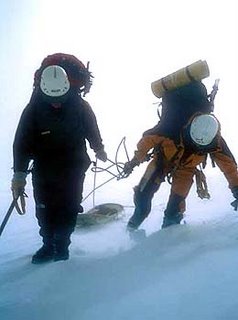 In the 05/06 winter, three separate climbing teams reported being caught in significant storms. Two were below Camp Muir, and one was higher on the Ingraham Glacier.


 You are probably getting tired of seeing reflections of the sky in the water, but I just can't help myself! I am captivated by them... a narrow view between the trees.
 Even with the sunshine, there occasionally were a few scattered showers.
 I took several shots of the pavement but it just doesn't show what it was really like. See those yellow flags alongside the road? Those indicate dips in the highway. So while you are jostled from side to side with the uneven pavement, when you reach the dips you are also bouncing up and down. Throw in a few potholes and several really bad sections for a challenging ride! I was so happy to get through it unscathed.
 The view from my campsite, looking south. Gorgeous. Forty-six miles long, Lake Kluane is the largest lake in Yukon Territory and the highway follows it on the west side for about half of its length.
 A closeup of the mountains on the south side of the lake.
 From the bridge on the west side of the south end. This is actually a river that feeds the glacial water into the lake.
 Looking east. A narrow peninsula juts out from the western side of the lake.
 The highway is at the base of that mountain, following the shoreline. Ten miles north of that point is the Cottonwood Campground.
 It didn't look too impressive from a distance but Steve said it was worth taking a look at. He slowed the boat, went in close (very close), and cruised completely around it. The color was so intense and amazing, especially on the other side where the light was better. Incredible, actually.


 And even more wondrous things were yet to be seen...


