Monday, April 29, 2013

Thank You, Family Tree Magazine

Early this afternoon, I took a break from research at the Family History Library and checked in on Facebook. There I saw a couple of mentions about Family Tree Magazine'sTop 40 Genealogy Blogs in .. so I clicked through and started reading the article. I was amazed and honored to find that Kinexxions had made the list in the "Story Time" category!


There are many fine genealogy blogs being written and it had to have been difficult to pare it down to just 40. I know I'd be hard-pressed to come up with such a list. But, like Randy at Genea-Musings, I was surprised to see some very excellent blogs missing. Congratulations to all of those who are listed.


For new visitors here, the post written in January for the 6th anniversary of Kinexxions, Now It's Six, provides links to the "year end" roundup posts and will give you some idea of what's been written in the past. Posts have been somewhat sparse thus far this year but more will be coming in the near future.


Thank You, Family Tree Magazine. I appreciate the honor and the recognition.


Tuesday, April 23, 2013

838 State Street

I don't know exactly what year my grandmother and her family moved to Traverse City, Michigan but they were living there in 1909 and 1910. At some point they moved to a small house at 838 State Street – the 1910 census shows the family residing on State Street. Grandma recalled those days in Traverse City fondly when she wrote her autobiography. They were there only a few years when the family had to return to Indiana in December 1910, due to the death of her father's brother, Hale Brubaker.


Written on the reverse side of this photo, taken about 1950, is “This is the house we lived in – Traverse City, Mich. 40 years later.” The lady standing in front of the house is my grandmother, Hazlette Brubaker Phend.


This week I had the opportunity to pay a brief visit to the house...


The house at 838 State Street as it appeared on July 27, ... The perspective isn't exactly the same but it appears to be the same house as in the previous photo. The front porch has been removed and the roof has been extended over the side porch. And the trees have gotten bigger. And there are more houses in the neighborhood.


The side view.


The red “A” marks the location of 838 State Street, Traverse City, Michigan.


The big purple blob on the right marks the location of Traverse City State Park where I spent the night. The little blue blob is at 838 State Street. I was at a McDonald's on the corner of Front and Hope Street (a block west and north of 838 State Street) when I learned exactly where the house was located!


Once you get off the main road (U.S. 31 aka Front Street) Traverse City is a pretty quiet place. A nice “little town” that I'm sure my grandmother would no longer recognize.


Sunday, April 21, 2013

A serious question about Arcteryx insulation?


I am sitting at my desk with a ton of information at hand. But nothing on the Arcteryx ThermaTek or Coreloft that I can verify. I asked Arcteryx directly twice but didn't get an answer. I want to make an informed decision on a jacket purchase and this isn't making it easy. When the jacket is $699 retail one might pause before "jumping in".


"Fisson SL (76g) and a
Duelly (152g) of ThermaTek"


The question I want answered is: How does the


Arcteryx Fission SL, shell is2 layer Gortex, 76g g/m fill, weight27.6oz and $699 retail


compare with some thing like a


RAB Alpine Generator Hoody,shell is Pertex® Endurance, 100g/m fill, weight20.7oz and $235 retail


Or very close to the same if not equal warmth....below, the Arcteryx Atom SV Hoody, 100g/m Coreloft, weight 18.6oz and $259.00


I find the difference in retail pricing troubling and the extra weight even more so. Having both jackets here at hand makes a physical comparison easy enough. I might believe the Gortex Fission will bethe equal to the Generator for warmth. But theGeneratorand the SV both show more insulation thickness.The Rab version has more insulation and it's insulation is 5% better than Coreloft according to the Arcteryx source. Where does the high tech Polarguard Delta (aka ThermaTec)fit into that equation? Because 76g/m sure doesn't look very warm compared to 100g/m sitting here at my desk! ThermaTechad better be some amazing stuff. And if it is such amazing stuff as the price would indicate how come there is no comparitive numbers to show us?


What am I missing? Because it looks to me like any one of the 100g/m jackets will be warmer (although not water proof like a Goretex garment) and a LOT cheaper. Enough so you could easily still buy a Gortext or Neoshell and still be ahead with only a 8oz penalty on the FissoionSL (Super Light?).


I'd really like to keep the Fission SL. It is a nice jacket. Just wondering how that price point is some how justified. Anyone have an answer they care to share?


This is a letter from Arcteryx to a customer I have seen:


"Currently, Arc'teryx does not have a recorded clo value for Coreloft. Apparently, there are two standards for testing clo value when it comes to Coreloft and even these tests vary with weight. In some instances Coreloft was tested and found to have a higher clo value compared to Primaloft. Other instances, Coreloft was tested with a lower value compared to Primaloft. Overall, I was told

that the accepted standard is Coreloft falling 5% below Primaloft One when tested head to head.


With regards to Synthetic fiber fill there's two factors that relate to warmth.


One is clo and the other is loft.


Insulations with high clo values, like down, are very fast acting. A garment with a high clo value, once on, traps your body heat very quickly. In comparison, insulations with high loft, generally have a lower clo for a given weight. The higher loft takes longer to heat the insulation and feel the insulation warm, but there is the potential to trap a lot of heat. Down being the ultimate combination of both clo and loft.


Frequently, to make up for Primaloft having a higher clo, Coreloft has a little
more loft.


I was also informed that when determining the warmth of down,
knowledge of the weight is really important because the density of the down can
vary. However, synthetic insulation is different because the density does not
vary. When comparing 2 comparable synthetic down jackets, the higher the g/m^2
the warmer it will be."


More to the point I think depending on what is true and what is merely speculation on the author's part:


"This one is warmer and also will be way better at resisting any moisture pickup due to the totally waterproof Thermatek fill. Another consideration is the construction;the insulation is laminated to the inner shell so there are no cold spots from baffle stitching, and this also makes it's loft last longer.


Thermatek is the Bird's trademark name for taking Polarguard Delta insulation, and then dipping it in DWR, and then LAMINATING it to the face fabric. It's spendy because it's just as labor intensive as it sounds, and no one else does anything like it.


The ThermaTek uses a bit different construction so this will be equivalent warmth to the Atom SV.


Therma-Tek and Primaloft-2.7 (78gm)Thermatek and 133gm Primaloft offer the same loft"


This is a good read:


http://www.verber.com/mark/outdoors/gear/pl1-or-pgdelta.html


RYAN JORDAN is the Founder/CEO of Backpacking Light


More:

Polarguard is the most popular insulation for synthetic sleeping bags. It is an extremely long strand fiber, and it is possible that the insulation in a sleeping bag might consist of one continuous strand. This fact helps the insulation last longer, as the long strands are less likely to clump. Because it is comparably stiff, you don’t see Polarguard in applications other than sleeping bags very often. There are four generations of Polarguard out there, and you still see all of them floating around. In order of ascending performance and cost, they are: Polarguard, Polarguard 3D, Polarguard HV, and Polarguard Delta. Delta is the pinnacle of the Polarguard line, and consists of hollow fibers for the lightest weight and highest efficiency. You will see this fill in most higher-end synthetic sleeping bags.


Primaloft has occupied the opposite end of the construction spectrum from Polarguard, with soft short-strand fibers made from microfiber polyester. Primaloft is highly compressible, very soft, and feels a lot more down-like than any other synthetic insulation. It also has remarkable water-resistance properties. The principle drawbacks to Primaloft are durability and price. Because of its short fibers, Primaloft is more prone to bunching and sees limited use in sleeping bags. While it is still cheaper than down, it is at the top of the price range for synthetics. There are a few varieties of Primaloft, but the most commonly seen are Primaloft Sport, the value option, and the higher-end Primaloft One, which features finer fibers and more water resistance. The newest material from Primaloft is called Infinity, and it is Primaloft’s entry into the continuous filament field. Look for it to compete against Polarguard Delta in sleeping bags.


Saturday, April 20, 2013

Toddler Camping ..

Or should I call this Solstice camping? In years previous I would be looking for long one day trips to attempt on the longest day of the year. I mean just under 16 hours of daylight for Seattle. A trip up to BC should clock in with 15 more minutes if you needed it, but headlamps optional for a day with that much light.


Anyway, the three of us had no obligations for two days and opted to go camping. This should have happened earlier this year, but we couldn't get our act together. We made one camping attempt back in May in the backyard, but it was so bright out, and in the tent, that Mirabelle couldn't get with the concept of sleep. We took the van this time as it provides a darker sleeping space than any of our tents.


We opted for Snoqualmie Pass on the drive out as we were hoping to get a small hike in and a longer portion for her to sleep during. Mirabelle wasn't too much into a hike under the lifts at Summit West. She wasn't into the snow too much either. So after 10-15 minutes out of the car, we had a small snack and started driving. She slept almost all the way to Leavenworth.


We were in town and it was hot. Not scorching, but hot enough that we went to Riverside Park and let Mirabelle go in the Wenatchee River. She dropped/threw rocks in and then fetched them out for a while. The water was cold but she didn't seem to mind. Eventually she went all in and we took her shirt off. After a while we hiked around the park before returning to town to wander the streets and shops. After dinner we drove up the Icicle to 8 mile to camp.


At camp we settled in and had a walk over to Icicle River where Mirabelle threw Ponderosa cones in a bit before we headed back to retire for the evening.


Even with the ridiculous amount of light, we were under some big trees and able to get Mirabelle to sleep before the sun went down. (At least that is what I think.) I was asleep shortly afterward. Unfortunately, she arose shortly after the sun around 6:30am or so and wanted out. We got ready fairly quickly and had breakfast at the picnic table in our campsite before getting on the road to a hike.


Since we didn't wish to drive far, we tried the interpretive trails at the national fish hatchery. There was some interesting things to see in the hatchery itself including a stuffed black bear and bald eagle. Outside saw raising tanks and then watched some Yakima tribe members fishing for Chinook in the Icicle before heading out on the interpretive trail. We didn't get too far before we opted to turn around as Mirabelle was already showing signs of needing a nap. That was right after we saw a small animal that may have been just a mouse, but almost looked too small and a bit yellow. But I cannot imagine what else it could have been. Perhaps the yellowish coat is more of a localized variation with all the ponderosa needles lying on the forest floor?


We hurried back to the car and Mirabelle fell asleep on the way home. She woke up in the burbs, so there was no second hike of the day.

Friday, April 19, 2013

Kendall Knob ..

Dan and I headed out to the Kendall Knob/clear cut area for some quick backcountry turns this morning. It turns out we didn't stay long.

What I have been learning is you need speed to easily execute turns in deep powder. I managed to do that last week at Hyak. However, trees were added to the equation today, and this made it more difficult to want to go fast. It is all a learning curve. On a positive note, I did not hit any trees. I did crash hard when catching a ski on buried alder.

Dan and I found the snow to be deep. Skinning was tiring. It snowed and the wind blew the whole time we were out. Dan had difficulty extricating himself a few times. I had difficulty with the one crash. A little more snow coverage would have made things somewhat easier.

We dug a snow pit at our high point to investigate the snow pack. Mostly soft snow for the top 30". We did a tap test and were able to have a 4" top slide with wrist taps on a fairly low angle slope. (~25° heavily treed) Often we heard the Alpental ski patrol bombing the slopes. (It was sort of scary.)

We made one run through the trees, and called it quits. By the time we left, I90 Eastbound was closed.

Dan breaking trail through trees

The view before conditions deteriorated.
Tuesday, April 16, 2013

Velo Vision

Focus
About a year ago, I started to notice that I couldn't see things in the distance as well as I used to. I could read and see up close just the same as before, but things far away were losing their clarity. I noticed this most of all while cycling.The landscape was not as sharp as it once was, far-away roadsigns were more difficult to read, faces of people riding toward me were harder to recognise. As someone who's always had perfect eyesight, I had no prior experience with vision loss and it took me a while to acknowledge what was happening. But finally I went to have an eye exam and the loss of "perfect" status in the eyesight department was confirmed. I was given a prescription for glasses that the doctor said I would need mostly "for driving."


Glasses

I expected shopping for glasses to be a nightmare, for the same reason finding a decent pair of cycling sunglasses had been a nightmare. But I underestimated modern technology and our neightbourhood's offering of optical shops.Picking up friends' glasses in the past, I remember them being heavy. But apparently eyeglasses today can be made extremely lightweight - with high-tech plastic and titanium frames. There is also enormous variety in shapes and sizes. I had no problem finding some that fit my face and weighed next to nothing.


Glasses

With cycling in mind, I got a pair with plastic frames and photochromic lenses. They cover a good part of my face, and the lenses turn dark in the sun, but clear at night. I have already worn them on a couple of rides and the fit is very comfortable.But wearing corrective lenses will take some getting used to!Everything in the distance now looks unnaturally sharp, or hyper-3-D. My feel for how close or far away objects are is a little disturbed by this, but I am assuming my brain will adjust eventually.


Focus

Another thing that's happening, is that whilethe glasses correct my far-away vision, they do so at the expense of making things blurry up close. On the bike, this means that I can't really see anything that's directly in front of me or at handlebar level (i.e. the cycling computer on my roadbike) unless I take them off or look underneath the lenses. I am still working out how to adapt to this. Meanwhile, it's a relief to see clearly at a distance again.

Children's Bicycle Revamped

Children's Bike Customised by Tomii Cycles

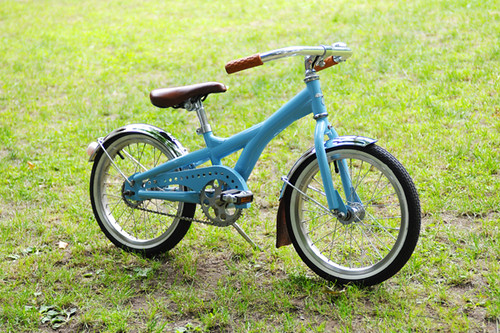
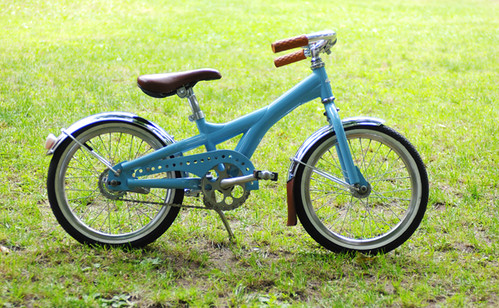
Visiting Nao ofTomii Cycles this morning, I finally saw this little gem in person - the bicycle he put together for his son Fugo. It is really something to see a tiny children's bike this elegant!


Children's Bike Customised by Tomii Cycles

The frame started out as a regular kid's mountain bike (Nao doesn't remember for sure what it was, but possibly a Schwinn). Stripped of the original paint, it was powdercoated a robin's egg blue and customised with some lovely components and accessories -


Children's Bike Customised by Tomii Cycles
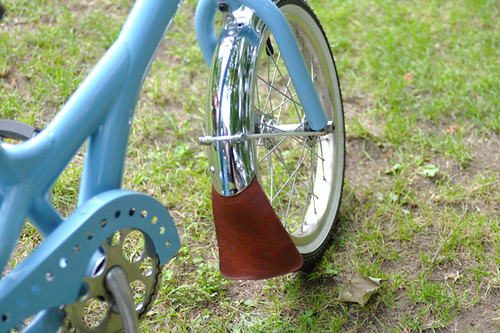
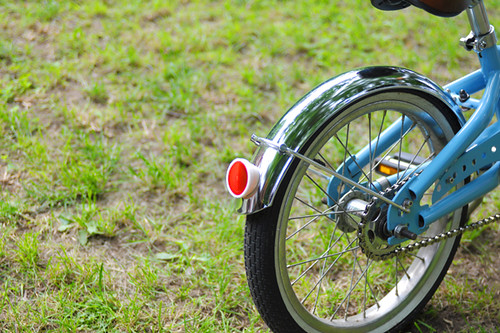
including the tiny stainless fenders with leather mudflap in front


Children's Bike Customised by Tomii Cycles

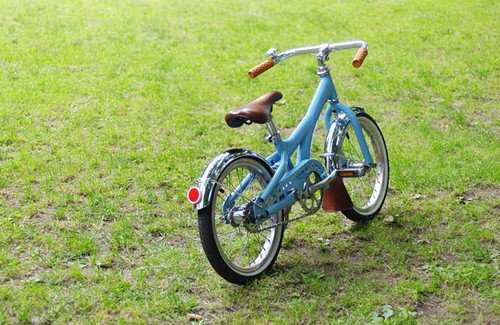
and vintage-style reflector in the rear.


Children's Bike Customised by Tomii Cycles

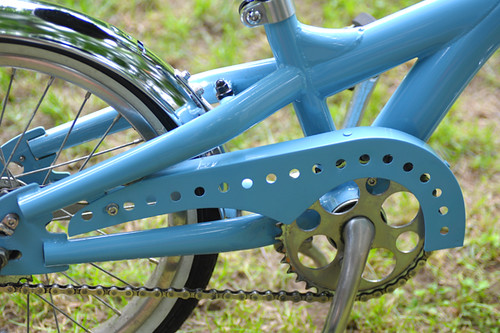
The drilled-out chainguard was powdercoated to match the frame.


Children's Bike Customised by Tomii Cycles

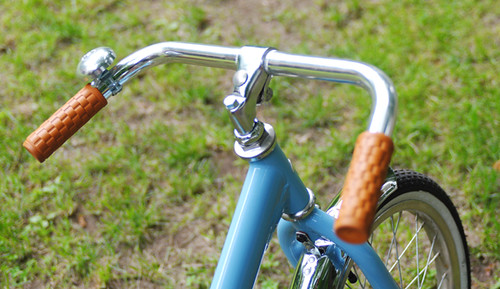
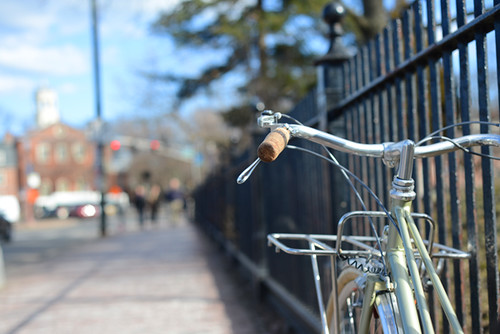
The handlebars are the Belleville bars from Velo Orange, which are surprisingly proportional for the bicycle's size.


Children's Bike Customised by Tomii Cycles
Caramel coloured basket-weave grips and tiny silver bell.


Children's Bike Customised by Tomii Cycles
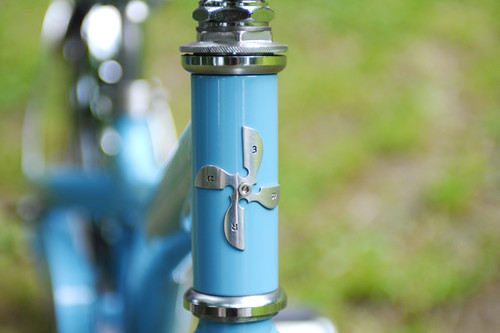
Prior to becoming a framebuilder, Nao had been making components under the 3RRR name, and often bikes in Boston can be found sporting his custom chainrings and headbadges. This propeller badge is one of his.


Children's Bike Customised by Tomii Cycles

I really like how this bicycle came out. It's beautiful and intriguing, but not "too much" for a children's bike. Recycled frame with decorative and functional touches, coaster brake, single speed, kickstand, nothing fragile or complicated. I like how the caramel accessories complement the pastel blue frame. The padded saddle has a scrap piece of leather stretched over it and matches the mud flap. The wide knobby tires are great for riding in the dirt and grass of the back yard, as well as in the nearby park.When I went to pick up the bike, I was warned that it would be heavy, but I didn't really believe it. How heavy could a bike this tiny be? "It weighs more than my own bike!" Nao clarified, referring to his steel roadbike, and he was right!


Fugo's Bike

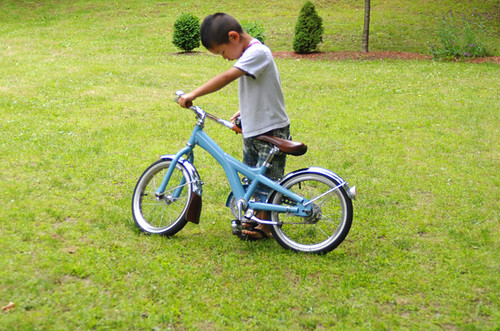
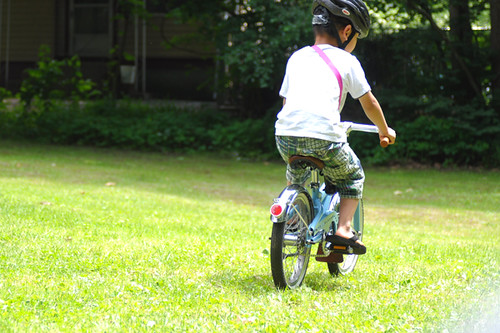
Fugo's relationship with this bicycle has been interesting. When Nao presented his son with the bike more than a year ago, the boy was not really impressed. He did not know how to ride yet and was not interested in learning. Then recently he suddenly wanted to try riding the bike. Nao was going to attach training wheels, but Fugo did not want them. He then got on the bike and began to ride, just like that.


Fugo's Bike

The trouble with nice children's bikes, is, of course, that children outgrow them fairly quickly. But looking at Fugo's bicycle and watching him ride it, I still can't help but think it is worth it. Great job, Nao, and happy riding to you both.

Sunday, April 14, 2013

Succulent Blossom


One of my houseplants, a succulent has been blooming some this summer. Here are some of the buds and an open blossom.

Saturday, April 13, 2013

In Print


I wanted to share that this Spring I have two pieces of writing coming out in print publications. An article on my impressions of a classic randonneuring bike will appear in the Spring issue of Bicycle Quarterly. And a reworked version of a post from last December, "Emotional Landscapes," has been included in Taking the Lane, Volume 6: Lines on the Map. If you are interested in reading these pieces and the excellent works alongside which they appear, both issues are now available to order.


Since the start of this blog I've been reluctant to commit my bicycle-related writing to print. I did not feel the writing here was good enough, and I also didn't think the style really flowed outside of the blog format. But working on the Bicycle Quarterly article and interacting with Jan Heine made me aware that I've accumulated material - stories, thoughts, ideas - that do not fit the blog format and would work better in print.


Posts like Emotional Landscapes and this earlier one about Vienna are examples of writing that really should have been longer and more nuanced, adapted for the blog only because I had no other outlet for it. Publishing a slightly altered version of the former in Taking the Lane allowed me to test the waters as to whether I felt comfortable turning non-committal blog snippets into real pieces of writing.


I think that one of my readers, who comments here as "Spindizzy" (aka Jon Gehman the rackmaker) is a genius writer who owes it to the world to write a book about life and bicycles. His comments alone are literature as far as I am concerned. I've also been inspired by the writing of Tim Krabbé, Grant Petersen and Bill Strickland (in a way I see the latter two as flip sides of the same coin), and reading their stuff has made me realise that distinguishing "bicycle writing" from "literature" is silly and a defense mechanism. I've written stuff that has been published before. But with this blog I wanted to de-stress and take the pressure off with what I initially thought was a lighthearted topic. Imagine my surprise.


TheSpring issue of Bicycle Quarterly and Taking the Lane, Volume 6 are now available, and those who order should receive theirs some time in April. I derive no financial benefit from the sales of either, but invite you to support these small, independent publications.

Wednesday, April 10, 2013

The Climbing Season Starts at Mount Rainier

Get ready, get set...the climbing ranger season has begun!

Climbing rangers are now staffing Camp Muir and the information desk at the Jackson Visitor Center (which is now open daily) to issue climbing permits.

Here's the current schedule for the JVC and for climbing information:

JVC Schedule May 3 -- June 6
10 a.m. to 6 p.m. daily except Saturdays, when it opens at 6 a.m.

Climbing rangers staff the JVC on weekends in May from 6 a.m to noon Saturday

Note that you can get a climbing permit at the JVC when it is open, even if the climbing rangers aren't there to issue it. Also, while the NPS transitions from winter to spring weather (there is still 5 feet snow in Longmire), be sure to call ahead for weather and road conditions.

To get you pumped about the upcoming good weather, we've posted a few new trip reports, featuring the Fuhrer Finger and Gib Ledges, and one about the ever-popular Muir Snowfield.

Elsewhere you can read about David Brown and Hannah Carrigan's trip up Gib Ledges and ski descent down the Kautz Glacier, as well as a trip report from Kyle Miller and Scott Stuglemyer about their splitboard expedition to Fay Peak - during which they dug out the Mowich Lake ranger station along the way (thanks guys!)
(Photo of Fay Peak ascent by Kyle Miller)

Saturday, April 6, 2013

Finishing What You Started

Fork Crown Finishing

"The hardest part of this for beginners is usually the cleanup," Mike said at the start. "It's a lot of filing. That's what breaks people."


"Oh," I said. "Well, that shouldn't be a problem. I've done filing."


Going into this, I was worried about many things. The measuring, the cutting, the alignment, the brazing. But filing I could handle. I thought back to my days of intaglio printmaking (etching on metal plates). The person who taught me insisted that everything had to be done from scratch and manually - from cutting sheets of metal to preparing the plates. The latter involved beveling the edges at just the right angle, then endlessly filing, sanding and buffing them until the bevels were perfectly even and smooth, polished to a mirror finish. His insistence on this level of prep work had more than a few students in tears before we even touched ink or got anywhere near the press. But for some reason I stuck with it, eventually got the hang of it, and continued to use this method after I began to work independently. It just didn't feel right to do it any other way. Now whenever I see an etching, I can't help but look at the edges in search for file marks. All of this is to say, the prospect of filing for hours did not frighten me.


Rack Mockup & Modification

So how do I explain what happened a week ago? I don't want to exaggerate it into some dramatic melt down, but it was certainly a low point. A very long day, throughout the course of which I grew increasingly quieter and less bouncy than I had been up to that point. This was supposed to be the last day. So maybe it was the discrepancy between having believed I was almost done, and discovering more and more little things needing to be finished. All these little things added up, and taken together amounted to a lot of work. Bridges, bottle cage mounts, eyelets, braze-ons for cable routing.I had been awake since 5:30am. By 5:30pm, I was so tired that I had a hard time focusing. By the time we mocked the whole thing up to make sure the wheels, tires, rack and brakes all worked together,I was no longer fully present. At this stage we decided that the frame was finished - "good enough." But the feeling of satisfaction or at least catharsis that I had expected at the end did not come.


At home later that evening I did nothing and thought of nothing, feeling utterly dejected. It wasn't until the following day that I could even get myself to look at my pictures of the finished frame. And then I finally felt something: panic. "Good Lord, how could I leave it like this? This is notfinished!" I could see smears of brass and silver. If I zoomed in closely enough, I could make out uneven surfaces. I had filed away at these areas, but apparently not enough. Mike had been right: like most first timers, I had flaked out on the cleanup. With horror, I imagined him powdercoating the frame as it was, uneven shorelines and all. Or, worse yet, putting the finishing touches on it himself, whilst chuckling "I knew the finishing would get her!" So I phoned him, trying to stay calm. He had not powdercoated the frame yet. And yes, fine, I could come over to continue working on cleanup. This put me in a fine mood.I showed up bright and early on a Friday morning full of energy.

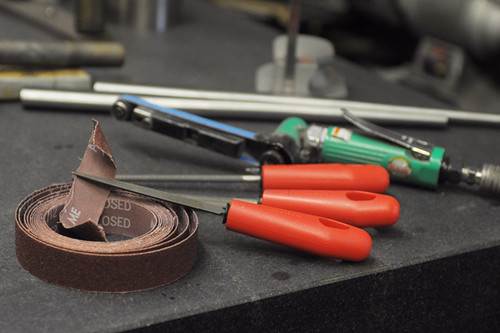
Some Finishing Tools

Somehow I maintained that energy for an entire day of using nothing but some files and emory cloth strips. All I did from 9:30am until 5:30pm, with a break for lunch, was file and sand, and it was tremendously satisfying. I guess having reached that low point my previous time at the shop, there was nowhere to go but up.


Mike had to go out for much of the day, and I was mostly on my own working on this. Not being able to seek feedback (Does this part look even? Did I file too much in this spot?) added a new layer of excitement to the process. When he returned, I think he was pretty amused by how cheerful I was after being at this for hours.


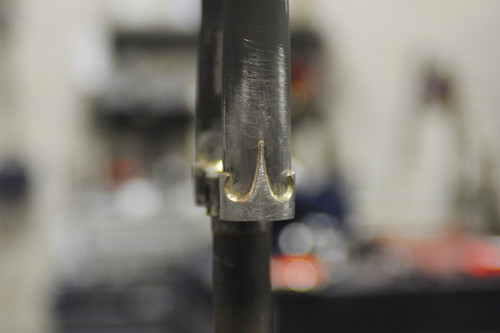
Fork Crown Finishing

One of the trickiest parts to clean up was the area around the Grand Bois fork crown. Those curly-cues make it difficult to get the file into that little space and chisel away at the extra filler material without gouging the crown or blades in the process. It took me longer to get it to this state from this state, than it did to do the initial post-brazing cleanup. The trick is to dig into the shoreline build-up with the tip of a file, then angle the file just so to lightly and gingerly clean up the rest.


Finishing

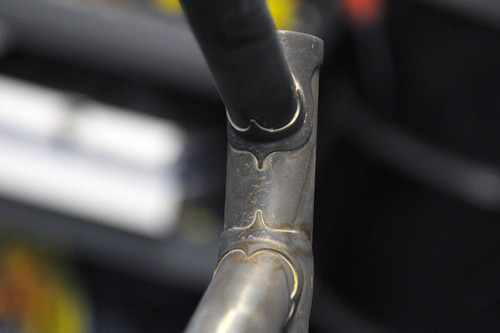
But the most challenging part of all was the seat cluster. My beautiful seat cluster! We made the seat stay caps from scratch to look exactly the way I wanted; it was the coolest thing ever. But during brazing I got a bunch of silver all over the caps, and was now terrified that in cleaning them up I would ruin their perfect concave surfaces. So ever so lightly, I dug into the tiny bulges with the tip of a file, using the most delicate micro-movements I was capable of to remove the filler material but not the steel underneath, then polished with an emory cloth until I got the stuff off. This took a while!


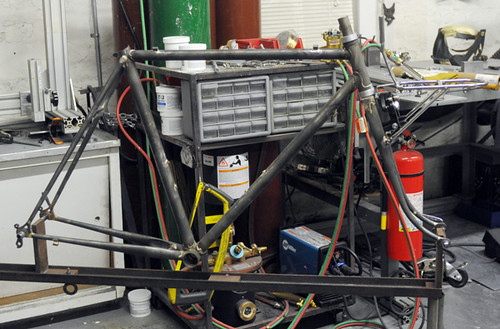
And so it went.The pictures here show the frame close to the point where I stopped, but not quite there.I didn't have the energy for pictures by the time I was done.


Finishing

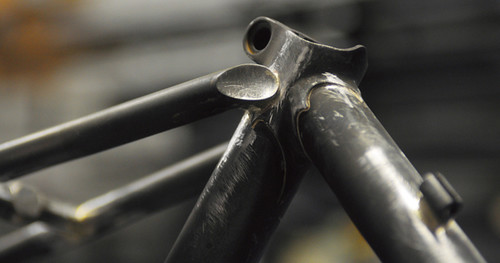
If you are wondering about the uneven looking surface from the sanding marks, they disappear after the frame gets sandblasted. The headlugs started out looking like this after brazing, then this, and eventually ended up as you see them above.


Don't get me wrong: The finishing on my frame still isn't "good" by real builders' standards. In fact I would not mind continuing to work on it, but unfortunately we are out of time. But at least now I can live with the state I left it in. And no matter how the bike turns out, I got the feeling of catharsis and closure I wanted out of the process. I learned how to build a bicycle frame (and fork!), from start to finish.

Friday, April 5, 2013

Perdido Key... Greetings from Florida!

Last Wednesday morning, I left Lake Lurleen, Alabama and drove the few hours south to Pensacola, Florida. My first night there I saw the most magnificent sunset, but got no pictures because I was still driving through Pensacola in the early evening traffic! I've spent the past four days in the area and, despite somewhat cloudy skies, have had great weather. Yesterday it got into the 80s – for me, the first time in that range since leaving California in June! I can't tell you how great that felt! So great that I spent all afternoon and early evening on the beach...


I'm heading east now, toward the Georgia coast, to spend Thanksgiving with my niece and her family.

Greetings From... South Carolina

Huntington Beach State Park

November 18, ..

November 18, ..

November 19, ..

Wednesday, April 3, 2013

Another Orchid


Although this isn't an orchid, it sure does look like one.

Aw, Nuts

Late on Monday afternoon I noticed that the passionvine that had been budded for Blooming Day had opened. I went back inside for about 20 minutes, then brought the camera out. As I turned the corner to walk toward the Passionflowers, something felt odd - where had those pecans on the fence come from? They hadn't been there 20 minutes ago!


I looked up to see a bend in one of the largest boughs - this year's rain has produced an unprecedented crop of nuts and the weight was apparently too much for the tree's structure. An enormous amount of branches and leaves were resting on the fence, tangled up in nearby shrubs, and in crepemyrtles and some young Arizona Ash trees on the other side of the fence. I called Philo out to look at what happened, and we tried to decide what to do. This job might well be too big for us to handle, but we also knew it was best to get the weight off the other trees and shrubs as quickly as possible.

We got out the loppers and pole pruner, thinking that if we cut away some of it, we could at least see what we'd be dealing with. As you all know, once a pruning job is started, with one small cut following another, it's almost impossible to stop. Pretty soon we had the ladder out, along with ropes, the chain saw, brown yard bags and twine for tying up brush.


Philo did the heaviest lifting and sawing, while I held onto ropes and hauled the boughs out to the center of the yard. He somehow hauled that enormous branch up over the top of the fence and away.

An hour later the shrubs were freed, battered but mostly intact, the crepe myrtles looked okay, and the flexible Arizona Ash tree was already straightening out. The fence is old and beat up already, so a few more nicks in the top are barely noticible.

We were impressed with the pile of debris, and set to reducing it, bundling up branches cut to the regulation 4 feet, with smaller stuff clipped so it would fit in bags. There were a few pieces that could be firewood, but pecans grow with many, many dense shorter branches. By 8 o'clock we were tired and hungry, and it was getting too dark to work safely. We thought we'd done pretty well for two people who get senior discounts at the movies - this was all that was left to be done the next the morning.


We're still wondering whether we'll ever get any edible nuts from these trees - whatever pecans were not eaten by squirrels each fall have been either hollow or wormy. Unfortunately the branch broke before the nuts were mature - the husks were still green and tight. And we've still got to saw that broken part smooth.

Aw, nuts.