Friday, October 31, 2008

One Way to Lower Your Bike's Gearing

AT's Refurbished Jeunet
overheard in a bike shop


Customer, returning from a test ride: "I love the bike! But it feels like there are not enough low gears? What is the best way to get easier gears?"


Salesperson: "Oh, well you need to ride the bike for several weeks for the gears to wear in. They should feel lower after that than they do now. If not, you can bring the bike back and we'll get you lower gears. But they usually wear in."


I almost laughed out loud, but I have to say I agree. The gearing on all of my bikes feels lower now than it did when I first got them. The gears have worn in so nicely! If you opt for this method though, be mindful that if you neglect the bike and stop riding it for a while, the gears will stiffen up and feel higher again the next time you get in the saddle. The fun facts of bike ownership.

Tuesday, October 28, 2008

Purse or Pocket?

Tyranny of the Purse
For as long as I can remember, I have loathed those things that are known as purses: small handbags designed to house not books, laptops or groceries, but tiny personal belongings such as a wallet, phone and keys. Traditionally women have carried purses, because their clothing is not designed with pockets to accommodate these miscellaneous items. Even when pockets exist, their design is not actually useful for storing things without distorting the fit of the garment or even interfering with movement. And so historically, women have carried tiny handbags, seldom experiencing the freedom of walking around empty-handed, the peace of mind of not constantly having to look after one's belongings, and the fun of spontaneous mobility (try running down the street with a purse).


In the twentieth century, some women have taken this up as a feminist issue, refusing to carry a purse out of principle and only buying clothing with well-designed pockets. But for the most part, the purse trend persists, with fashion designers making a fortune on this accessory every season.


Freedom of the Pocket
For me it's not really a political thing, but I do get frustrated carrying a purse. Over the years I've made an art of finding clothing with proper pockets, or else adding my own pockets to garments. Even for 90°F summer heat, I own skirts and sundresses with cleverly placed pockets for my wallet, keys and phone.


Looking at a friend's vast collection of diminutive handbags one day, I asked why she preferred this method of carrying her things. She replied that this way everything is always in one place, and she need not move it from jacket to jacket as I do. That makes sense - except that she switches from one purse to another on a semi-daily basis, so she still ultimately has to move everything over. But explanations are about subjective perceptions of reality, and this was how she saw it. When I talk of purses being a burden, those who like them probably think it's mostly in my head as well.


I've been thinking about the purse vs pocket issue more since I started cycling. When riding a bike - particularly if that bike is not bolt upright - pocket design presents a special challenge, as contents can spill out more easily than when walking. Clothing that is marketed as cycling-specific, even for commuting, usually features lots of complicated pockets that try to get around this. Sometimes they work, sometimes they don't. Personally, I find the rear pocket design of the cycling jersey to be an extremely efficient way to carry small items on the bike, and I've wondered what elegant method can be devised to translate this into streetwear and maybe even business-casual attire. Begrudgingly I've ridden my bike with a purse in the basket or strapped to the rear rack now and again, but I always wish for pockets.


I am wondering what my female readers prefer. And does it depend on whether you are on or off the bike?

DPS Spoon?

I am a big fan of the carbon DPS 138.


http://dpsskis.com/ski/lotus138


But the "Spoon" is another step on the wild side. With OR coming next week it is fun to look back at what was shown last year and still isn't available yet. I got on the list anyway.


http://www.powdermag.com/stories/first-look-dps-skis-new-spoon-in-action/


"this design has been in the works for a year and a half, and its really cool to see a skiable example of it. stoked to test it in the next bit, once the tradeshow circuit slows down.


the ski is designed to really promote super high edge angle powder skiing with out seeing drag and reduced speeds from snow contact on your leg from loosing the plane. when a flat-base ski gets higher and higher edge angle , the amouint of float gets lower and lower. this spoon shape starts to engage at the point that a normal flat ski starts to dive. and then keeps going... so like really from dragging your hip in pow super powerful GS type deal.


aside from that, the goal was to open up a totally news style of drifting into and railing/carving super cleanly out of turns and terrain features.


the cleats were added to enabe the ski to be somewhat controlable on runouts. it is pretty different from magnetraction where you are trying to gain edge grip by undulating in and out. the cleats go down to add a small level of stability and edge so a fully convex base will change direction and slow down etc on 2dimensional snow. as it is now, you will not be carving turns. if there were no cleats, the ski would be in essance a death trap. ~20deg base effective bevel otherwise.


this ski shape is based around a lotus 138 + 12mm. full rocker (reverse camber). 192cm. his particular ski was built in eden utah in the engineers garage. it is not ready for retail production, but the tech will see trickle down in the future, is the goal. once the amount of base convexity and positioning and amount of cleats and height of cleats etc is finalized.


base prep out of the mold is a pain, but once that is done, tuning is straight forward actually. far easier to wax etc than i thought they might be. hand prep the base. really no biggie. flat enough to mount bindings without issue upderfoot.


stephan sees this as being the future of powder skiing, based on his testing of it the past 2 days, and well... going by how it looks in my hand, i am inclined to agree... but i have not skied them yet. these skis literally came out of the mold 4-5 days ago."


Last edited by marshalolson; 01-27- at 08:51 PM.


http://dpsskis.com/blogs//january/dps-spoon-150-patent-pending-dps-cleat-technology


www.dpsskis.com

Saturday, October 25, 2008

Jemez Creek

Took the dogs and when to Jemez Creek for a walk the other day.
There are several rest areas along the road that have acess to the creek for hiking and fishing. There are nice paths for walking. On this day we noticed the water in the creek was really low allowing us to see a lot of rocks we can't normally see. We also saw a few trees that some beaver had been cutting down for food or for damn building but no sign of a damn any where here like we see higher up in the mountains.

Joslin Family :: 1830 Census Delaware County, Ohio

The 1820 census of Delaware County, Ohio included only one Joslin family, that of Jonas Joslin. The 1830 census includes just two Joslin families: Jonas and James, both in Liberty township, listed seventh and fifth from the bottom of page 85. Additional research provides us with the names and ages within the square brackets.

The probable household of Jonas Joslin:
  • 1 male under 5 [1825-1830... grandson, John, age 2, born June 1828]
  • 1 male 20-29 [1800-1810... son Jonas Jr., 23, born February 1807]
  • 1 male 60-69 [1760-1770... Jonas Sr., 61, born March 1769]
  • 2 females 15-19 [1811-1815... daughter Fanny, about 20, born about 1810 and one other, name unknown]
  • 1 female 20-29 [1800-1810... Lucy, 23, wife of Jonas Jr., born August 1807]
  • 1 female 50-59 [1770-1780... Ruth, 59, wife of Jonas Sr., born 1771]
Elizabeth, aged 16-25 in the 1820 census, was married to Milton Bartholomew according to "Abstracts from Miscellaneous Delaware County Ohio Newspapers 1821-1857" extracted by Mary V. Reed, Delaware County Genealogical Society, 1992, page 38. Citing the Franklin Chronicle, Worthington, Ohio of March 19, 1821: "Married on Thursday 15th inst. in Middlebury, Delaware County by Nathan Carpenter Esq. Mr. Milton Bartholomew to Miss Elizabeth Joslin." There were no entries for the two unknown females aged 16-25 that were in the Jonas Joslin household in 1820.

From published newspaper abstracts we learned that James and Abigail Joslin were married prior to June 30, 1826. The 1850 census and additional research gives us the names and dates within square brackets.

Probable members of the James Joslin household:
  • 1 male under 5 [1825-1830... son Edwin, age 1, born December 1829]
  • 1 male 5-9 [1820-1825... son Lysander, age 5, born May 1825]
  • 1 male 30-39 [1790-1800... James, about 34, born about 1796]
  • 1 female under 5 [born 1825-1830... daughter Fanny, about 4, born about 1826]
  • 1 female 5-9 [born 1820-1825... Unknown]
  • 1 female 20-29 [born 1800-1810... wife Abigail, about 25, born about 1805]

Friday, October 24, 2008

My new boat!


Well, after 10 years of wanting a kayak I was finally able to get one! I went down to Duluth this week and picked up a Wilderness Systems Tsunami 165. I could barely contain my excitement as I drove back from Duluth with the kayak on top of the car. This evening I went for my first paddle in the new boat.


It was a sublime evening on the bay, perfect for trying out the boat and getting a feel for it. I was just going to goof around right in front of the house with it, but it was so nice I decided to actually "circumnavigate" the bay with it. The first thing I noticed was how much easier it glides through the water compared to my canoe. I played around for a little while in front of the house, practicing turning and getting used to the feel and balance of the boat. Then I headed over to the Hat Point Marina and paddled up to the Isle Royale ferry "Wenonah", which looks positively gargantuan from the seat of a kayak! Next, I headed for Pete's Island. After only about 10 minutes of paddling, I was at the island (I thought it would take longer to get there!). I landed and got out for a minute to stretch my legs (not used to the sitting position yet!).


For the next leg of my "trial paddle", I went from Pete's Island to "The Pines", a picnic area on the east side of Grand Portage National Monument. As I crossed the bay there was a gentle swell rolling into the bay and every now and then one of the swells would give me a little push, causing my speed to increase. As the boat rose and fell on the backs of these swells, it was a wonderful feeling. It felt like I could feel the lake breathing. I can tell I'm going to love this sport! This wasn't my first time kayaking, but it had been awhile so the sensations all felt new again. After reaching the pines, I turned and followed the shoreline back to my house. This part of the bay is very shallow and almost entirely sand bottom. It was fun gliding along and watching the ripples in the sand as they passed beneath the boat. When I got back to my place, my brother was sitting there waiting for me. He had seen me paddling and wanted to give the boat a quick try. I pulled up parallel to shore and in my haste to climb out, promptly tipped over on the lakeside of the boat and got completely wet. Oh, well! I also got to try out my new bilge pump :-) I can't wait until the next outing!

Thursday, October 23, 2008

Dead Trees

Here is a shot of two of the cottonwood trees that were killed by the fire but haven't been carved into figures yet. The sandhill crane on it's tree trunk can be seen in front. If you look close you can see Coors Blvd behind the park with the housing develpment that is to the west of Coors Blvd. The parking lot for the park can also be seen along with a distant view of the eagle.

Anastasia State Park

I didn't quite make it down to the beach for the sunrise, but the sun was playing hide and seek through the clouds when I got there.

It was a chilly morning, but that is sand, not snow.

Surf and Sea Foam.

Sand and Sea Shells.

Wind-blown patterns in the sand.

Saturday, October 18, 2008

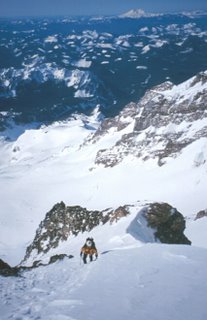
Gibraltar Ledges and Ingraham Glacier Direct Route Conditions

Two teams attempted these routes this week.

Tuesday at Camp Muir, two climbers departed in the morning hoping to climb the Ingraham Direct. The pair made it to 13K before turning around. They reported knee deep snow the entire way up the Ingraham Glacier. They also reported several crevasse crossings, most of which went smoothly. They stated that the bridges were in good shape and most were easy to cross. That said, one of the pair did take a crevasse fall at 13K... After a day of kicking steps in deep snow, the pair decided to descend after the crevasse fall.

Gibraltar Ledges was attempted on Wednesday by a soloist (carrying skis). He reported knee deep snow on the Cowlitz Glacier up to the beginning of the ledges. The snow on the Cowlitz was described as powdery, underneath a crust of varying thickness, but "thin" overall.


On the ledges, the climber experienced a lot of soft, sugary snow... Sometimes even waist deep. It took over 2.5 hours to traverse and climb the ledges. After pushing through what you get when you "open a bag of cane sugar," upward progress seemed futile. He turned around at 12,500 feet (about 3/4 of the way up the chute). It took over an hour to descend the ledges, as the footing was still quite challenging.

There is a boot path up the Muir Snowfield. The weather is supposed to be excellent this weekend.


Photo by Mike Gauthier, climber ascending Gib Ledges before the traverse and chute.

Who Did What? The Closing Ceremonies!

Thomas has posted the Genea-Blogger Games: Closing Ceremonies with some interesting tidbits about the games as well as the flags of all medal winners along with their medal count.

Among other interesting facts regarding the games that Thomas provided is that 35 of the 38 people who entered the competition were able to complete one or more events as planned and earn at least one medal. A total of 120 medals were awarded, of which there were 40 Platinum, 33 Diamond, 24 Gold, 10 Silver and 13 Bronze. Be sure to read the rest of his post for more information and to see who did what. Great job, everyone! Are you ready for ..?

So, how did I do? The details are here. . .


  • Cite Sources: Bronze
  • Back Up Data: Gold
  • Organize Research: Platinum

  • Write, Write, Write: Diamond
  • Genealogical Acts of Kindness: Platinum

Wednesday, October 15, 2008

Can We Have It All? The Mirage of the Perfect Bicycle

This post has been long in the making, its birth finally inspired by the plight of a fellow velo-bloggerist - whose story I will use as a case study here. Taking care to keep her identity hidden, I shall refer to my fellow velo-bloggerist as "Dee".


[image: "Dee" rides cargo trike]

Case Study: Dee and Her Search for "The Bike"


Dee lives in the suburbs. She rides an enormous cargo trike, in which she carts around two children, groceries, drycleaning, sleds, and whatever else the day might bring. Being young, fit and vivacious, Dee hungers for a personal bike - one she could ride on her own with joyful abandon. Her husband agrees that she must have such a bike, and a reasonable budget has been allocated. All seems rosy ...until Dee tries to decide what bike to get. Let's see, what are her criteria? She wears mainly dressy clothing, she plans to ride the bike in all seasons, and she always carries a bag when she is out and about. An upright sitting position, internal gear hub, enclosed hub brakes, a chaincase, and a good basket set-up would be ideal.

["Dee" completes triathalon]


But wait. Dee also dreams of going on longer, zippier rides on this bike, in hilly areas. Perhaps try touring some time. She wants to keep up with her husband when he is on his carbon fiber road bike. She wants speed when she feels like it. And did I mention she has completed a triathalon? All this brings a different bike to mind: derailleur gearing, handlebars that allow for a variety of hand positions, lighter weight.

If you know about bikes, you can already see the problem here. The two "ideals" for the different styles of riding she plans to do, are in conflict with one another. The heavy loop frame, North Road handlebars and the internal gear hub that will protect Dee's ivory silk trousers as she pedals elegantly to her meeting in town, will not get her up hills alongside her husband's roadbike. Likewise, the sporty geometry and derailleur gearing that will allow her to glide uphill on those long rides, will not be kind to her dressy outfits once she is back to her town life. Not to mention that derailleur gearing is a pain to maintain in the winter season, and the caliper brakes that come with sporty bikes do not work as well in poor weather as enclosed hub brakes. As Dee shops around, goes on various test rides, and continues to weigh her criteria, she realises that she cannot have both sets of features on the same bike. What is she to do?

["Dee" wears elegant duds]


Here is a list of what, in my view, are the options available to a person in Dee's position:
A. Recognise that you need two bicycles rather than one: you need a city bike and a sporty bike. Adjust your budget, your manufacturer(s) of choice, or your purchasing timeline accordingly.

B. Determine what kind of cycling you will be doing most: city or sporty? Based on this, buy a bicycle that is ideal for that type of cycling, recognising that whenever you will be doing the other type, you will be riding a less than ideal bike and it may be difficult.

C. Try to find a bicycle that you see as the best possible combination of some city features and some sporty features.
Based on anecdotal evidence, my impression is that many people in Dee's position are naturally drawn towards Option C. Option A seems financially prohibitive. Option B seems scary, because it involves accepting that you will not be able to do some of the things you want to do on the one bike you're getting. Option C appears to make sense: It seems like a sensible idea to get a bicycle that lets you do some of this and some of that.

However, I think that Option C is often a mistake, and that those who choose it may ultimately be unhappy. A bicycle that has some city features and some sporty features is not "the best of both worlds" as we wishfully think, but rather, a compromise. Let's say Dee finds a bicycle with upright geometry and derailleur gearing. A comfortable bicycle that can handle hills, right? Well, yes, that sounds reasonable. But what about riding it in the city wearing those flowing silk trousers? And what about caring for that derailleur in the winter? During times like these, Dee will be wishing she'd gotten a "real" city bike. And what about those long rides, when her hands will begin to go numb because of the North Roads' limited hand positions? Well, during times like those she'll be wishing that she'd gotten a "real" sporty bike.


Essentially, "kind of good for both" means ideal for neither. That is my main caveat against buying "compromise bikes", especially if you plan to spend a great deal of money on the bicycle and rest all of your hopes and dreams on it.


While at first glance it might not seem possible that you can afford Option A, there are most definitely ways to do it. One suggestion, is to buy the dominant bicycle (for the style of riding you will be doing most) new, and the supplementary bicycle (for the style of riding you will be doing less of) vintage. This is the route I went when I bought a new Pashley for the city (retail price: $1200) and a vintage Motobecane for sporty rides (typical C-List price: $150). The extra cost of the Motobecane was marginal, but my needs were pretty much satisfied between those two bikes. A year later, you can save up and upgrade by replacing that second vintage bike with a new bike, if you feel that's necessary.


The main point that I hope to bring across here, is that the idea of that one bike that is perfect for every kind of cycling is a fiction - a dream that's as futile to chase as our own shadow. There is no such thing as the perfect bicycle, only the perfect bicycle of its kind. Versatility is good, but there is a fine line between versatility and compromise. It is up to you to decide where that line lies.

Tuesday, October 14, 2008

"Strength in Unity"

Not exactly sure who this guy is.

His mates say his name is Jimmy. But there seemed to be someuncertainty.

They reckon he is about 20. Again, not sure.

They say he remembers to bring his guitar to the crag but forgets his harness and shoes. It all sounds pretty vague.

Style:Jimmyscreams socialistchic and solidarity inlast seasons "Enterprise Bargain Agreement" T-Shirt in black with yellow ".Your Pay - Your Call" print by the always hip Aussie label, Australian Workers Union.

Did you get a good look at me Jimmy? Spooky huh?


The movethat started it all.Nine routes fan out from thisbeginning.


Jimmy put down the guitar long enough to switch on and send Spoonman.


Then back to guitar for songs of workers struggles and sendage celebrations.


It never hurts to have a stab at something hard at the end of the day.


Saturday, October 11, 2008

Yellowstone :: West Thumb Geyser Basin

Wednesday, August 31st - - After spending the night at one of the campgrounds in Buffalo Bill State Park west of Cody, Wyoming it was a relatively short drive (a little over an hour) to the eastern entrance to Yellowstone National Park. Then another 30 miles to the campground at Bridge Bay in the southeast portion of the east side. I had decided to give the park a “second chance” since simply driving through it last year just before the Fourth of July weekend. My visit this time was quite pleasant with less people, far less traffic, and much cooler temperatures!


After checking into the campground, which would be my “base” for two nights, I drove the southern loop through the park. My first stop was the West Thumb Geyser Basin, which overlooks Yellowstone Lake, the largest lake at high elevation (7,733 feet) in North America – it encompasses 131.7 square miles, is 14 miles wide and 20 miles long, with an average depth of 140 feet. In other words, it is HUGE! And beautiful, with the Absaroka mountain range on its eastern side.


The volcanic caldera at West Thumb contains many geothermal features including pools, springs, geysers, and paint pots. Above is a view of the central portion, which sits above the lake. The geysers, however, are currently in a dormant stage, thus no eruptions were seen.


The Abyss Pool is one of the deeper hot springs in the park, descending to a depth of 53 feet.


The trail guide states that Black Pool was, at one time, actually black. Cooler water temperatures allowed thick mats of dark green and brown thermophiles (heat-loving microorganisms) to grow in the pool, causing it to appear black. The water temperature rose during the summer of 1991, killing the organisms.


Walking alongside the pool on the boardwalk you could feel the heat from the hot water. At times, the steam rising from the pool was so thick you couldn't see the other side!


The water appears to be turquoise but it was so clear you could easily see portions of the bottom. There were several deeper areas – the “black holes” where the bottom could not be seen.


Interesting formations line the sides of the pool.


Constantly in a state of change, new features appear every day.


Hot water from Black Pool and other features in the area flows into Yellowstone Lake. The color variations are caused by those little thermophiles – microorganisms that thrive in the hot water.


Along the shore of Yellowstone Lake is this feature, called Big Cone. It's difficult to tell from the angle of the photo, but the cone rises about 12 inches above the outer surface.


Boiling hot water bubbles up in the Big Cone.


Further along the path and completely surrounded by water is the “Fishing Cone” so called because Mountain Men told of catching a trout in the lake, swinging the pole around, dipping the catch in the boiling pool, and cooking the fish without even taking it off the line! Sometimes in spring and early summer the Fishing Cone is underwater due to the rising lake waters from snow melt.


Thursday, October 9, 2008

Eyebrook circuit


Led by Mel. Maureen, Gordon, Norma, Chris and Marion, Chris, Phil, Steph, Terry and me. Sunny and not too cold. A bit muddy in the woods.


We set off from the parking space by the reservoir downhill from Stoke Dry and walked along the road, then round the track past the fishing lodge and the dam.


Coffee break taken on the wall near the fishing lodge. Then lunch at the café in Cottingham.


A very pleasant sociable wander on a fine Monday morning.


of walk