Monday, February 28, 2011

Sugarloaf triple-trail challenge, Ohiopyle trail running


Here's another trail run that I'd like to share with fellow trail runners local or visiting the Laurel Highlands of SWPA. I offer this one up as a challenge to see how fast anyone can complete it or as a great training run for "the hill of it". As always comments are encouraged regarding the route and your experience while on it! A few posts back I highlighted the Bear Run, Trail Run Challenge hoping to help fellow trail runners find the great running trails of the Laurel Highlands. This is the second route I'd like to highlight since its easy to follow and offers a great hill workout. This route takes advantage of 3 great trails that Ohiopyle State Park offers. Sugarloaf trail, McCune trail and Baughman trail pretty much in that order. I've named it "The Sugarloaf Knob Triple Trail Challenge". It utilizes all the great elevation between the train station and the peak of Sugarloaf Knob. I've been running a shorter 10 mile variation of this route for several years. I've added a new section which makes it just shy of 15 miles (seems like a better training distance). I found it to be a nice change of pace from the normal out and backing usually done on the early miles of the Laurel Highlands Hiking Trail (LHHT) for hilly runs.


The Start/End point at the train station


Here's the route: Start the clock at the red line under the information kiosk outside the train station (see the above photo). Follow the bike trail a short distance to the turn off for Sugarloaf Trail. Turn right onto Sugarloaf trail. Follow Sugarloaf trail up the ridge for about 5 miles to the Sugarloaf mountain bike/sledding area. From the parking area take a right onto Sugarloaf Road and follow less than a mile to the McCune trailhead. Follow the McCune trail loop 3.5 miles back to Sugarloaf road. Retrace Sugarloaf Rd. back down to the mtn biking/sledding area, retrace Sugarloaf trail downhill a short distance to the intersection with Baughman trail. Turn right onto Baughman trail and follow back down to the bike trail. Turn left onto bike trail and follow back to train station Start/End.


Trail maps are available at the Train Station visitors center. The trails are easy to follow and for the most part single or double track. The whole thing is very runnable if you've got the legs and lungs. Two vistas are passed along this run. One on the McCune loop (at the bench) and one at Baughman Rock Overlook which is passed on the way down. Both worth stopping to check out, unless going for the speed record ;)


My experience on this run: The temps were hovering around 83 with high humidity. I worked hard to keep my run going up the initial long climb. I was grinding away with my head down. I find looking up on long steep sections can be mentally defeating. Most of the run was in the shade, but the heat took its toll. I ran with my Nathan hydration pack filled to capacity (70oz.), which on most days would be plenty. I was drinking more than normal with the high heat and humidity which caused me to run out (thankfully only) 2 miles from the finish. I consumed 3 elete tablytes and 2 gelsfor electrolytes and energy. I completed the course in 2:27:50 which felt like a good first effort. I look forward to running this one again... I hope you do too!


This bench was recently installed at the overlook
along the McCune trail. Mile 7.5


The view from Baughman Rock overlook. Mile 13ish


FKT (fastest known time):

6/25/13 Tim Anderson 2:27:50

Sunday, February 20, 2011

Attach of the Birds


Everyonce in a while we have a big flock of blackbirds come in to water.

Small Tent Rocks

All over the Jemez Mountains are pointed rocks like these. Most are bigger than this. They are called tent rocks but to me they should be called teepees.

Saturday, February 19, 2011

Wind-blown snow


I was mesmerized by this scene when I came across it. The patterns in the snow created by the wind made for a nice foreground and begged for a vertical composition. The morning light and clouds were the icing on the cake!

Tuesday, February 15, 2011

Gunks Routes: Sixish (5.4+)


(Photo: following the 5.3 pitch two of Sixish)


Sixish was one of my first outdoor climbing experiences. It may well have been THE first experience I had in the Gunks.


It was the summer of 2006. I was with my friend Greg, who'd introduced me to climbing in April of the same year. Greg had been climbing for a couple years. He had some leading under his belt, but not much.


I was little more than a liability to him. My experience was limited to toproping indoors with a GriGri. When we climbed outdoors, Greg had to teach me the standard commands and tutor me in ATC usage at the start of every pitch. I was just along for the ride, willing to follow Greg up anything. I was enthusiastic, but I brought nothing to the team. By agreeing to climb with me, Greg knew he was taking responsibility for both of us.


I remember nothing about the first two pitches. As I recall they went uneventfully enough.


What has stayed with me is what happened at the end of pitch two. We arrived at the GT Ledge and Greg began to scope out the 5.4 pitch three. And he wasn't at all pleased, because it looked scary. Over our heads was a gigantic roof. The guidebook said to move left to where the roof met the wall, and to climb up on the outside face of the cliff. Then we were to traverse back right just above the lip of the giant roof, and underneath a second roof, for about 15 feet to a notch, where we would head straight up to the top.


Greg thought the traverse looked precarious. It didn't appear to him that it could possibly be only 5.4. He worried that if he fell he'd hang below the roof and have trouble getting back on the rock. He was especially upset about a pointy dead tree stump, about ten feet tall, that stood on the GT Ledge just below the finishing notch. Greg envisioned taking a fall at the end of the traverse and being impaled on this stump. This was an unlikely event, but Greg can be morbid like that.


Of course, at the time, I had no tools with which to judge the likelihood of any of Greg's fears coming to pass. I just sat there impotently as he thought out loud about the risks of continuing, and about bailing. He considered leaving gear behind so we could rappel off. He worried about whether we could get down to the station atop pitch one with a single rope rappel. Unsure of this, he decided we had no choice but to continue.


Of course, I now know that we could have easily reached the next station with a single rappel. And I now know that we could have done even better: a short walk left on the GT Ledge would have taken us to the bolts above Kama Sutra, an unbelievably easy two raps to the ground. No need to leave any gear behind. But back then I was a blank slate, with nothing to offer, which turned out to be a good thing in this instance because our collective lack of information led us to continue with the climb.


Finally Greg led pitch three of Sixish; he got through it with no problems. Then I followed the pitch and it turned out to be a formative experience in my climbing life. I had no expectations, but the pitch nevertheless surprised and delighted me. No pitch in a gym was ever like this. The climbing up the face was straightforward, and then a perfect foot rail appeared just where you needed it to move back to the right above the giant roof. Traversing felt entirely different than moving upward; the most elementary of steps seemed somehow insecure when the movement was sideways. The position between the two roofs added a thrilling element of exposure. Then the exit through the notch to the top featured good holds, but the features of the real rock again seemed entirely new to me. Maneuvering my body through the notch was unlike any climbing I'd done before.


I arrived atop the cliff to find Greg totally high on having successfully done it. The lesson for him was that Dick Williams can be trusted. If Dick says the pitch is 5.4, you should have faith the holds will be there.


For me, the lessons were different. I was learning what real climbing was like. I was at a stage where I still found pulling on plastic to be novel, great fun. But doing a climb like Sixish made me see that climbing outside had so much more to offer. And I began to fall in love with the special features of the Gunks: the wandering traverses, the roofs, the escapes. The peace of sitting on the GT Ledge, comfortably belaying your partner in an atmosphere of seeming isolation among giant rocky overhangs. The pleasure of watching the birds slowly circle, of admiring the green valley below.


Fast-forward five years to . I was climbing with Margaret on a very hot day. She was looking for easy leads, and after I led Son of Easy O (5.8) in the bright sunshine, I was looking to collapse, I was so dehydrated. We took the very short walk over to Sixish, and upon finding out it was in the shade, we decided to do it.


(Photo: Placing gear at the crux of the 5.4+ pitch one of Sixish)


I was figuring I'd lead pitch one because Margaret seemed interested in taking the easiest pitches. In the case of Sixish, the easiest pitch is the middle one, which is only 5.3. I also thought it might be fun to try the 5.6 variation start to the climb. But then we looked at the traditional 5.4+ start to the climb, which ascends a large left-facing flake and then moves left into the big corner system, and it seemed pretty straightforward. Margaret said she thought she'd be fine leading it. I was sure she'd be more than fine leading it and I was thrilled to follow her.


It turned out to be a bit of a sandbag. If I'd been told this pitch was rated 5.6 I wouldn't have argued. The climbing past the initial crux flake is steep and pumpy. The holds are very good, but hanging out to deal with pro is surprisingly strenuous. Then the pitch moves left to the big corner and it gets pretty pumpy all over again. This pitch is not very long, maybe 60 feet or so, but it packs a lot of value in.


Margaret had no trouble with the climbing, of course, but she did get a bit confused about where to belay. I told her I thought I remembered that she was to go all the way around the big corner to the left and onto the main face to finish the pitch. But she found a small ledge in the big corner which seemed to match the "small belay stance" mentioned in Dick's guidebook, so she stopped there. When I arrived I thought she'd made the right choice, but then I began to lead pitch two and as soon as I moved onto the main face I reached a much better stance with some fixed gear. This was obviously the right place to do it. It wasn't an issue of safety or even really of convenience, and Margaret didn't miss any important high-quality climbing by stopping where she did. But you'll find if you lead pitch one of Sixish that you'll have a more comfy belay if you move all the way around the corner onto the main face.


I led the 5.3 pitch two, and it was such a pleasure. The pitch goes up and slightly left, passing an overhang. Then it moves right to a vertical crack system that provides plentiful holds all the way to the GT Ledge. As I led the pitch I was struck by how nice the climbing was, and how I hadn't realized what I was missing by not doing these easy classics much any more. I couldn't remember the last time I considered doing a 5.4 like Sixish. There are so many of them in the Gunks; it is so easy to take them for granted. How many climbing areas have such high-quality super-moderates like this? In most places a 5.4 would be an unpleasant thrash up a gully. But in the Gunks you get clean climbing up steep rock with great holds and pro. What more can you ask for?


(Photo: At the end of the traverse on the 5.4 pitch three of Sixish)


When we reached the GT Ledge I found the scene unchanged from 2006. The big, pointy, dead tree stump was still there. I assured Margaret she'd find the perfect foot rail up there above the roof, and she cast off on the lead. While she took care of the lead I looked at the 5.10 b/c variation, which is the original aid route directly out the huge roof. Standing on the ledge it appeared to me there'd be good pro in the crack running out the roof but later I saw Dick gives this variation a PG/R rating. I'm not sure whether he gives it this rating because of the pro through the roof, or because of poor protection for the face climbing below. It looked like it would be fun to try it out if the pro were good. I'd wager it would be easy to rig a toprope from above by climbing Sixish through the traverse and then bulding a gear anchor above the roof, but I would be a little concerned about the swing you'd take if you blew it before making much progress out the roof, or during the face climbing below the roof. You might swing out and hit a tree pretty hard.


Soon enough it was my turn to follow pitch three. The traverse was great, still exciting and exposed even after a little more experience. I was surprised by one aspect of the pitch I didn't remember: the notch at the finish is kind of hard for 5.4! Like pitch one, it is surprisingly pumpy. The holds are there but they aren't quite the jugs I was expecting, and pulling through the notch felt to me a lot like pulling a small roof. It is a fitting finish to a great three pitches of climbing, well worth doing regardless of whether 5.4 is your leading limit.

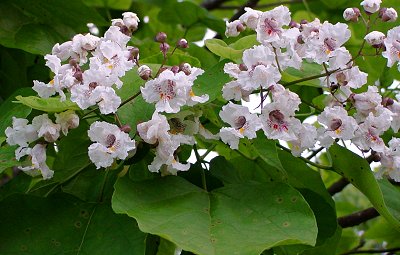
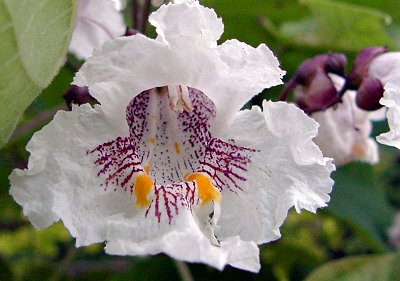
I say Cataba, you say Catalpa


Sometimes things are just different here in the south.

It wasn't until I was 18 and had a roommate from New Jersey, that I realized that only southerners use the term fixing to. At least in the sense that means "about to".

Similarly, our Cataba (cuh tah buh) tree is a Catalpa tree to everyone else.


To be precise: the Southern Catalpa (Catalpa bignonioides).

The caterpillar of the Catalpa sphinx moth (Ceratomia catalpae) feeds on catalpa leaves, sometimes defoliating entire trees. But it's also "treated with mystical reverence and respect by southern anglers," since according to most grandfathers it's the bait of choice for catfish and bream.

Bream is of course pronounced "brim". Around here, anyway.

This site has it wrong though, I think, when it comes to the explanation of why we pronounce it Cataba or Catawba.

In another display of regional pride and colloquialism, many fishermen in North and South Carolina use the names "Catawba worm" and "Catawba tree"-- misnomers that arose because the Catawba River flows through both states.
It's not just Carolinans. My grandfather in Georgia said Cataba, and Alabamians do too. Maybe Carolinians add more of a "w" sound though, I'm not sure.

There is also a Northern catalpa (Catalpa speciosa), which is very similar, apparently to the point that some botanists think the two species should be lumped together.

Another somewhat similar species is the non-native Royal Palownia (Palownia tomentosa) (a.k.a. Empress tree or Princess tree), which has purple blooms.

Oh, and one more thing. To many southerners, there is scarcely a thing more irritating on earth than a fake southern accent. If any actors read this, I beg you - I implore you! - to never try imitating a southern accent. Please. I almost had to walk out of the theater during the previews of Cold Mountain. Unless you're Holly Hunter or Beth Grant, I don't want to hear it.

Friday, February 11, 2011

Allen County Public Library Grand Opening

This afternoon I attended the ceremonies for the grand opening of the Allen County Public Library in Fort Wayne. It's impressive, to say the least. I spoke very briefly with Curt Witcher, the director of the Genealogy Center, and of course he was quite excited. He said there were a few minor things that still needed to be completed but they were about 99% ready for the opening. Below are some pictures I took this afternoon.

Some lucky folks got a sneak peak at the library last Sunday. You can read about that in an
article in the Fort Wayne News-Sentinel; they also have some pictures.


Opening Ceremony The opening ceremony. A few people were on hand.
ScannersThese scanners allow you to create a digital image of the microfilm, two of them can also scan microfiche. The image can be edited on site. If you load the film wrong and the image is backwards you don't have to reload, the scanner can be set to reverse the image. It can also rotate the image and switch it from a positive to a negative or vice versa. Way cool. Even more cool, you can print the images or write the images to a CD or save them to your thumbdrive (or any USB drive). The email feature is not yet working. I could see using that if you only had a few images. I forgot to ask if they sell the CDs. At this time there is no cost for scanning or printing but, according to the staff member that was giving the demonstration, that may change in the future.


Patron AreaThis was taken shortly after the opening ceremony. It is the largest of the patron work areas. It is in the same room with all of the family history books, a small portion of which can be seen on the far wall. The chairs are very comfortable. Two copy machines are available in this room.


ShelvesThis is a huge space. It is where all of the City Directories and oversized books are located. The shelving units move with the push of a button. If someone is in the row the unit won't move. Of course everyone had to see if they worked properly. There are three aisles of shelving units. Each unit is quite wide, probably 20 feet or so.


ComputersOne of the computer areas. This was about 15 minutes after the opening.


East EntranceThe east entrance from the south side. A city street used to be where the stairs and the ramp are now. The entire area in front of the library has been turned into a plaza. The entrance and the side to the left of it are new. That's where the cafe and bookstore are located. The inside of the building was completely gutted and remodeled. If you've been there before you won't recognize it as the same building, nothing is where it was.


East EntranceThe east entrance from the north side.

Aaargh. I got a little frustrated adding these pictures. They kept disappearing on me! Aside from that, it was a GREAT day!!

Entering Oregon


Wednesday, February 9, 2011

A Moveable View

Sunset Down the Road
Staying by the sea, I notice how unaccustomed I've become to a stationary view of any kind. Back in the city, the windows of my apartment offer vistas of a brick wall, a narrow alley, a tangle of branches and telephone wires. And I usually keep the blinds closed when I work anyhow; there is too much commotion outside.


But now I sit on this porch, just yards from the water's edge. A vast harbor is stretched out in front of me. The surface ripples of the cerulean water are like a silk scarf fluttering in the wind. Lobster buoys bob up and down. Now and then a fishing boat goes by. A family of swans travels back and forth along the shore in perfect peloton formation.


It is peaceful and almost improbably beautiful. And as I try to work, I find that it drives me nuts - the unchangeability of it. I am not used to looking at scenery so... passively. My eyes focus on the right outeredge of the harbor, where the rocky shore curves and disappears from view. As I study it, the curve begins to look hard-etched and forbidding, willfully preventing me from seeing beyond the bend.


In fact, I know - roughly at least - what lies around the bend; I have been there many times. A hilly back road winds along the shore's edge sleepily. There is a small patch of dense woods along the cliffs, then a gravel garden path, a wild rocky beach, an abandoned coast guard's tower... Soon I am visualising each of these landmarks in great detail, picturing them as they look when I cycle past them. I laugh at myself, realising that I am enjoying this mental game more than looking at the view in front of me.


I close my laptop, get on my bike and take off just as the sun begins to set, heading for the hilly back road that will take me around the bend. No one else is here. The road narrows and steepens dramatically and I get into my lowest gear. With each pedal stroke I see more and more of the landscape that was hidden from view as I sat on the porch just minutes earlier, and this fills me with an absurd sense of fulfillment. I reach the top easily, unhurriedly, and there sits the patch of woods with its narrow mossy path to the edge of the cliff. I keep going, coasting down the steep hill now at what feels like flying speed, passing all the landmarks I'd recalled. The mysterious garden path, the wild beach. And I remember now also the old sprawling house with a beautiful garden and the "bunnies for sale" sign taped to the green fence. After the coastguard's house I stop and turn around, my urge to experience a movable view satisfied. It seems silly now to have taken this short ride for no reason at all, but I am pleased.


I roll up to the porch as the last of daylight disappears. The vast harbor is still there, its fluttering silk surface now a deep indigo. A green light flickers in the distance. A stray boat is being rowed ashore. The swan peloton is making its last round. I get my coffee cup and turn on the porch light, ready to settle down in the stillness. But I know the moveable view will call out to me again tomorrow, even though I know what's around the bend.

Tuesday, February 8, 2011

Joslin Rendezvous :: The Homestead

If you had been a young man eager to begin a new life back in the early 1900s and you saw something like this photo below, would you have invested several years of your life trying to make a go of it?


South of Murdo in Mellette County, South Dakota

Twenty-five year old Virgil Newton Joslin did just that in 1916. Tired of working for other men he was determined to have a place of his own. He took up homesteading in west-central Mellette County, South Dakota, almost on the eastern edge of The Badlands. His first abode on the homestead was a dugout in the side of a hill. About the same time or shortly thereafter, his parents Luther and Phoebe (Elliott) Joslin joined him on the homestead. Two years later Virgil married Mary Matilda Hutcheson and he built what he called a “tar paper shack.” It was 12x16 feet, constructed of boards and covered in tar paper that was normally used for covering a roof before the shingles are put down.


Soon a son, Irwin, was born. In 1922, the tar paper shack was replaced by the beginnings of a “real” house - a concrete basement. A few years later a daughter was added to the family and then two more sons – Ruth, Jim, and George were all born in the nearest "large" town, White River.


A barn was built. A dam was constructed across a stream and a pond was dug. Virgil and Mary worked hard on their homestead. His parents helped as much as they could. Virgil still had to work for other men to help feed his growing family.


The dream house was never built. The family was caught up in the wrath of Mother Nature. It started with a prolonged drought. Irwin tells about the conditions in the early 1930s in his memoirs:

“For two or three years there was not enough rainfall to produce crops. Then the wind, which always blows in South Dakota, began picking up the dirt from the dry fields and we had dust storms. They might not have been as bad as in the Oklahoma dust bowl, but I recall them lasting for 2-3 days and the fine dust was everywhere...It literally blew all the dirt out of the fields as deep as it had been plowed.”
“In addition to the drought, depression and dust storms we had plagues of insects. Beetles overran the place once and ate anything green that was growing. Another year it was grasshoppers – the big kind that fly. They were so thick that, at times, when they flew over they made a shade like a cloud. they ate everything – even the dried bark off fence posts that had been in the ground for years. They also ate pitch fork handles because of the salty taste of perspiration from our hands.”
“During these times my father did as everyone else did, and kept borrowing money from the local bank and giving livestock and farm implements as collateral. The taxes on the land couldn't be paid in these years either. Everyone hoped for a better year – next year. but it came too late for most of them – their resources ended. My father finally had to just turn it all over to the banker and let the land go back for unpaid taxes. Then we left the homestead.”
In 1928, Luther and Phoebe Joslin had moved to Missouri where a daughter lived. Virgil and his family remained on the homestead until sometime in 1934 when they moved to Martin, South Dakota. A Sheriff's sale held at the homestead in May 1936 raised $2219.31 all of which went to the state. Soon thereafter, Virgil and Mary and the four children moved to Turkey Ridge, Pulaski County, Missouri not far from where his sister and parents lived.


In October 1986, 50 years after the family left Mellette County, South Dakota the four children of Virgil Joslin “revisited” their homestead. Over the years they returned several more times. George and his wife Lorene made a visit there in September of last year and learned that Mellette County was going to have its Centennial Celebration this year. Descendants of the early homesteaders were invited to return. George and Jim began planning the trip and invited me to join them. I'd heard so much about “The Homestead” that I just had to see it for myself!


I was standing a ways south of where the basement house was located, looking to the north. George was trying to determine where the barn had been – he's standing a little right of the center of the photo.


Hardly a trace of the buildings remain – just a few pieces of concrete where the basement house was dug out. Fred is walking down into the hole where the basement was. It is partially filled with debris and junk. When they were here in 1991, they could still see the square walls of the basement, which have begun to cave in.


Looking to the west from the location of the house.


The pond that Virgil dug out. It lies to the north of the house, below the hill.


The view to the East.


And, looking toward the south.

I was quite surprised to see so much green grass, especially this late in the summer, but it has been an unusually wet summer in South Dakota this year, unlike some areas of the country that are experiencing a prolonged drought. It does look inviting. Coming from a land with an abundance of trees and lakes and streams, I enjoy visiting these “desolate looking” places but I would find it difficult to live here. The folks that do have my admiration even if I do think they are a bit crazy!


The Joslin Clan – standing - Richard (descendant of Luther's daughter Phoebe), Me (descendant of Luther's sister Malissa), Tim (son of George), Babs (daughter of Irwin), Joann (daughter of Ruth), Fred (husband of Sue), Sue (daughter of Ruth). Seated are George, Ruth and Jim (children of Virgil). Irwin passed away in 1990. Ten people came from six states: Alabama, Colorado, Indiana, Louisiana, Missouri and Virginia!


Photographs taken August 20th and 21st.


Update August 30, ..: Sue has additional photos of the visit to White River on her blog. Also, see her post The Homestead Tour.


Monday, February 7, 2011

Horse Books


Raising Rainbow let a comment about horse books and I haven't even mentioned them yet. I have lots of horse books from a Roy Rodgers book and a Lone Ranger book for small children to The Black Stallion series of which I was a member of the Black Stallion Club to dozens of other teenage horse books both fiction and non fiction. Now I have expanded my horse books since I got my real books with a lot of books about how to care, and train horses, plus some on horse breeds and a couple that are photo books on horses. Anything that concerned horses in any way has gone into my horse collection.

More Thoughts on Tandem Riding


I hoped that I'd get over my tandem fever by now, but instead I have only grown more curious. So when local tandemnist Matt O'Keefe offered to take me on an early morning ride, I was there with bells on.Matt and his wife Susi have been riding tandem for years. They have one for the city and one for sport, both of which Matt -production managerat Seven Cycles,and welder at Merlin prior to that -built himself.


A former mountain bike racer, Matt's attitude to cycling is "the less pavement, the better." When we set off, he suggested we do an unpaved loop instead of going on the road. I had no objections.


I was actually very interested in the logistics of how a tandem would work where we were going. The thing about dirt roads in the Boston suburbs, is that they are more like trails: For the most part not technical, but quite narrow - at times claustrophobically so, with a path through the woodsjust wide enough to fit a single bike. They can also be twisty.I was curious how a tandem could be wrangled around corners through some of the trickier spots.


But neither the tight turns along the narrow parts of the path nor the sharply zig-zagging boardwalks across bogs were a problem: Matt steered the long machine with precision through gravel, dirt, mud and sand, over ruts and ditches, and around tight corners. Tandems really can go anywhere! The experience from the stoker's seat was fantastic. All I had to do was pedal, and the huge bike did all this cool stuff under Matt's captaining.


In this vein, I keep mulling over the idea that tandems are a great way to expose cyclists to styles of riding they are not yet comfortable with on their own. They could be a tool not only for couples and friends of disparate abilities, but also for cycling clubs and various organised events. For instance, I can imagine a club event where experienced tandem captains offer stoker spots for tours through gorgeous but tricky terrain. Or a tandem race, with stoker positions open to cyclists who would not race on their own. Just a thought, but it could be great fun... Then again, it could turn out like this. Either way, I am in!

The Copper Falls Trail

Monday, August 8th - - For some reason, I was quite ambitious today and went on a second hike. This was a 1.7 mile loop through the forest, along the river, with a few stair-steps involved as well as some other downhill/uphill sections where there were some handrails to help provide support. I'm not ashamed to admit that I made ample use of the handrails!


The trail would also cross two rivers in three places on very sturdy foot bridges and we'd see several waterfalls along the way. The pictures I took really do not do it justice. To fully appreciate the area you have to be there – feel the spray from the water and hear the roar of the river as it drops over the ledges and through the narrow passageways that it has carved out over many years. This was one hike that was definitely worth the effort!


A small portion of Copper Falls, which drops about 12 feet, on the Mad River. Like the Tahquamenon Falls, the copper color comes from tannin in the water.


A slightly better angle, but still showing only a small part of the falls.


This view shows it a little better – how the river has carved two paths around and through the stone walls of the canyon - but I think the only way you could get a really good shot of this falls would be by being suspended over the river in front of the falls, with a wide angle lens on the camera!


Flowing in a northeasterly direction, the Mad River essentially “runs into” a stone wall, making an abrupt left turn to the west. Coming in from the east is Tyler Forks. Visualize a rather crooked “T” with Mad River being the long upright part as well as the left hand part. Tyler Forks would be the right hand side of the “T” with a bit of a zig and zag just before and after it meets up with the Mad River.


Brownstone Falls is created when Tyler Forks plunges down 30 feet to join the Mad River. The name Brownstone comes from the color of the rocks surrounding it. They were formed eons ago from lava flows that contained small quantities of iron. Tyler Forks curves off to the right, eastward, above Brownstone Falls.


This picture provides no perspective whatsoever! But, there is the Mad River coming in at the top of the picture. The “whitewater” at the bottom of the image is actually Brownstone Falls dropping over the edge of a 30 foot cliff, plunging down and meeting up with the Mad River. Together they continue their journey as Mad River, veering off to the right (where the white foam is in the center of the photo). The sound was incredible. Not nearly as loud as Niagara Falls by any means or even Upper Tahquamenon Falls, but the sound reverberated around the canyon.


Okay, maybe this is a little better. But it still appears as though the water is flowing in from the right and the bottom and going out the top. You'll have to trust me, it isn't.


Adding to the sound of falling water was Tyler Cascades, which is a set of four smaller waterfalls just above and to the east of Brownstone Falls. Simply Gorgeous!


The trail followed Tyler Forks to the east a little ways then crossed at a point just above the cascades. By then the roar of Brownstone Falls was muted and the sound of the water tumbling over the rocks was quite soothing.


Oh, yes! This was one hike that was definitely worth the effort! And I savored every minute of it...


Sunday, February 6, 2011

Nene Way 2 Nether Heyford - Sixfields and return.

With Marta. 22 July . 11.2 miles. Walking time 3 hrs 30, a total of almost 5 hrs including breaks. Weather, fine, warm, some sun.


'Organisational difficulties' meant that we had to do this walk as a there-and-back. Fortunately we worked this out after 5 and a half miles, and the walk was roughly the samedistanceas we had planned.


At Nether Heyford

The pub at the start of the walk served us coffee although they were not officially open until 12 noon. Much appreciated. We turned left from the pub car park, along Middle Street, turned right at T-junction, then right into Watery Lane, where we met the first waymarker.


The first waymarker - were the bags too heavy before we'd even started the walk?


From Watery Lane we took a signposted track between two houses. The path turns slightly left and crosses a stream (not the Nene) and several fields. There are stiles. On the left a mile or so away is Glassthorpe Hill, and according to Mia Butler, there was once a Roman villa in the valley.


We meet the mighty Nene itself as we approach the bulk of Heygate's Flour Mill (marked on the OS map as Bugbrooke Mill. Weirs remain from the original watermill. The water is very clear - we saw small fish and a froglet, as well as damselflies. There's also a walled fruit and veg garden full of rows of beans, and with a fig tree growing against the wall.


Just here was the only place we made a small unintentional detour. After crossing the service road, we followed the clearly signposted path, but didn't notice the gap in the hedge a couple of hundred yards further on - no signs here. We realised what we'd done when we came to an impassable ditch and barbed wire at the end of the field. We even walked all the way back and missed the turning. Careful consulting of the map - and, yes, there had to be some way through the hedge - it's just after the end of the taller bushes, to skirt the industrial building.


The path leads diagonally through a field storing what look like abandoned food storage containers - grain silos? - round and very big.


Through the gate and across a wheat field towards the M1 and through a tunnel underneath.


Under the M1


This was the quietest place within a hundred yards or so, and was clearly the place where old farm machinery comes to die.


Across a meadow where cows were doing their best to eat the maize in the next field, then through the maize jungle, closely planted, neat rows, computerised sowing, taller than we are, past an area where children were playing by the river and a cat was observing from its vantage point.


Totem cat


.


The fourteenth century church at Kislingbury

Kislingbury has three pubs, a general store and a butcher's shop, as well as the church.


I like the colours here, though I should have got the writing and flowers in focus too. Need to study 'depth of field'.


The path to the footbridge is part of the flood defences, and a large metal gate can be closed off to protect the village against another two for three foot rise in the water level.


After Kislingbury we turned right from the road, and walked through several fields, quite a distance from the Nene, which was on our right. We could see a raised dyke area, and the path was clearly marked. We walked past a long wall, which has fallen down in places, although there is a door in one of the remaining sections. We arrived at Upton Hall Farm with horses and vociferous geese, then came to the new development of Upton Sustainable Urban Extension. It still looks rather new, but when the trees have grown and the water/ drainage areas have settled in it promises to be an attractive area.


Part of Upton Sustainable Housing Development


The signs for the Nene Way were a little sparse through the new houses, but we found our way through to where the path crosses the dual carriageway of the old A45 at traffic lights

and were ready to take the Duston Mill Lane when we decided we had to turn back.


Geese getting ornery


Wildlife - kestrels and a couple of herons.

For details click here

Saturday, February 5, 2011

No climbing today. Wedding only.

The wedding of Craig and Lotus.

This post is more for my own memory than anything else. Aknowledgements will be imcomplete. But thank you to all the special people who cast this spell.

Sandra and I talked the next morning about how we had all worked on so many details for so many months to make a majic moment. The majic doesn't last forever, but it leaves something special behind.

How to cast a spell: Prepare the space.


Aunty Lorelle showers the ground with rose petals.


Fill the air with the sacred ritual music of the Gamelan.


Bring together the beautiful bride and the nervous, terrifiedbut happy groom.


Perform the ceremony


Bring together fabulous guests from around the world.


Easy!


Now Jools from Panic Hair Bazaar performs her special girls majic.


I was quite busy for the day but I did get to take a few photos. You know, can't trust the professionals and all that.


Mother and Daughter


Lotus and her Grandmother, Molly phoenix.


I can't take my eyes of this girl!


Kirsten and Willow


The very fabulous wine from Mike Olsen of Cypress post.


The banquet team.


127 guests, plus the Gamelan and the band, Astrid and the Asteroids.


The kids have thier own party.


It's a bake off. Sandra made cheesecake, Martha made tarts.


Can you believe this cake?


Willow, the Maid of Honor.


Dear friends.


I was there too.


The ruck.


The lovely guests.


The perfect spell.