Tuesday, November 30, 2010

Traveling from Dublin to the Antrim Coast, with Luggage and a Brompton

Dublin-Belfast Luggage

I am staying in a remote area on the Antrim Coast in Northern Ireland, near the town of Ballycastle. Getting here from the suburbs of Dublin was quite something, though very much worth it in the end. I had with me three pieces of luggage: A suitcase on wheels, my fully folded Brompton bicycle sheathed in a cloth cover, and a Carradice City Folder bag that can also be carried as a shoulder bag. I am an average sized female with below-average upper body strength, and lugging these 3 things around on my own through the various segments of the trip was doable. I rolled the suitcase in my left hand, carried the Carradice across my chest messenger style, and carried the Brompton by the frame in my right hand. This last part was the most difficult for me. The Brompton weighs over 20lb and I can only carry it in one hand for so long, especially if I am also dragging other things at the same time. But again, doable.


As is probably obvious by the rolling suitcase, this is not the sort of trip where I planned to ride to the train station and to my destination upon arrival. I am not touring, but rather traveling with a bike, which I intend to use once I settle in. I will be here for a while, staying in the same place the entire time, and so I wanted to be comfortable, have plenty of clothes to change into, and have all the camera equipment I wanted with me. I thoroughly researched the transportation situation in advance and determined that for the last leg of my trip, a bus could drop me off within walking distance of the place I am staying despite its remoteness. There is also a local commuter train (DART) that stops just down the road of where I stayed in Dun Laoghaire and goes directly to the train station in Dublin. I was a little nervous of course that things don't always work out in reality as they should, but I had an emergency taxi fund just in case.


Enterprise

The main leg of the trip was taking the train from Dublin to Belfast. These leave from Connelly Station in Dublin and they run roughly every hour on weekdays. I knew that it was supposed to be hassle-free to travel to Northern Ireland. But I didn't expect that it would be quite this nonchalant. There was nothing about the ticket purchasing or boarding experience to indicate that we would be crossing a border. I simply bought a ticket to Belfast. No one asked me to show ID. No one asked why I was traveling there.


The train station itself was a remarkably calm place compared to other train stations I have been to in large cities. No pushing, no yelling, quiet, everyone incredibly courteous. A few people tried to help me with my luggage at various stages. I wasn't struggling with it, so I think the motivation might have been a sense of fairness - that they had none and I had three pieces, so they might as well carry some of mine to even it out.


Luggage on Train 1

On the platform I saw a man with a folding bike and a couple of large bags. He must have been watching me also, because when the train arrived he pointed to an entrance indicating that I should use that one. I did, and it contained a nice empty luggage compartment. I easily fit both my suitcase and my bike on the middle shelf. I then sat nearby with the Carradice bag on the floor next to me.


Once the passengers settled in and the controller checked everyone's tickets, a trolley cart was brought by selling food. I bought a hot tea, and the server asked whether it was okay to give me change in pounds sterling, since he was out of change in euros. This was the first indication that anything would be different at our destination.


Dublin - Belfast Train

The train from Dublin to Belfast proceeds mostly along the coast, and the views are beautiful. The sun even came out. I relaxed and felt pleased at how well everything was going.


An hour and a half later, the train broke down. We waited inside for 15 minutes as they tried to fix it, but were finally asked to disembark. It was then announced that we would be switching to a local service commuter train for the remainder of the journey, and that this train was waiting for us on a platform a short walk away, accessible by multiple staircases. An elderly lady beside me poked me with her elbow, winked, and said "Welcome to Northern Ireland."


I braced myself for the ordeal of multiple staircase climbs with a suitcase and a Brompton, but thankfully there were lifts, so it wasn't that bad. However, the commuter train was crowded with locals and did not have luggage compartments. I stacked my things in a corner near one of the exists, found a seat from which I could keep an eye on it, and hoped for the best.


At length we arrived in Belfast. I expected a busy station and a rush to get off the train, but there was neither. No one shoved me or even expressed annoyance at my things being piled in front of an exit. My suitcase was promptly placed on the platform for me by a huge hand whose owner I didn't even have a chance to glimpse, and I quickly grabbed the bike, worried that who-ever tried to help with it would try to pick it up by the (bottomless) bag.


Connoly Station, Dublin

The Belfast Central Rail Station is very small. There is a ticket stand, two tiny coffee shops, and two bank machines: one dispensing pounds sterling, the other dispensing euros. The one dispensing pounds was out of order. As luck would have it, I hadn't brought any cash in GBP, figuring I'd easily withdraw it here. So I bought a coffee, paid with a 20 euro note, and got the change back in pounds. A few others had the same idea and the coffee shop became the currency exchange booth.


Speaking as a visitor, it felt a little disorienting that there was nothing acknowledging a border between the Republic of Ireland and Northern Ireland, and yet there was suddenly a different currency system.A local radio station was playing, and in between songs the announcer said something like "the weather across the United Kingdom is beautiful today" and that too felt odd, since at no point had there been signs or announcements mentioning the United Kingdom.It's hard to explain, but the dichotomy feels confusing.


Luggage on Train 2


At the Belfast Central Rail Station, I bought a ticket for the local train to a place called Ballymena, which was the closest train station to my destination. These trains also ran very frequently, which impressed me given how sparsely populated County Antrim is. At the end of each train car, there was a section dedicated to bikes and baby strollers, with liftable seats. I easily stored my luggage there. The train route from Belfast to Ballymena is mostly inland, and there I saw saw some light industry and some farms. The landscape in this area looked a little stark compared to the Eastern coastline.


Up until this point it had been sunny, but as soon as the train stopped at Ballymena and I disembarked, it began pouring. Thankfully the Ulster Bus terminal was just across the road and it was covered. I carried my luggage there and found the Ballycastle bus stop. According to the schedule posted, the next bus was due to arrive in just 5 minutes. I was alone in the terminal except for a man in his 60s, who was pacing back and forth nearby. So far in Ireland, I have found it impossible to occupy the same space as someone else without ending up having a chat with them, and this was no exception. Within minutes I learned that the gentleman was a retired policeman who lived in the area and enjoyed a free bus pass on account of being a pensioner. Glancing at his watch, he gleefully announced that my bus was already late and that I was lucky if it showed up in the next half hour despite was the schedule said. "He's probably stopped for a sandwich, or having a chat with his mate," the man speculated cheerfully. However, the bus pulled up only a few minutes behind schedule.


Incredibly, it looked like I was to be the only passenger and the driver suggested that I simply toss my luggage onto the front row of seats. That is what I did, then sat down next to it.


We traveled 27 miles from the inland town of Ballymena to the coastal town of Ballycastle, as the weather alternated between glorious sunshine and dark skies with pelting rain. We passed mostly farmlands with lots and lots of baby lambs. Occasionally there was a village center, then back to lambs. They were beautiful and fluffy and I began to get sleepy counting them.


As we approached the coast, the driver asked me where I wanted him to stop. This sort of stunned me, but he assured me that he had nothing better to do and might as well take me to my door so that I didn't have to walk. As a dramatic view of the sea opened up in front of us, I told him the address and that is where he dropped me off.


And so finally there I was, with my suitcase, my Carradice bag and my Brompton, ringing the door bell of my new residence. At this point I was utterly exhausted. But all things considered I think the trip went well. I left Dublin at 7:40am and arrived at Ballycastle just past 12:30 in the afternoon. I managed fine with my luggage, and now here I am settled in and with my own bike on the Antrim Coast.


The transportation system in Northern Ireland is impressive as far as density of coverage and the frequency with which the local buses and trains run; I had not expected anything nearly this good. For anyone interested in traveling through County Antrim, you can definitely do so without the hassle of renting a car. Prices for buses and trains are reasonable, and the stops take you not only to local village centers but also to remote scenic locations along the coast such as the Giant's Causeway.Traveling with a folding bike should not be a problem, especially if it's one that folds up as small as the Brompton. For anybody considering visiting the Antrim Coast in this manner, I highly recommend it.

Monday, November 29, 2010

The Life of Hazlette Brubaker :: Introduction

What will follow in this series of posts is the story of my Grandmother, Hazlette Aileen Brubaker Phend Dunn Ferguson, written in her own words. Words that were sometimes scribbled in pencil, scattered throughout several wire-bound notebooks and on loose pieces of paper. Since the stories were not written in any particular order they are arranged here in what seemed, to me at least, to be a logical sequence.

I have taken the liberty of adding hyperlinks to the blog posts that have been written about some of the people she mentions. For clarification, in a few instances, additional information has been added at the bottom of the posts as noted by numbers within square [ ] brackets. And, of course, I'm adding family photographs, some which have been used in previous posts.

Grandma was born 109 years ago (January 16, 1902). She grew up mostly in Troy Township, Whitley County, Indiana although she was born in Lorain, Ohio and lived for a time in Traverse City, Michigan. Her roots were in Whitley County. Twenty-six of her ancestors lived in Whitley County with several arriving as early as 1838. They came from Ohio: Champaign, Delaware, Holmes, Perry, Muskingum and Wayne counties. And before that from Connecticut, Massachusetts, Pennsylvania, and Vermont.

I remember sitting with her, going through her genealogy book, of which she was extremely protective and proud, and which held her pedigree charts, family group sheets and some photographs. But, like many researchers, my interest came along too late. It was not until after her death in 1984 that I became enthralled with the family history. By then it was too late to ask the questions that needed to be asked, questions that could have only been answered by her.

Although the information on her family group sheets was not documented in any way, it was invaluable to me in my early research. Basically all I had to do was locate the documents to “prove” her research, and almost all of her data has been found to be accurate. Grandma had a nearly-full five-generation pedigree chart - missing only one set of great-great-grandparents. She also had several lines back another generation or more. In a few cases I have been able to extend the ancestral lines back a little further, but most are still quite elusive.

Pedigree Chart #1 - Five Generations (almost)Nancy Neal's parents are James and Rebecca (Franks) Neel. The parents of Benjamin Foster are William and Magdalena (Daniel) Foster. The maiden name of Margaret Foster was Meyers, and I've found her parents, John and Margaret. I think that the parents of Jacob Wise are Peter & Christina, but haven't found definitive proof yet.

Pedigree Chart #2 - Joslin/GoodrichBoth the Joslin and Goodrich lines have been extended back to the immigrant New England ancestors. However, the parents of Sally Church are not Ebenezer and Eunice Garnesy Church. And the parents of Abigail Price still elude me.

Pedigree Chart #3 – Stemm/CiceleyThe lineage of Indiana Sisley has been extended several generations, but the parents of Conrad Stemm are still unknown.

Pedigree Chart #4 – Jones/HelmsThe parents of Conrad Helms have been found, and his wife's maiden name is Swigart but I've not gotten any further with her line. And the Jones line? You would not believe how many William Joneses there are in Muskingum County, Ohio in the 1840s!

Pedigree Chart #5 – RobisonI now know where Henry and Ann Robison came from and when he died, but nothing more.

Pedigree Chart #6 – Brubaker/SteinwegJacob Brubaker's parents and grandfather have been found, thanks to another cousin. And turns out that the Steinweg surname is really Stoneroad. But nothing more is known of them.

You would think that with the “head start” that Grandma gave me, I would have gotten further back on the pedigree in the last 25 years! But some of those ancestors don't seem to want to be found just yet...

A few years ago I became the custodian of most of Grandma's papers and some of her photographs. I think her story is interesting and I was always amazed that she did double-entry bookkeeping and ran her own restaurant with no more than a sixth grade education and the simple desire to do something.

On August 4, 1976 she wrote: “Well, I did get a little writing done. I do hope some one of you kids enjoy it. Maybe one of the grandchildren or great grandchildren will really get some good out of it.”

I'm not sure she would be pleased to have her story published on the world wide web for any and all to see, but I am sure she would be happy to know that at least one of her grandchildren has “gotten some good out of it” and has taken up where she left off in the search for her family's history.

I hope you enjoy Grandma's story. And, if you are connected to any of the families she mentions, I hope that you will contact me!

The Life of Hazlette Brubaker
  • Part 1 ~ The beginning :: A Brief Family History
  • Part 2 ~ The beginning :: A Brief Family History, continued
  • Part 3 ~ Papa and Mama
  • Part 4 ~ Papa, Mama and the Children
  • Part 5 ~ Move to Traverse City, Michigan
  • Part 6 ~ Life at Traverse City
  • Part 7 ~ Return to Goose Lake Farm
  • Part 8 ~ The Goose Lake Farm
  • Part 9 ~ The Goose Lake Farm, continued
  • Part 10 ~ Childhood on the Farm
  • Part 11 ~ Farming Life in the Early 20th Century
  • Part 12 ~ Growing Up, the Teenage Years
  • Part 13 ~ Adult Life
  • Part 14 ~ Adult Life, conclusion


Sunday, November 28, 2010

Waves in the sky


This is one of the first photos I made the other night as the waves of aurora began to wash over the skies of northeast Minnesota. The aurora forecast and cloud forecast were good so I left home just before 11:30 PM and arrived at McFarland Lake just after midnight. I've been wanting to catch a good aurora show at McFarland for some time now. After several attempts over the last year I finally got what I was hoping for. This lake has a public swimming beach on the south shore and the beach looks almost due north, perfect for viewing the northern lights! The lake also has very distinctive bluffs lining its shores which makes for a very photogenic horizon. The aurora was already active when I left home, but the lights were faint at first. I was hoping to get to McFarland just after midnight as the lights often flare up in their intensity around that time. Sure enough, as I was driving up the Arrowhead Trail and midnight drew near, the lights started to pick up in their intensity. When I arrived at the lake there was a full-blown aurora storm waving and dancing throughout the sky. I scrambled to get my gear set up and as quickly as I could started making images. For the next 45 minutes I stood in awe as the sky erupted with waves of light and color over and over again. In this picture you can see a line of aurora that "points" to the left. This line resembled the wall cloud of a quickly advancing thunderstorm and much like a thunderstorm, the line quickly moved from right to left across the sky then faded away. And this was just the beginning of what would end up being an awesome geomagnetic storm that would carry on through the rest of the night and well into the morning.

Friday, November 26, 2010

Phend-Fisher Family Reunion Ledger (1927)

The Phend - Fisher family reunion was held at McNaughton Park Aug 26-1927.

The time before dinner was spent socially. At 12:30 all gathered around the table and prayer was offered by Rev. Oberholser after which every one got busy eating and talking.

After dinner the President called us to order for a short business session. The Sec'y report was read after which we were favored with two solo's by Mary Poole. Duet by Rev. and Mrs. Oberholser and a reading by Rev. Oberholser.

The officers elected for the ensuing year were.
President, Claud Poole
Vice Pres. Will Phend
Sec'y. Raymond Phend
Treas. John Ernest.

Programe Com.
Iva Wherley & Katherine Pletcher.
Memorial Com.
Surelda Thornton

[page 2]
Publicity & Family Tree
Fred Ernest.

Com. On Arrangement.
Grace Vassmere, Goldie Lynch.

There were 91 present.
Ed Phend
Sec'y.

P.S. It was voted to hold the next annual reunion at McNaughton Park, Elkhart, Ind. on the last Sunday in August.

Researching Mount Rainier's Glaciers

Everyday, climbers inquire about thinly covered crevasses, glacier conditions, or that “bergschrund” on top of the Emmons. And we’re here to share what we know about the Emmons, Kautz, Tahoma and other major glaciers on Mount Rainier. But we also wanted to let you know that the NPS is actively monitoring these glaciers in an effort to better understand how the climate is affecting them and how these glaciers are affecting the mountain and the surrounding areas. This is important stuff when you consider that Mount Rainier’s glaciers are a primary water source for many Washingtonians, while at the same time a potential geological threat to communities in the floodplains downstream.

Basic Science Recap:
Glaciers are permanent sheets of flowing ice that erode mountain slopes, carve valleys, and affect the geography of the park. Rainier’s glaciers have an “accumulation zone” (where more snow gathers than melts) and an “ablation zone” (where more snow melts than accumulates). The most recent detailed measurements (1913 to 1994) on Mount Rainier indicate that the combined glacial area has receded by a 1/5th, and that the total volume of glacier mass has decreased by 25%.

The Nisqually and Emmons are part of a long-term monitoring program making them the most scientifically prodded glaciers in the park. The current study is a cooperative venture between Mount Rainier and North Cascades National Parks and includes field measurements of snow depth, snow density, and snow/ice melt. It includes an annual series of terrestrial, aerial and satellite images. To better understand what's going on, researchers place “ablation sticks” (PVC poles) at various elevations and locations on the Emmons, Ingraham and Nisqually Glaciers. In the spring, researchers us a steam drill to sink these stakes into the winter snowpack until they reach the glacier ice. Then throughout the season, researchers measure the snow accumulation and more importantly, the rate of snow melt. This allows them to calculate the net balance of the overall snow and icepack. The graph below shows the results gathered since 2003. As you can see, the overall mass balance of the ice is decreasing.

So why are we sharing this geeky science information? Well, we like it, but also because climbers have been noting the PVC poles buried on the glacier and have asked, “What’s the plastic pipe all about?” Those PVC poles are the measuring sticks. If you keep your eyes peeled on your next summit attempt, you may note one or two of them on the Muir Snowfield, Nisqually, Emmons, or Ingraham Glaciers. If you do see them, please do not disturb or remove them.


For more information on the glacier monitoring being conducted by North Cascades National Park, check their website. And if you’re interested in the historical Mount Rainier glacier studies referenced above, check out the “Glacier and Glacier Changes” homepage on the Mount Rainier website.

Photo contributed and graph by North Cascades researcher Jeanne Wenger.

Monday, November 22, 2010

San Felipe de Neri Church


This is the huge, old Catholic church in Old Town Albuquerque. It is over 200 years old. I took this photo from across the street from the church, and you can see the steeple and gates leading to the area in front of the church. This church is still used and very popular for weddings and other celebrations. This church is known as the historic San Felipe de Neri Church.

Saturday, November 20, 2010

Easter!!


May you have Egg-zatly the kind of easter day you want. Make sure it is a good one.
Happy Easter one and all.

Friday, November 19, 2010

Beautiful day on Devilfish Lake


We are heading out kayaking again today! Right now the conditions are foggy on the Lake Superior shoreline but we are headed to an inland lake so maybe it won't be foggy up there. Of course, if it is foggy I won't complain because that could make for some interesting pictures! In the meantime, here is another shot from last week's paddle on Devilfish Lake. I loved this tree hanging over the water and couldn't resist paddling under it to photograph Jessica out in the lake with the tree in the foreground.

Wednesday, November 17, 2010

A Tree?

I think my 3 black cats thought I had gone nuts for putting up a tree in the house even if it was an artificial one. They helped me decorate it and then undecorated it.

Tuesday, November 16, 2010

Gunks Routes: MF (5.9)


(Photo: Approaching crux # 1 of MF (5.9) in the fog. Is there a climber up there?)


The weather gods have been joking around with me.


Thanksgiving weekend was stunning. We had record highs, in the sixties and seventies, and abundant sunshine. I had a full agenda of stuff going on. This was joyous, important, family stuff. Stuff that I wouldn't dream of missing, it goes without saying.


So there was no way I could go climbing over this beautiful weekend. But I had to take advantage of the warm-weather window somehow. It was killing me to let it just roll by; this could be our last good climbing weather until next Spring. Surely, I thought, there must be something I could do?


I decided to take a vacation day on Tuesday to go to the Gunks.


The only problem was that it was expected to rain. After reviewing the forecast, I decided to go for it anyway. It was going to be warm, and the rain wasn't supposed to come until the late afternoon. A pretty full day was possible, even likely, I told myself. And the weather report for the following days called for deteriorating conditions: more rain and then colder temperatures. My obsessed mind saw Tuesday as my final chance of the year.


Parker agreed to meet me. We'd climbed together once before, in early summer. Back then we were both leading similar climbs but since that time Parker had been climbing a lot, and it sounded like he'd been ripping it up. I was eager to see what he could do. I told him I wanted to climb MF, one of my big goals for . He wanted to do Amber Waves of Pain (5.10a), which I was really excited about climbing (as a second) as well.


When I got up on Tuesday morning it was pretty gloomy out. During the drive up from the city I grew concerned about how foggy it was. The air felt damp. I worried that the cliffs would be coated in a slick, wet mist. It was an unpleasant experience I'd had before.


Then at the Sloatsburg rest stop, as I stood there pumping gas, I detected rain. Not just wet fog, but actual rain.


I paused to search the sky. Were these really drops of rain, falling from the heavens to the earth?


Yes, it was definitely raining.


It grew heavier as I stood there.


This wasn't supposed to happen! Not until later.


I was furious. I started yelling into the air. "Stop it! Stop raining!"


I'm sure I resembled a crazy person.


I got back in my car and started driving faster than before. I'm not sure why-- was I trying to outrun the rain? I kept hoping it wouldn't be like this in New Paltz.


The rain stopped, thankfully, before I got to Exit 18. I couldn't tell whether the cliffs had seen any precipitation. Actually, I couldn't tell whether the cliffs were even there. They were invisible, hidden by dense fog. This was not a good sign.


As I drove to the stairmaster parking lot I saw that the roads were wet. Also not a good sign. If the roads were wet, the rock was likely wet too.


Upon his arrival at the empty parking lot, Parker remarked that we seemed to be the only idiots intent on climbing. But since we were already at the cliffs, we decided we might as well go see if the rock was, by some miracle, dry.


We went straight up to the Mac Wall to look at MF. Described by Dick Williams as "THE standard for 5.9 in the Gunks," MF has a reputation as a tough climb. (As you might have guessed, the letters in the name stand for "Mother F**ker.") The first pitch has two cruxes, the first coming at an awkward, scary move around a corner, and the second involving some thin moves over a bulge. Pitch two has just one crux: a big roof.


I've been working up to MF all year-- all my climbing life, really. I knew on Tuesday as I stood before the route that this could be my last chance to climb it before the end of the season. But I was scared to try it if the rock was damp. Hell, I was scared to try it, period. Even in perfect conditions. Maybe in this iffy weather it was beyond scary. Maybe it was a stupid idea.


But Parker touched the rock and said he thought we were okay. It seemed dry to him. "Feel it," he said. "There's plenty of friction!"


I wanted this climb. Badly. I put my hand on the rock, and it appeared Parker was right. Even though we were surrounded by mist, the rock felt fine. I decided to do the climb. I could always bail if it started really raining. It's only gear, I figured. Who cares if I leave a piece or two behind? Don't I have a catchphrase that covers this situation?


Yes I do: Carpe Diem, bitches.


I tied in and headed upward.


The early going on pitch one is tricky. There is a steep bit right off the ground, and you have to make a few moves before you get any pro in. Maybe this part of the climb just seemed hard to me because I was a bundle of nerves. The conditions were making me jittery. I stepped off the route, back to the ground, just after I started because the fog suddenly turned to rain. But then in a minute it turned back to fog again.


I went back at it, placing two pieces at the first opportunity.


After the initial moves the pitch jogs left, then back right to the big overhang. I moved slowly, checking each foothold, fearful I'd pop off. I placed a ton of pro. As I approached crux one, it seemed much more intimidating and difficult than it did from the ground. It is steep there. It is pumpy to hold on. You can see the horn thingy that you need to grab as well as the foothold that will bring you around the corner, but it seems kind of improbable that this move will work out well.


On the bright side, the pro is great. There's a pin just where you want it and another piece can be put there to back it up. The fall is clean. The holds are good. You can stand there for a good long while, shaking out each hand in turn as you reflect on the life you've lived, and the leap you're about to take.


I hemmed and hawed there a long time, but in the end I found no real trick to the move. You just have to commit. Grab the horn, get your right foot on that hold, and go. And then it's about balance. Shift slowly to the right foot and keep inching to the right. The holds are further around the corner than you want them to be, but they exist, trust me!


(Photo: Having placed pro, I'm getting ready to move through the bulging crux # 2 on pitch one of MF (5.9).)


I spent even longer hemming and hawing over the second crux. I didn't want to blow it. My flash of MF was within reach, yet still so far away. Luckily there's a good stance below the bulge from which you can think over the moves as much as you like. Again the pro is good. There is a horizontal right below the bulge (quite slimy on Tuesday, but it took a cam), and an irregular pod/handhold up in the bulge in which I managed to seat a solid green Alien. This last placement made me feel really good. I clipped the piece direct and knew if I fell I wouldn't go far.


When I finally went for it the moves were not bad. The holds were small but positive, and before I knew it I had the jugs.


As I hit the chains I was thrilled. It had been a slow lead, a methodical lead, but it had been a successful onsight lead of MF. I was no longer breaking into 5.9. I felt solid in the grade. I couldn't ask for anything more.


Parker started following me up pitch one. I heard him say something about a nut.


"Did I place a crummy nut?" I asked.


"No!" he replied. "I said YOU'RE nuts! I can't believe you did this pitch. The rock feels so slimy!"


So much for Mr. "Go For It, There's Plenty of Friction!"


I tried to remind Parker that his enthusiasm is what got me to climb the route in the first place, but he wasn't accepting the blame. For some reason, he was convinced that I was the crazy one.


I have to say it didn't feel so slimy to me. By the time the pitch was over I'd forgotten all about the weather. I thought the rock was okay, and I really wanted to continue and do pitch two. Parker said if we kept going I'd be leading. He'd led the pitch before and he had no ambition to lead any longer, given the conditions.


(Photo: Examining the roof on pitch two of MF (5.9).)


Pitch two begins with easy moves directly to the right from the bolted anchor, around a small corner. Then it's straight up to the roof. Just beneath the roof is a pin. After clipping the pin I spent a lot of time experimenting and feeling around, trying to find some holds, any holds, that I could use to get up to the obvious horizontal that was out of reach a few feet above the roof.


It's tricky because you can't really see what's just over the roof, and there are no footholds right under the pin. So you paw around over your head, finding nothing. Then you paw around to your left, finding nothing. Then you retreat to the stance to the right of the pin, shake out, and get ready to do it all over again.


I found some really poor crimps around the pin, and kept trying to contrive a way to use them to reach the horizontal over the roof. But it wasn't working out.


After a while I looked at Parker, who was standing just a few feet to my left. I said "I'm about to have you take so I can hang on this stupid pin."


"Dude, your feet are, like, on a ledge," he replied.


"Yeah, but I'm getting frustrated."


I was tired of going back and forth. I wanted to rest and look it over. But just in time I finally found the crucial hold. I'm not going to spoil the details. It makes reaching the horizontal a breeze! And it's hiding right there, in front of your face.


As soon as I had that hold, I stepped right up to the horizontal and clipped the second pin. Then I placed a cam to back it up, even though I was already feeling the pump clock ticking away. Above me I could see the creaky little flake mentioned by Dick in his guidebook. It was the next hold. The path was obvious. It was time to go. A couple quick, pumpy moves and I was through the crux, standing at the big horizontal that heads left. Pitch two was basically in the bag.


Although I really enjoyed the crux, I didn't think the rest of the pitch was nearly as nice. The difficulty level decreases greatly and there's some questionable rock. After traversing left, the pitch follows an obvious corner to the GT Ledge, but it seems numerous other paths can be taken to the finish. It all goes through similar, moderate territory.


(Photo: Parker coming up the final bits of pitch two of MF (5.9).)


Parker reached me on the GT Ledge just as a real storm started to roll in. We could see the rain falling over New Paltz as we set up to rappel and by the time we got to the ground it had reached the cliff. Our climbing day was over after just two pitches.


Ah, but what a pair of pitches.


I realize this particular trip to the Gunks was a waste of a vacation day. I know I've been clinging to summer, to the climbing season. It's been good and I don't want it to end. I probably should have gotten out of bed on Tuesday, looked out the window, and called it off. That would have been the sensible thing to do.


But then I would have missed MF.


And MF I will cherish. It's so nice to have my last climbs of the season confirm that I've made progress. Maybe I'll still be able to squeeze one more milestone into the year. And maybe not. It doesn't matter. It's been a great year either way.

Sunday, November 14, 2010

Tree & Houses


In this photo you can see the old juniper tree with a dirt road behind it and the houses in the housing development that is near it. It is such a shame to see this ancint piece of history being threatened by development. There is a dirt trail on this side of the tree where I found the tracks of motercycles and ATV's, and I saw lots of trash; mostly beer cans and bottles; in the area right around it, which I picked up. The tree is surviving but it doesn't look as healthy as it did 25 years ago when I first saw it. Every time I go by there I am afraid I will find that progress has destroyed this beautiful, and still living conifer.

Saturday, November 13, 2010

It's a School Night Matt.

The force is strong in this one.

Even before meeting him he had bugged the hell out of us all on qurank.com


"I turn my back for 5 minutes and these little Tinny (Mt. Tinbeerwah)kids are running around qurank and theCrag, posting like they're on red cordial and pixie sticks. Between posts from Sister Matt and Chester 2000, I'm finding it hard to catch some shut-eye.


We can blame JJ for encouraging them. "

Lee Cujes


It's true. I figuredthis precocioustweenager wasn't going to go away, so we had to take him in and show him the craft. Now he's my coach.


Within a few years Matt is working some of the hardest routes around. He is the onlyclimber to seriously take on the Lee Cujes test piece "Bite the Hand that Feeds" Coolum's hardest and as yet unrepeated.


Sensational flexibility gained from previous years of gymnastics have given Matt a crazy range of moves.His years of pianoaccordian training haven't shown anyusefulness yet though. Mercifully.


Here's an example of whatputs schoolboy Matt Schimkein the top handful of Queenslands sport climbers.A wirey strength and explosive energy.


Here's the kooky thing about Matt: He has a savant like memory for beta.He can tell you the sequence for any route that he has ever seen.Not just his beta but the exact sequence that each individual climber has used for each route.Spooky, I know.

I often say "Hey Matt how do I do this bit again?"


Thanks to Matt's Mum for all the yummy cookies.


Also at Shiloh


Seen soaring above Shiloh, a beautiful Broad-winged Hawk (Buteo platypterus).

-----
Submitted to the Friday Ark.

Tuesday, November 9, 2010

Joe Tasker and Dick Renshaw English Alpinists?

Much of the ideas you read here frommy own climbing came early on as I and my partners weretesting our own limits as young men. The climbs I aspired to then are still the climbs I aspire to do now.Ice and mixed climbs generally nothigher than 6000m. More typically less,at around4500m. That covers most of the alpine faces in Alaska, theCanadian Rockies and the Alps.


Some how I am not surprised that the same discussions ingear choiceswe had in the'70s are the same discussions we are having today. Frozen feet and frost bite in single boots have brought us the warmestdouble boots ever made. But may be not the best double boots ever made. High tech clothing, insulation and fabrics are exceptional now . But the designs and products you can buy off the shelf may not be the best designs for climbing. Designs intentionally must do multi tasking as ski, snowboarding and climbing clothing."Climbing designs" being the last in line generally as the smallest consumer group.

Long gone are the days when most serious climbers owned a sewing machine and actually knew how to use it!


Tasker and Renshaw did a number of first British and first British winter ascents in the Alps from the mid '70s on. Including a winter ascent of the Eiger in 1975. There were others that were just asimpressive at the time asthe Eiger. Both went on to succeed on bigger climbs. The climbs are the same.Our gear has gotten better. I would be hard pressed to say we as climbers have gotten better. Certainly our imaginations have grownas have our capabilities.


A lot has changed in alpine climbing over the last 35 years. Including the weather. It is generally warmer. But much of the basic challenge has stayed the same as well, which is why winter alpine climbingstill interests me..


This article is from the August/September 1975issue of MOUNTAIN LIFE.


Jonathon Griffith photo @ http://www.alpineexposures.com/


One Man's Gear

by Joe Tasker (1948-1982)


"Are you taking your long-johns?"


The author of the "Wall in Winter", an account of his seven-day epic on the Eigerwand with Dick Renshaw, featured in MOUNTAIN LIFE 20, will need no introduction to readers. Here Joe Tasker presents his own personal likes and dislikes in Alpine equipment.


Even after years of practice I still find that before an Alpine route the same questions about clothing and equipment get asked: 'Are you taking your "long-johns"?'


'No, I've got my overtrousers. They'll do just as well. How many jerseys have you got?'


'Just one spare.'


And so it goes on, the ceaseless evaluation of weight against eventuality; the number of krabs and pegs estimated in accordance with the difficulty of the climb and then whittled down to a manageable load. Each time it all needs rethinking and there is no guarantee that one has chosen the right combination and amount of clothing and equipment until one is back safely off the mountain. But some things can be seen to be more useful and better suited to Alpine climbing than items of clothing and equipment currently in use. One of the most awkward pieces of clothing that many people wear are those much praised thick, woollen breeches [I think Americans call them knickers]. They are meant to be warm even when wet, but in practice they tend to be too warm and uncomfortable when it is hot, and when it is cold the snow sticks to the wool, melts from the body warmth and freezes into an icy armour-plating, stiff to walk or move in and storing up moisture to melt later in the warmer surroundings of a hut or bivouac. Much more sensible - but much more expensive and not readily available - is a salopette. This is a chest-high trouser with sewn-in braces; for climbing the leg of the salopette ends low down on the calf and for skiing it is ankle-length. The design is excellent; the height of the 'waist' virtually eliminates the cold spots which can develop there from jersey and shirt getting separated from breeches. The length of the leg cuts out the cold spot below the knee where gaiters and breeches often part. On top of that the material dries readily if it does get damp and consequently does not freeze solid. The material is a stretch fabric, not completely waterproof but, more importantly, snow does not adhere to it. Skiers have been used to much more sensible material for dealing with snow for years but I wouldn't recommend rushing out and buying a climbing salopette derived from the ski salopette, even if you can find any on sale. They were retailing last year in Chamonix at £27 per pair!


As with so many articles of clothing the salopette can be readily made from materials obtainable in many big stores or by mail order. It only requires a bit of patience and a few hours with a sewing machine.


It is difficult, however, to compromise on footwear. Even for summer climbing in the Alps double boots seem to be the best thing. This may simply be a reflection of the sort of climbs that Dick Renshaw and myself have been doing over the last few years, but we have done some hard rock routes in 'doubles' too - such as the Walker Spur and the Bonatti/Gobbi route on the Eckpfeiler. At first it wasn't through choice that we climbed such routes in doubles but because they were the only boots we had. Although such routes were quite trying in doubles the boots came into their own on mixed climbs. We rarely experienced cold feet on stances and once survived a whole night on the Dent Blanche North Face standing up on a step cut in the ice, unable even to take our crampons off, never mind slacken our boots (as the books advise). Although we had to wiggle our toes to make sure they were still there we never had the slightest trace of frost-bite afterwards.

Except for the Galibier Hivernales, most double boots seem similar in their warmth-retaining properties and clumsiness; my own are Harlin Leroux, which don't seem to be made anymore. There isn't a lot one can say about krabs, nuts, slings and pegs, except that we British climbers seem to take far too many. Perhaps this is due to the habit of taking meticulous care to protect pitches on a British climb - a precaution which is out of place in the Alps, where protection is usually more straightforward and must be more rapidly arranged. Some of the 'super-strong' krabs on the market today seem to be too fat for ease of manipulation in awkwardly-placed pegs or where one wants to slip a piece of line or tape through the eye of the peg. I do not really think that there is any one set of equipment that is the answer; it depends on what you grow accustomed to. Of the various models of curved pick axes available Dick and I have been using Chouinard axes and hammers. At the time we got them there were few others available. In summer the combination of axe and hammer curved picking' seemed to work well, though Dick was justifiably apprehensive of his axe after the tip broke off on a winter climb in Scotland - an eventuality one dare not contemplate on a big ice route like the North Face of the Droites. When the ice is very hard, though, as it can be in winter, the Chouinard hammer is very unsatisfactory - the shaft being too short. This causes poor purchase in the ice due to the limited arc of swing and also damages the knuckles, even through Dachstein mitts. In very hard ice we were often making a Terrordactyl-type insertion movement, and that sort of axe/hammer might be more efficient on certain ground - but against that would have to be weighed its disadvantages on more general ground.


On the question of crampons I am undecided. I climbed a lot in a pair of Salewa adjustables which someone described as 'bent tin' and another lad, whose gear hadn't arrived in Chamonix, declined my offer to loan them to him until I said that they had taken me that year - amongst other climbs - up the North Face of the Eiger, Dent Blanche and Eckpfeiler. I didn't see them again for another six months and was consequently forced to buy another pair. I chose the Chouinards but didn't find myself on really difficult ground in them until a year later. Meanwhile Dick had used his on various hard climbs and was visibly startled one day on the camp-site when doing the ritual sharpening of the points to find fracture lines across both crampons; they subsequently came apart in his hands. A couple of weeks beforehand he had been on the North Face of the Col de Peuterey. They fractures must have occurred then.


It constantly surprises me to think of how much crampons do put up with and that the front points don't just buckle up.


As far as performance goes the 'bent tin' Salewa crampons seemed perfectly satisfactory, but I did feel that Dick had the advantage over me on the North Face of the Eckpfeiler, when we were climbing very steep ice for about 1500 feet and he was wearing the Chouinards. They do give very good support for front-pointing but after one or two unnerving moments on difficult mixed ground I've never really felt at home in Chouinard crampons where there is rock around. The more flexible crampon seems to mould itself to the contours of the rock and hold better.


The sharpening of crampon points is overdone in the Alps. When you think of how much rough ground you often cover before meeting the real difficulties of a climb it is quite clear that all the effort put into sharpening them - and quite a bit of steel - is lost. I felt the points of my crampons at the foot of the Eckpfeiler; they had been razor-sharp to start with but were more blunt than they had ever been - and that was just with the descent from the Trident bivouac hut, and Col Moore! I don't think the same holds true for axe and hammer.


The drive-in/screw-out ice screw is the most useful ice peg around. The oddly-shaped Salewa-type, however, tends to hold too well in very hard ice. It can take far too long to extract and precious time is wasted hacking it free from the ice or riskingmaking it unusable by warping or even snapping it while it is still tight. A much more manageable drive-in/screw-out is the Simond-type,which has a round, slightly tapering shaft with a fine thread. It seems to hold well and is extracted with a minimum of effort. However, in some ice the Salewa does hold better.


Finally a word about food. Sometimes our food seems to weigh a bit heavy but at least we know that what we have got is nourishing. Over several seasons we have evolved a bivouac menu that has nothing to do with dehydrated foods and soups - which seem to be the standby for many teams. Quite apart from any considerations as to whether there is actually any food value in the dehdrated stuff, it takes too much heating and cooking.


For soup we take bouillon cubes - a continental equivalent of Oxo - in various flavours. This is a meat extract, very tasty, and replaces a lot of the salt lost in the day's exertions. It only needs to be put into hot water and it's ready.Into that you can put polenta, a ground corn, easily obtainable abroad and far more nutritious than powdered potato (Hiebeler survived several days in winter living solely on heated-up polenta. You can also buy fairly cheaply big, fatty lumps of meat to cut up into the bouillon. This makes the 'soup' into a tasty concoction of real value.


These comments are not meant to be definitive but might suggest new possibilities and improvements. The End!


More here on Taker and Renshaw:


http://reference.findtarget.com/search/Joe%20Tasker/


http://en.wikipedia.org/wiki/Joe_Tasker


http://cc.bingj.com/cache.aspx?q=dick+renshaw&d=5037361146364964&mkt=en-US&setlang=en-US&w=54fd9b70,895d08b0


I'd like to thank IAN PARSONS for tracking down this article for me and making the effort to email it from England to the far side of the USA. The effort is much appreciated!

Adult Medulloblastoma


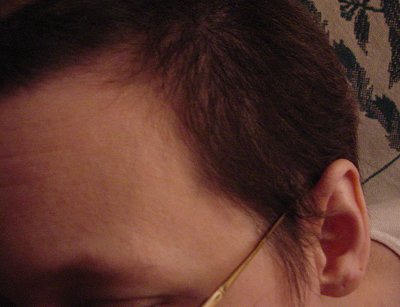
It's not such a great picture.

The light level was too low and it turned out grainy, like most of my indoor pictures do.

But I love this photo, because it means that my brother's wife is a cancer survivor. And her hair is growing back!

She had a brain tumor - an adult medulloblastoma. "Adult" because it's normally a tumor that is found in children. It's rare in adults.

Luckily, she was diagnosed quickly after the onset of her symptoms. She had surgery and came through with few serious deficits. She's had a rough time of it though, especially during radiation and chemo, and I didn't want to mention it here before now. But she's doing better every day.

Even if one of her nieces did ask why her hair was growing back in a different color.

-----------

Links:

My sister-in-law said that it helped a lot to be able to speak with other people on this Yahoogroup email list for Adult Medulloblastoma.

Saturday, November 6, 2010

Cactus


Here is another photo of the cholla cactus. This shows the cactus itself better as well as the flowers.

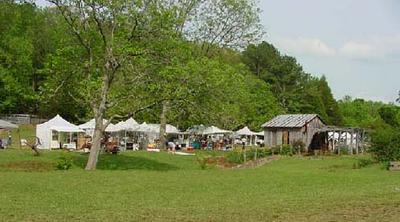
Homestead Hollow


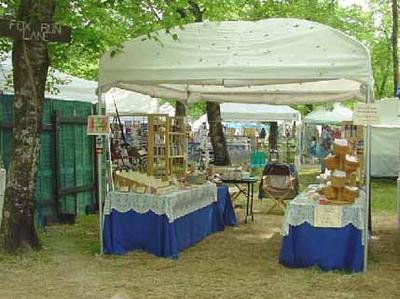
We are set up at the Homestead Hollow craft show this weekend.

But we are not in our normal spot - they moved us.

We are in space "Barnyard 201", which is nearer the front of the show than we normally are.

This picture is from a couple of years ago, but our booth looks pretty much the same.


Just look for the royal blue tablecloths with the white lace covers.

Wednesday, November 3, 2010

California:: Jalama Beach County Park

I got a late start when leaving Morro Bay on March 29th and I only went about 100 miles south. Driving along California Highway 1 near Lompoc, in Santa Barbara County, I noticed a sign for Jalama Beach County Park. It had a campground and I needed a place to stay for the night.

It was somewhat challenging to get to. The sign showed that it was 14 miles down a county road. Wow! What a drive. Talk about a winding road and hilly! After about the first two miles I was ready to turn back, but there was no place to safely turn around, so I continued on. It was definitely worth the drive though...

It was a rocky, sandy beach.

Late afternoon and the fog started rolling in toward the shore.

I had forgotten that there was a railroad along the coast. This bridge was on the north side of the campground. Several passenger trains came through while I was there.

It was extremely windy that day. The two fellows in the background are kite surfing. It was amazing how they jumped the waves and moved in and out along the shore.

They did occasionally fall off their boards, but quickly retrieved them and went back out for more.

Heavy fog was on its way and the kite surfers were still having fun. So am I.