Friday, January 30, 2009

The Estate of Dederick Hoffman :: Property Widow Kept at Appraisement

In addition to the Widow's Allowance provided for Susannah Hoffman by the administrators of the estate of Dederick Hoffman, she also took a few items at the time the estate was appraised.


A list of the property with Its value that the widow kept at the appraisement.

Estate of Dederick Hoffman (Packet 805) Columbiana County, Ohio

FHL film 2032459 accessed June 8, ..


A list of the property with Its value that the widow kept at the appraisement.

Estate of Dederick Hoffman (Packet 805) Columbiana County, Ohio

FHL film 2032459 accessed June 8, ..


D C
one twelve gallon kattle - - - - - - - - 02 50
one ten plate Stove and pipe - - - - - 11 00
one German Sermon book - - - - - - 01 50
one lot of Flax - - - - - - - - - - - - - 00 40
one Table - - - - - - - - - - - - - - - - 00 75
one bed and beding - - - - - - - - - - 06 00
one lot of flax and tow - - - - - - - - 00 75
one Reel - - - - - - - - - - - - - - - - 00 25
one lot of lether - - - - - - - - - - - - 01 00
one Spider frying pan pot trameland

coffee mitt - - - - - - - - - - - - - - - -
02 00
one fat hog - - - - - - - - - - - - - - - 03 00
one chest - - - - - - - - - - - - - - - - 01 00
one Side Saddle - - - - - - - - - - - - 06 00
three chairs - - - - - - - - - - - - - - - 75
$42 00


The above is an Inventory of the property that the Widow kept at the apprased value

May 15th 1826

Samuel Hoffman

John Hoffman

Administrators of the Estate of
Detrick Hoffman Deceased


The total as calculated by the appraisers was $42.00 but their addition was off a little as the amount adds up to $41.90 which is the amount shown in the final settlement papers.


Thursday, January 29, 2009

The Phend Surname

The "Phend" surname, as you might imagine, is not a common one. The index to the book on the Phend Family that was published in 1991 only includes 331 people with the surname, and that included everyone that I had found since the family came from Switzerland to the United States in 1832. Johannes Phend, the progenitor of our family, had two daughters and two sons, John and Jacob. John didn't have any children. Jacob had seven children, six sons and one daughter; there were 43 grandchildren, 29 grandsons and 14 granddaughters. In the next generation the numbers flipped and girls outnumbered the boys by about 2 to 1.

According to my Grandpa Vic, his grandfather, Jacob, pronounced the Phend surname as "pay-hend" and said that it was spelt pay-hay-a-n-day. He also told me it was originally spelled with a B instead of a P but that the B was pronounced softly like a P and that is how it got changed from B'hend to Phend. However, in Swiss records the surname has been found spelled as B'hend, Bhend, Fend, Fendt and Pend. In the United States, the surname has also been found in records as Fend, Fiend, Fin, Phind, Pheud, Phena, and Phent.

Considering that names were often spelled phonetically, and the fact that many record keepers and census takers wrote so poorly, the variations are not all that surprising. It just sometimes makes it a bit challenging to find the right records.


Johannes Phend was recorded as Jean (or Sean?) B'hend on his 1832 passport.


The signature of Johannes on his passport.


The Land Record from Carroll County, Ohio (Deed Book 11, page 367) showed John Phend and his wife Susan selling their land in 1849 - and his signature!

The family was found in census records the "old fashioned" way - by turning the crank and going through the reels of microfilm image by image, before indexes were widely available, and before the internet. Lucky for me, from other records, I knew where to look and the townships they lived in were relatively small.

1840 Carroll County, Ohio (Brown Township page 192)


1850 Greene County, Indiana (Taylor Township page 409b)

1860 Marshall County, Indiana (German Township page 56)


1870 Kosciusko County, Indiana (Scott Township page 434)

1880 Kosciusko County, Indiana (Scott Township page 33)


In 1900 and 1910, Jacob was livng with his daughter and her husband, Sophia and John Ernest, in Elkhart County, Indiana. (Nappanee, Locke Township page 232 in 1900 and in Concord Township page 56b in 1910)

Three other recent posts highlight some family records from Switzerland, the christening record of Johannes Fendt, and the family's emigration to the United States.

Breaking Away

Fruitlands, Harvard MA

A luckless morning. I had attempted to join a 100K club ride, only to get an important phone call as I pulled up to the start. By the time I got done the others were nearly an hour ahead. I would never catch up. I decided to ride the route anyway.


The weather had been beautiful. But as I set off, it began to rain - cold, hard little drops, carried sideways by the wind, sharp against my face.


On the road there was more traffic than usual. A mile in, adriver cut me off and I barely avoided a collision.Still fuming over this, I began to notice that my throat hurt. I was hot and cold. I felt sluggish. Maybe I was running a fever.Maybe I should count my losses.


A deep irritation over a day wasted was building up. Workdays that have no clear end or beginning. A weak constitution that has derailed my plans one time too many. If it's not one thing, it's another.


Nagog Hill Farm


For some miles, it was angry riding. Riding a wave of frustration. But I pedaled. Mechanical motions. Round and round. Rain and chills, traffic, scratchy throat, round and round. "Oh shut up," my legs said to my throat. We would break away.


I had the sense that once I was a certain number of miles out, it would all resolve itself, because turning back would no longer make sense. Concord, West Concord, Maynard. I pedaled harder.


But then came a moment of doubt. I had not meant to be on my own with my thoughts on this day. What would I doout there, for hours, with all these thoughts? "Oh shut up" my legs said to my brain.


And we broke away.


Steele Farm, Boxborough MA

20 miles in. As if someone had waved a magic wand, the cars were gone. The sun came out. The pedals lost their resistance. We floated up hills.My mind emptied.


In Still River I passed aBenedictine monastery. It stands on top of a hill, overlooking a green and blue rolling landscape. Slowly I rode through it, not seeing a single person on its grounds. The monks must have been indoors.


In Boxborough I stopped at a farm. It had visitor hours and notices posted, but looked abandoned. With my bike, I stood in the middle of a field dotted with white barns, thinking of nothing. I heard ringing in the air. The field was full of dandelions.


Fruitlands, Harvard MA

The climb leading up to the Fruitlands was shorter and tamer than I remembered. Today, the hill was an invisible host, gently taking me by the arm and leading me to the view.


At the hilltop, I had the place to myself. No cars were parked at the scenic overview along the side of the road. No cyclists passed. I had made it all alone up there and the world felt far, far away. The sun flickered through thick clouds, a flood of light going on and off.I looked down at the little mountain clusters across the state line. The entire world felt close.


Harvard General Store

Descending into town, I remembered that I had not eaten for hours and stopped at the general store. When I ordered coffee and a sandwich, it felt strange to talk - as if I hadn't spoken out loud in years. Was I even saying the right words? The boy behind the counter had an inscrutably friendly face that had seen many cyclists.


Nagog Hill Farm

Orchards and orchards on the return leg. The apple orchards have such neat rows of such crooked,erratic-lookingtrees. Line-dancing trees. Shaker trees.


This ride was coming to an end much too fast, I thought. I wasn't ready. And I veered off course onto another road, with more uphill floating, more orchards.


But at length, unfamiliar farms gave way to familiar ones, a gentle reminder of being homeward bound. Then finally, the bikepath, and the city - with 100 miles on the computer and frustration a faint memory.


Sometimes if you just keep pedaling, everything else breaks away, falls away. If you keep pedaling, the mind quiets down.

Wednesday, January 28, 2009

Once More with Feeling: the Return of the Winter Tire Dilemma

Snowy Streets, Cambridge MA

After last year's mild winter, this holiday season caught us off guard with a bountiful snowfall. My two ridable transport bikes at the moment are a Brompton and a 650B prototype mixte (more on that soon). The mixte sports 42mm Grand Bois Hetre tires, and so I thought it would be a great idea to ride it in the snow. After all, the Hetres ride so nicely over unpaved, uneven terrain. Crusty snow feels kind of similar. I took to the streets.


Here I will pause to admit, that despite 3 previous winters of cycling behind my belt, I had never before ridden on roads that look quite like what's pictured here. There was never a need to, since our neighbourhood usually gets plowed and salted pretty thoroughly. Typically the streets look morelike this-with snowbanks piled high on the sides, but the travel lanes mostly cleared. This time around, maybe on account of the holidays, they had not cleared the snow all that well. I got to experience the real deal.


Snowy Streets, Cambridge MA

The snow on the roads created terrain of three distinct categories. There was the even, packed snow. Riding on it felt similar to riding on post-rain dirt roads, nicely packed and kind of softish. The Hetres handled well there. There was the crusted-over snow, uneven and slippery at times, though not outright icy. This too felt manageable. And then there were the occasional stretches of deeper, slushier snow. I expected it to feel similar to mud, but it was way more slidey and my front wheel kept fishtailing. Still, overall I thought that the tires did fine. There were only a few stretches where I felt uneasy, and I attributed that to a lack of confidence.


So I got home and uploaded some pictures of my snow ride, planning to comment on how decently the Grand Bois Hetres handled. But promptly the pictures received feedback from others to the opposite effect, warning that these tires ride poorly in the snow. The fact that I happily rode them and felt they were fine strikes me as funny - in a concerning sort of way. Ideally, I'd like to be able to tell the difference between lack of traction and lack of confidence.


Snowy Streets, Cambridge MA

And so, once more the Winter Tire Dilemma is upon me. Naturally, everyone is suggesting studded tires. This is my 4th winter commuting by bike and I have yet to try them. Partly this is because they are expensive and I cannot seem to commit to a wheel size. I am riding 650B now, but in winters past I've ridden 26", 28" and 700C, and who knows what I'll be riding next winter. I am also convinced that getting studded tires and mounting them on my bike will activate the Umbrella Carrying Principle, ensuring that I will not need them.


Finally, the very fact of having gotten through 3 winters without them makes me question whether I really need studs. Winters here aren't really that bad, and tires with some tread seem to do pretty well. The Schwalbe Marathon Plus are the husband's favourite for city slush and snowy paths alike, and they are even available for the Brompton's wheel size. The performance-oriented Continental Top Winter IIs also come highly recommended. Knobby mountain bike tires are another popular choice. One issue, as I understand it, is that no tire is equally good for both snow and ice. Studded tires help with ice, but not snow. Tires with heavy tread help with snow, but not ice.This winter, my commutes cover longer distances and more remote areas than previously, so a good winter tire is worth considering ...though with all the choices and factors involved, I suspect spring might come by the time I decide.

Monday, January 26, 2009

Remember Bernice Calvert


In our family, we learned to remember Pearl Harbor early in life. My mother's mother, Bernice Bailey Calvert, was there starting a new life. Her first husband, Roger Calvert was killed in a car accident in 1930, and her son, Roger Jr was killed in a freak accident at the age of 13. A widow at 32, she managed The Broadmoor Apartments where she met her second husband, Frank Bernard Schultz who was playing a in a band at afternoon teas there to help put himself through medical school. In May 1941, he was a doctor in the Army Reserves, when he was called up and stationed in Hawaii-which seemed like a great gig at the time. It took over two months to get there. They were enjoying their new life- even though it was far from family here in Washington. Then the attack came. Bernie was called in to the hospital, and my grandmother was alone when a shell hit her home. She hurt her ankle, but managed to get to the hospital as well, and ended up helping all day. Soon all Army wives and children would be evacuated, but my grandmother wanted to stay. She joined the Red Cross and became the only woman correspondant to cover the war in the South Pacific. There she was at the age of 43, one life behind her and a completely different one ahead. They remained in Hawaii all through the war right up to the end- literally. She was actually on board the USS Missouri when the Japanese surrendered. That's why we remember Pearl Harbor.

The Round House

Round House

It is no small task to describe the entity that is "Camberville" - that serpentine Somerville-Cambridge city line with its mazes of pocket neighbourhoods, unkempt grapevines, mysterious alleys lined with crumpling garages, and grandiose structures tucked away on sleepy side streets. Wandering through a neighbourhood you think you know, it is not unusual to encounter something wholly unexpected - perhaps a sidewalk treehouse, an enchanted forest, a small castle, or a warehouse-sized artisan incubator.


Round House

Very possibly I have cycled past the Round House before without taking much notice. The once-grand structure is not difficult to miss, now only a shadow of its former self. A lusciously overgrown garden torn out some years ago, a grass lot and chainlink fence now surround its bare walls, stripped of trim and embellishment. A thicket of condominiums stands in what was once an open space, blocking the house from view in certain directions.


Round House

But on this ghostly-quiet afternoon, I noticed it straight away. It was one of those humid days when the air stands still and the scent of flowers is sickly sweet. The weekend's explosion of lilacs was making me lightheaded. I cycled up a steep hill, and as I turned the corner onto a tiny one-way street the house appeared like a hallucination -backlit by the waning sun and tilting slightly to the left.


Round House

Stopping to have a look, I was distracted by the prominent signs discouraging trespassing. They struck me as so insincere as to almost be playful.


Round House
I was intrigued further by the curious discrepancy between the siding - which appeared newly installed - and the foundation, which seemed on the verge of collapse.


Round House

And then there was the bulging wall.


Round House

Strange to think that a Victorian-era locksmith is responsible for this cylindrical wonder. Inspired by the idea of octagonal houses floating around at the time, Somerville resident Enoch Robinson decided to take things one step further and build a round house. Constructed in 1856, the 3-story single family residence housed generations of Robinson's family.


Round House

It is not clear why the Round House was vacated and stood empty for so long. But by the 1980s it had its windowsand ornamentation removed, had suffered water damage and faced serious structural problems. There was talk of tearing it down, which, predictably, riled up residents who saw it as a landmark of historical value. Thankfully, it never came to that. Several years ago, the house was purchased by a developer with experience in historical preservation. He plans to restore the house and place it on the market as a single family home.


Round House

The Round House was created on a whim, to satisfy a personal interest - possibly an obsession, judging by the limited information I found on its creator. Yet by virtue of existing in a publicly visible and visitable space, it is also a communal resource, and will continue to be as ownership changes hands. How will the new residents feel about that, I wondered, eying the awkward battlements that surround the top story. I hope they plant a nice garden. Maybe some lilacs, dogwood and pines, against that stark beige facade.

Sunday, January 25, 2009

A mountain of maintenance

I've been wondering about the upper mountain. It must be snowing up there today, because the temperatures are much cooler here in Longmire. The Camp Muir and Paradise weather stations are both offline... Perhaps they are casualties of the intermittent disruption of power, phone and internet. I do know this: there was 7 inches of snow on the ground at Paradise yesterday, and I can see a snowline at 3,500 feet today.

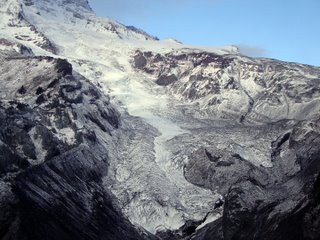
I am also wondering about all that rain on the glacier. I have a feeling that at some elevations, the rain turned the glacier into hard/bulletproof ice when the temperature dropped. Here is the Nisqually Glacier from the air, taken on Wednesday.

It has been raining steadily today, but the river flow and currents have remained normal. Access to the backcountry and mountain is dependent upon repairing the park's infrastructure. A lot of cranes, dozers, and dump trucks will be needed to re-sculpt the land for roads and sewer systems. Like today, I saw a large crane moving rock in the Nisqually River in order to help protect a historic cabin, road and treatment plant. But it's not everyday you see this sort of thing in a national park.

There was another spate of articles online at MSNBC and in the local papers about the park closure and flood damage. The big pieces were in the News Tribune, Seattle Times and the
Yakima Herald. In the meantime, let there be colder temps and stable weather.

New Camera Photos


These are the first photos from my new camera. Of course some of the Sandia Mountains.


Cassie


Twinkie


Wiley


Murphy


Tuffee


Ziva


Star


Stormy & Traveler


Saturday, January 24, 2009

The Petzl ICE pick issue


The quotes listed below were found from a quick Internet search on the current Petzl ICE pick. It seems silly to me that Petzl had a amazinglyly well recieved pick, the Cascade, that they have now discontinued for the Nomic. Even more so now that the Cascade pick would fit all three tools, Nomic, Quark and Ergo. When your customers start using another brand's picks I suspect you have an issue that needs to be resolved, sooner rather than later.


None of this is to argue the newest picks are bad, just that some prefer the previous design.


Here is a short discussion on how to modify the newest picks for better ice performance by duplicating the older Cascade pick.


http://coldthistle.blogspot.com//10/petzl-picks-again.html


Quotes by various Internet authors on the same subject:

"I've heard rumors that Cassin's X-All picks can be modified to fit onto Nomic or Quark. Any truth to this? I'm a little frustrated with the new Petzl Ice picks (detuning isn't working out that great)."


"The new Nomic Ice pick is hard to clean, but filing it down to closely match the profile of the old Cascade pick worked great for me."


"there are a few things I noticed with the new Ice picks. Durability, cleaning, and ice displacement. Maybe this season is a bad example because how thinner the routes are, but I noticed my Ice picks getting chewed up and worn down significantly faster. I've filed the picks three times already, when I normally do three filings for the entire season on my old Cascade picks. Cleaning on the new Ice picks is harder than before, this is well know."


"When I compare the picks to old style, they are completely different. It has beenpointed out that I can modify the new Ice picks, but I haven't had the chance to test that out."


"I have a big potential issue with the new Nomic Ice pick though. At the gym where I train, it is literally impossible to get a stick in the Iceholdz(TM) on the mildly overhung system board. With adjustments to swing and hand position, I have been able to get good sticks with both Cobras and the old style Vipers. I'm guessing the first tooth is too steep (which is one of the things causing the cleaning problem with Laser picks) so I worry what they'll be like on real ice."


"The new Ice picks, while better than the old Astros, are definitely not as good as the old cascades from my experience using both of them last season on a pair of new Quarks and old Nomics. I'm pretty sure the reason is the same already mentioned: the angle of the first tooth."


In North America if you have a similar thought you can direct an email toPetzlAmerica at info@petzl.com

It is a topic Petzlwants to hear from you on. So the emails aren't going to a round file as some might expect.


I don't have a Petzl France email but if you are outside North America I suspectyour concerns will be relayed to Petzl France as well.


A Look at Kinn: the US-Made Midtail

Kinn

Before setting off abroad earlier this summer, I had a chance to glimpse the much talked about Kinn - a new midtail utility bike manufactured in Portland, Oregon. Today being the 4th of July, it seemed like a good time to share my initial impressions of this US-made machine.


Relatively new to the scene, "midtail" bikes are characterised by an extended rear end that is longer than that of a conventional city bike but shorter than that of a full-on longtail cargo bike. In , Yuba released the Boda Boda midtail (featured here) andKona introduced its MinUte midtail. At around the same time, following two years of prototyping, Kinn unveiled the Cascade Flyer.


Kinn

Kinn describes its mission as to be "big enough for family and small enough for you."The company's name is a double reference: to kin, as in family, and to kinetic, as in motion. Designed by founder Alistair Williamson, the frames are manufactured in small batches (around 100 per year) by the Zen Bike Fab. The racks are fabricated at ADX. And the wheels are handbuilt at Sugar Wheelworks. All of these are Portland, OR establishments, so the company keeps it very local indeed. An interesting article on the development and prototyping of Kinn Bikes is worth having a look at here.


Kinn

The Kinn's frame and fork are welded chromoly steel, designed around 700C wheels and up to 50mm tires with fenders. The geometry is characterised by 72° head and set tube angles, a low bottom bracket and a high trail front end. The frameset is available in the "robin's egg blue" colour shown and two sizes: The Small/Medium fits riders 5'3" - 5'9" and the Medium/Large fits riders 5'8" - 6'2". The standard component build includes Avid disc brakes, a choice of a 9-speed derailleur (Shimano Alivio) or 8-speed internal hub (Shimano Alfine) gearing, fenders, chainguard, city pedals, kickstand, and Velo Orange Milano handlebars with cork grips. Complete bikes are estimated to weigh 34lbs-38lbs, depending on size and build. Prices start at $1,950 for complete bike with derailleur gearing, and $2,200 with internally geared hub. Detailed specifications can be found here.


Kinn

The integrated rear "multi rack" is rated for 130lb carrying capacity. The pannier rails are designed to fit two panniers on each side (or one on each side if the rack is fitted with a child seat). The rack features a long bamboo deck (21” x 5.5”), hidden lockable toolbox, a platform that integrates with the Yepp child seat mount, built in footpeg mounts. The child seat and little passenger bars (shown) are available as extra accessories.


Kinn Lock Box

The bamboo platform is modular: The front part swivels out of the way for the child seat mount. The rear part opens to access the lock box.


Kinn

I have only done an introductory test ride on the Kinn so far: Around 4 miles, with a single pannier in the rear. Now, I do realise that Kinn's literature focuses largely on child transport. In fact, when Kinn offered me a test ride, I wondered whether I was the right person for the task. I do not have kids and do not plan to cycle with other people's children on board for the sake of a review. They still wanted me to try the Kinn and see what I think of it as personal transport - so those will be the parameters of my impressions. The bike is also available for other locals to try with their own kids on board (at Bicycle Belle in Cambridge/Somerville, MA), and I will later collect their impressions.


Kinn Cascade Flyer

As far as my own first impressions: What I liked most was how the Kinn rides. It is distinctly un-cruiserish and un-cargobikish; a fast, responsive, "sporty" bike. Part of that is the positioning: The handlebars are intentionally set lower than those on bikes like the Xtracycle and Yuba, the stem is long, and the front end geometry is pretty tight (notice the way the downtube curves around the front wheel). I like the low bottom bracket and the quick, yet stable feel of the steering. The Kinn is not meant to be a relaxed city bike, but something a bit more aggressive. The ride quality over bad roads was great as well, even with the 35mm tires the demo bike was fitted with. It was simply a fun bike to ride that did not feel like a cargo bike.


Kinn Cascade Flyer

For a transportation bicycle, the Kinn's frame is a little tight for my taste. The sloped top tube is too high for me to step over (it is higher than the Xtracycle Radish, or a typical mixte frame), and my toe rubbed the fender a couple of times on slow tight turns. I would love it if the bike's ride characteristics could be retained while providing a little more toe clearance in the front and a lower standover height. An obvious solution would be to go with a smaller wheel size - though I understand that they went with 700C intentionally, aiming for a roadbike type feel.


Kinn vs Xtracycle Radish

As far as cargo capacity, the Kinn is visibly shorter in the rear than a typical longtail (shown here next to the Xtracycle Radish). It does not come with any sort of dedicated carry system: You strap things directly to the rack as you would with a regular bike. The rear rack is an intricate design, with lots of rails and support stays onto which cargo could theoretically be strapped. One thing I wonder, is how two full-sized panniers can fit on each side of the rack, as claimed, since the one I used took up most of the dedicated pannier railing. I will experiment with this some more.


Walking and parking the Kinn in the city felt entirely like dealing with a regular sized bike. When an extra degree of compactness is desired, the front wheel can be turned all the way around to fold into the frame (like so), making it compatible with bus and car racks.


Kinn

The Kinn Cascade Flyer is an intriguing specimen that I look forward to examining further once I am back stateside. The compact design that still offers more carry capacity than a typical transport bike is of obvious benefit to city dwellers who do not want to lock up a cargo bike outside. The invertable front wheel is a useful feature for those who take their bikes on city buses. And for parents who like a sporty ride, the Kinn's rack is rated to carry a kid up to age 12.


Finally, it is impressive that Kinn has managed to produce this bicycle locally at the current price point. They are soon planning to launch a Kickstarter campaign for Kin 1.1 (the next batch will have a few minor modifications) to help fund the continued manufacturing of these bike in the US - I will keep you posted.


If you are in the Boston area, this bicycle (including child seat) is available to test ride at my neighbourhood's new bike shop, Bicycle Belle. I will post a detailed review in August.