At 8:32 am on May 18th, 1980 a magnitude 5.1 earthquake “shook the ground beneath Mount St. Helens in Washington state, setting off one of the largest landslides in recorded history - the entire north slope of the volcano slid away. As the land moved, it exposed the superheated core of the volcano setting off gigantic explosions and eruptions of steam, ash and rock debris. The blast was heard hundreds of miles away, the pressure wave flattened entire forests, the heat melted glaciers and set off destructive mudflows, and 57 people lost their lives. The erupting ash column shot up 80,000 feet into the atmosphere for over 10 hours, depositing ash across Eastern Washington and 10 other states.” - - from The Big Picture which has a fantastic collection of photos of the volcano and its 1980 eruption.

The western side of Mount Saint Helens as seen from the Visitor Center at Silver Lake, 46 road-miles away.

From a viewpoint on the north-northwest side.

Clouds covered the upper half of the volcano for the entire afternoon with an occasional break, which briefly revealed the peaks. This, and the remaining photos were taken from the Johnston Ridge Observatory. Named for David A. Johnston, a volcanologist on duty nearby on that fateful day. His last words were “Vancouver, this is it!”

The lateral blast exploded to the north toward what is now Johnston Ridge and, quite literally, destroyed everything in its path.

The mountains and valleys were tall old-growth forest. Now all that remains are a few denuded logs lying about like pick-up-sticks.


A park service sign nearby tells a tale of the blast as “spoken” by this stump: “Step up and look at me carefully. Notice my shattered trunk, my missing top. I once stood 150 feet tall, surrounded by a beautiful forest of green and growing trees. When the blast exploded sideways out of the mountain, it plowed through the debris avalanche and swept across the landscape, picking up and carrying large chunks of rock, ice, and splintered wood.”
“Within a minute, I was struck and scoured by the stone-filled wind. My bark and branches were stripped and scattered toward the edge of the blast zone, 17 miles away. As trees that had stood for hundreds of years crashed around me, my upper trunk strained, then shattered in the nearly 700 mph winds. Only a small part of me remains as evidence of the blast's power.”

Down in the valley, the blast dumped 680 feet of debris, filling Spirit Lake to the east with logs and ash.

Johnston Ridge was completely denuded. Spirit Lake lies beneath the far ridge at left-center and St. Helens rises up from the valley on the right.

The early evening light emphasizes the ridges and the gulleys now being carved out by the flow of water.

Another view of cloud shrouded St. Helens from Johnston Ridge in the early evening. All photos were taken on Sunday, September 12th.
The Johnston Ridge Observatory, which is 5 ½ miles from the crater, has some really nice exhibits as well as a 16-minute movie about St. Helens. If you've never been there, it is well worth the 60-mile drive off of Interstate 5 on State Road 504.
A couple of the many websites about Mount St. Helens:
- The many faces of Mt. St. Helens
- Mount St. Helens Visitor Guide
- Mount St. Helens National Volcanic Monument
 I didn't take many pictures along the way. Though pretty, the scenery didn't lend itself well to picture taking, and the further south I drove the cloudier it got. So you'll just have to take my word for it that it was beautiful.
 There was some road construction and about 15 miles of gravel road, and my van, which had to go through two car washes in Anchorage to get clean, was now dirty again...
 There were signs of autumn in the air, besides the chilly weather.

 It had started raining about 30 miles north of the Alaska border and the rain continued all the way to Haines, 40 miles south of the border. I stayed at the campground at Chilkoot Lake State Recreation Area (which also happens to be where Sue and Fred stayed). It is ten miles east of Haines at the end of the highway.


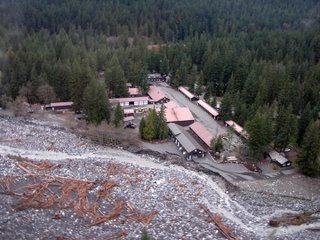 In the newspapers, NPS officials predict road openings as late as Christmas, but cautiously hope it will happen sooner. At this time, it's difficult to tell just how long it will take to get things ready. Another complication is the ongoing Paradise construction project. The contractors had planned to work continuously this Fall and this isn't helping. In the meantime, I'm cheering for the road, electric and water treatment crews who are hustling to get things reopened.
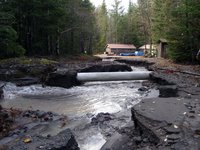 Here are a few extra images that I didn't weave into the blog earlier. To the left is the only road into the Kautz Helibase. This one may not be so easy to repair, because some of the creeks have changed their course and now flow down road corridors.
 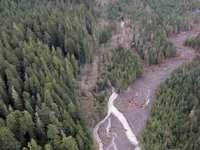 As for creeks that change their courses, the main one of concern so far is Kautz Creek. It jumped its main channel about a mile above the road, and now runs through the forest as seen in this aerial photo. Note the dry creek bed where it once flowed. You can also see the younger forest as compared to the older growth.


 A view from along the trail to the Forty-Nine Palms Oasis.
 There may have been forty-nine palms at the Oasis at one time, but no more. These are Desert Fan Palm trees, which can grow to 75 feet in height and live for 80 to 90 years. The Cahuilla Indians (pronounced: Ka-wee-yahs) used palm thatch to make their homes wind-and- waterproof. The leaf fibers were woven into ropes. Baskets were made with the palm fibers and sandals from the palm leaf fibers.
 There weren't many flowers in bloom yet at Joshua Tree, but the few that I saw, were gorgeous! Found along the trail, this Canterbury Bell was about 12 inches in height and was nestled against the rocks.
 A closeup of the Canterbury Bell. Beautiful.
 Heading back. You go up, then down, around, up, and down... definitely a good workout!


 As I drove further west, the weather got better!


