Wednesday, April 27, 2011

Bugged


A Japanese Beetle (Popillia japonica). Bad news. Alien invader, rose-chomper, crabapple defoliator. Off with them to a bucket of soapy water. Die, die, die!


Not a Japanese beetle: an Emerald Flower Beetle or Emerald Flower Scarab (Trichiotinus lunulatus).


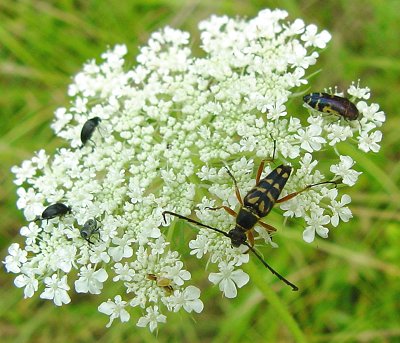
Yo, bug party at the Queen Anne's Lace. (Be there or quadratus estó?)


A big thanks to Thingfish23 for the Emerald Flower Scarab ID!

No, I never took Latin, feel free to correct me.

Monday, April 25, 2011

A second opinion on the Scarpa Rebel Ultra


Patrick in his new Ultras.

Photo courtesy of P.J. Cooke


a guest blog by Patrick Walsh


As one would imagine, I was very very excited when I found out I
was going to own these boots. I had my reservations purchasing them
sight-unseen, not knowing if they would be the right size and/or fit my feet
properly. I figured worst case the boots should be pretty easy to re-sell if
nothing else.


My first reaction, and that of most to the Rebel Ultra, has been
“what are those, can I see them?” This is followed by “holy crap those are
freakish light.” They are more akin to a sneaker than an ice boot, and often
the next questions are “what size are they? Can I try them on!?” This initial
excitement is soon followed by “but are they warm enough?”


At this point i have spent twelve days climbing in these boots.
I was fortunate enough to receive them just before an end of season trip to the
Canadian Rockies. I have now spent eleven back-to-back days and one single
day on the east coast in these boots. Although this is not a long time to
have spent with a boot, I feel it has been enough time to offer some real
feedback having spent the better part of two weeks in them day in and day out.


I guess first we should talk about fit. I have what had been
described as a fairly low volume foot with a high arch. My feet measure US 11.5
left and 12 right. The first thing I did was toss the factory insoles and throw
the gamut of off the shelf offerings at the boots in an attempt to get the
perfect fit. In doing so I soon came to understand that these boots are not
your average ice boot, and that bit of toe wiggling room one usually looks for
in a attempt to stay warm and ward off black toe nails is not what this boot
wants to do. This boot wants to fit more like a rock shoe (think "all day
trad shoe") resulting in a boot that feels like a warm blanket but
performs like tightly fitted sport climbing shoe. I went back and forth with
insole/sock combos searching mostly for the ideal fit regarding volume. I kept
coming back to a fit that allowed me to just barely stuff my feet into the
boots without my toes bashing off the ends or cutting off my circulation, thus
leaving little need to crank down on the laces to keep my foot in place. Fit
this way, the boots offered an amazing combination of support and dexterity,
all the while feeling much more like a overbuilt running sneaker than an
uber-light ice boot of any sort. With so little to the upper of this boot, it
really needs to be fit this way in order to offer the support ones desires in
an ice boot. Had I fit the boots with room to wiggle my toes and cold weather
circulation in mind, the boots would begin to feel a bit sloppy and lack the
support I would want in a boot I planned on climbing ice in. Fit as I had them,
the boots offer the perfect combo of support and all day comfort and
performance.


My first impression of this boot was that it was a niche item. I
figured it would be one more tool in my quiver of gear probably reserved only
for warm and or fast and light days on moderate ice in moderate conditions.
Having now done everything from long alpine days on both hard and easy terrain
to a few short days spent ice cragging and even some mixed climbing in both
warm and cold weather, I have to say these are a do everything boot and a does
everything well boot. I would go as far as saying these are a do everything and
does everything better boot. Yes on a couple cold days high on a route with
wind whipping my feet got cold. But so did both of my partners’ feet in Nepals
and Baturas. Add to that the fact that I fit them with a lightweight Smartwool
PHD ski sock more akin to a cycling sock than a wool winter sock of yesteryear
and I think, although far from a warm boot, the boots are pretty darn warm. On
a coupe of high-teens to mid-twenties Fahrenheit days, my feet felt downright
warm. These boots both approach and climb so well that even days i expect to be
cold I still choose to wear them because they just climb that much better than
any other boot I have worn, and I have worn them all. I simply no longer want
to wear any other boot as my feet just love climbing in this boot.


In summary, this boot is crazy crazy light and built incredibly well
regarding craftsmanship and materials! The boot makes me feel more like a
spider monkey climbing ice simply on his way home rather than a giant ape
clumsily making his way up the Empire State building only to be shot down by fighter
planes in a attempt at freedom. For me at least this boot is a game changer and
one I might go as far as saying you will have to "pry from my cold dead
hands."


more feedback via previous emails:


On New England Ice?

"Boots are great! I can climb anything in them. Meaning they climb hard ice
just fine if not better than my other boots. Not sure if it is in my head but I
suspect a little of both. They might be a 1/2 size small but only cuz I have
had to run my high volume custom orthotics in them.

In all reality I am pretty sure these boots made me a better climber for
real. I pretty much have stoppedkicking as I can just place my feet on the
smallest of features. What once felt like a tiny ledge now feels like a
giant shelf.I am in love!! They will be cold on cold cold days but it is
clear this is not a cold weather boot. Still though it will be very
very hard to ever want to climb in anything elseever!"


Two weeks later:

"So we had a great first trip to the Canadian Rockies. We ended up
getting out 11 daysstraight.
The boots rocked. I brought my Phantom Guides and never once wore
them. I have only great things to say about the Rebels."


The original Cold Thistle review is here:

http://coldthistle.blogspot.com//02/the-scarpa-rebels-part-one-ultra.html

Friday, April 22, 2011

Errandeuring and Errant Weather

Post-Blizzard Rain
Today were possibly some of the worst conditions I have ever cycled in - a situation made all the more dramatic by the fact that I wasn't merely cycling; I was erandeurring. But let me start from the beginning. You see, there is an entire culture out there that thrives on turning transportation cycling into a sport in its own right - reinventing commuting as series of challenges to make it more interesting. While this approach is pretty much the antithesis of my own, I am nonetheless intrigued by it. When the utilitaire and coffeeneuring crazes swept the nation last year, I followed along with interest. Loosely modeled on randonneuring, these games involved keeping track of one's coffee shop and utility rides, complete with control cards and minimum mileage requirements. The authors of the Chasing Mailboxes blog in Washington, DC hosted the challenge, diligently collecting entries from participants all over the US, posting updates and results.


This winter they announced their latest project: theerrandonnee. Participants are challenged to "complete 12 errands in 12 days and ride a total of 30 miles by bike between February 9-20." A detailed list of rules was again provided, along with control cards. I read through it all and decided - what the heck - to give this thing a try. While riding a minimum of 30 miles in errands over the course of 12 days would not be out of the ordinary for me, I wondered what it would be like to keep track of this mileage, to categorise it according to the rules, and in general to reframe everyday cycling as taking part in a challenge.


Post-Blizzard Rain
The thing I did not foresee, was that the challenge aspect would become quite real. On February 9th we had our blizzard, and on the next day I still did not feel like braving the streets on two wheels. So as of this morning, I had only 10 days to complete the 30 miles of errands. Not only was there plenty of snow still on the roads, but it was now also raining badly.


Post-Blizzard Rain
I may lack the words to adequately describe today's road conditions. There wasn't just snow, there was deep water. Temperatures had risen sharply overnight, with snowbanks melting and additional rain coming down. By mid-day, some streets were downright flooded, and in many cases the water concealed slush underneath. On top of this, it was raining quite hard, with poor visibility and all the extra traffic chaos that comes with that. I now own a bright yellow raincoat for days like this, and that's what I wore. I also always have my lights on when it rains, despite it being daytime.


Post-Blizzard Rain
Even along stretches where the road itself was mostly clear, turns were treacherous, as that was where deep water and uncleared snow were gathered. Street corners were also where snowbanks were at their highest, which, as I soon figured out, meant that cars turning onto the main road from side streets had poor visibility. After a couple of close encounters, I decided the safest place to ride was smack in the middle of the travel lane.


Post-Blizzard Rain
Mid-day traffic was bad, and being on a bike did not put me at an advantage this time. Between the snowbanks and the trucks, there was not always a way to cycle past the standing traffic. My pictures were taken close to home, on a street where I felt it was safe to get off the bike and photograph the conditions of the roads. But for most of my route it didn't feel right to stop. Rain kept coming down, cars were honking at each other and executing all sorts of crazy maneuvers, roads were flooded and/or still covered with snow, and the whole thing was more than a little stressful.


Post-Blizzard Rain
In the course of all this, I completely forgot that I was errandeuring, remembering it only once I'd returned home. So far, the awareness of taking part in a challenge has not made me feel any differently about doing errands by bike. I had to go out today either way, and riding was still preferable to walking in ankle-deep water.


My impression of the utilitaire, coffeeneuring and errandonnee family of challenges, is that they are largely for athlete cyclists who might normally drive for transportation, but are looking to do it more by bike. The competitive paradigm appeals to them, so they've extended it to transportation cycling as a form of motivation. But I do know of cyclists who are purely commuters and have been enjoying the challenges too. Ultimately, I see errandeuring as a celebration of cycling, with its elaborate rule structure as largely tongue in cheek. Now to check whether bonus points are in store for the epic road conditions I've endured...

Thursday, April 21, 2011

Mammillaria Cactus


I have had this little cactus about 10 years and last month it decided to bloom. Blossoms are tiny, less than a quarter of an inch across. But such a beautiful color. There have been 18 of them in a circle around the top of the cactus. You can get an idea of size comparred to our cat, Twinkie. On looking it up I found it is in the mammillaria family.


This is another suculant plant that blooms frequently. It is almost an inch across. There are several succulants in this pot. The flower is on the plant that has long, thin but fleashy pieces not the one with the short thin tringles as it looks like, You can see the piece of plant on the left side of photo. Don't know it's name.

Tuesday, April 19, 2011

Mt. Rainier, Kautz Glacier


After climbing the easiest routes on Rainier, we wanted to climb something a little more challenging. So we decided to try the Kautz Glacier.

We crossed the Nisqually Glacier, then we went up a gully called "The Fan." It is full of rocks that break loose each day as it warms up.


We headed up the Wilson Glacier and found a great camp site just below the Turtle Snowfield. The rock wall would serve as a windbreak and there was running water close at hand. Unlike Camp Muir, we did not have 99 people camping right beside us. Mt. Adams in the background.


Jonathan in the kitchen area.


The main challenge of the Kautz Glacier route is a short section of 45 degree ice.


The shadow of Rainier just after sunrise. If you want to get the most out a sunrise, you need to be above 11,000' in elevation!


Jonathan finishing the fun part of the route.


Dave just above the icy section.


One of several large crevasses on the upper mountain.


Dave and Jonathan on the summit. The upper mountain was really windy and covered by a cloud cap.


Doug (holding onto his hood) and Jonathan. We took pictures and headed right back down.


Jonathan found a hidden crevasse on the way down!


Here are 3 tired and hungry climbers just a couple of hours from the car and some real food. Jonathan was able to summit an intermediate route for his first attempt on Rainier! It was fun to climb something new and challenging in this awesome part of creation.


Monday, April 18, 2011

How Do You Choose a Winter Bike?

Snow in Somerville/Cambridge, October
With the snow bound to arrive any week now, I am hearing local cyclists talk about "winter bikes" again. Before my first winter of cycling, the very notion surprised me. You're supposed to ride a different bike in the winter than you do during the rest of the year? why?? But then I understood that not everyone's transportation bicycle is a "tank" that is already winter-proof. Some bikes are more suitable for winter conditions than others. And while there is no one bicycle that is universally considered to be the ideal winter bike, there are certain characteristics most cyclists would probably agree are beneficial for winter commuting in snowy climates:


Stability:One reason the number of cyclists decreases so dramatically in the winter, is that cycling on ice and snow is scary. On the right bike, it is much less so. A winter bicycle should handle well on slippery, snowy, muddy and plow-ravaged winter roads. City bicycles and mountain bikes tend to do best in this respect. Those who commute on aggressive bikes during the warmer months may prefer a more relaxed and more upright bike for winter, with wider tires. If there is a great deal of snow where you live, studded tires could be a good idea, or at least knobby tires. Tame, predictable handling becomes much more important than speed in the winter months. Stepover is another factor to consider. A slippery road surface can make it easier to lose one's balance when mounting and dismounting a bike, and even those who normally ride diamond frames might prefer their winter bike to have a step-though frame or a sloping top tube.


Reliability:Related to the above, it is important that the bicycle's crucial functions - in particular, braking power and shifting ability - are not compromised by winter conditions. Rim brakes and derailleur gears can function poorly (or not at all) if clogged with snow or frozen over, which is why many prefer for their winter commuter to haveenclosed hub brakes and hub (or single speed) gearing.


Durability:Understandably, cyclists may not want to expose their nice bikes to freezing temperatures and road salt, for fear that doing so might damage the frame and components. This is why some recommend getting a "beater bike" for the winter. Personally I am uncomfortable with this advice, because a beater bike is unlikely to be reliable (see above). The approach I prefer is to get a bike that is not vulnerable to the elements in the first place. A tough paintjob, stainless and aluminum components where possible, hub gears and a chaincase should get your bike through the winter relatively unscathed with little maintenance.


Visibility: Not only does it get dark much earlier in the winter months, but snowfall can further decrease visibility - making good lighting more crucial than ever.


Presentability:Just because it's winter, does not mean that we are no longer expected to look presentable at work. With road conditions messier than ever, it is important that a winter bicycle be equipped with features that protect the cyclist's clothing: full fenders, and ideally a chaincase or chainguard.


Taken together, these features suggest a number of candidates that could work especially well as winter bikes. If buying new, fully equipped classic city bikes are worth looking into: They already offer hub gears, hub brakes, a full chaincase, a resilient powdercoated frame, stable handling, generous fenders and reasonably wide tires. Recently I wrote about city bikes with mountain bike heritage, which might be particularly appropriate due to their super-stable handling. For those who prefer to put a bike together from scratch, frames with horizontal dropouts (suitable for hub and single speed conversion) and clearances for reasonably wide tires are now easily available from a number of manufacturers: Soma, Surly, Rawland, Rivendell, Salsa and Velo Orange are just a few that come to mind. For extreme conditions there are even all-terrain models that will fit monstrously wide tires, such as the Surly Pugsley and Moonlander, and the Salsa Mukluk. If you prefer to refurbish a used bicycle, an old mountain bike converted to a single speed and fitted with some upright handlebars could work nicely. Same with a vintage 3-speed, fitted with a modern wheelset with hub brakes.


It goes without saying that not everything mentioned here will be applicable to every cyclist who reads this. The kind of winter bike that is ideal for you will depend on everything from the harshness of your winters, to the character of your route, to your bike handling skills, to your bike storage situation, to the amount of time you are willing to devote to bike maintenance, and to the type of clothing you wear when cycling for transportation. Your current bike may already be a winter bike, either as is or with minor modifications. Or you may need to get an additional bike specifically for winter cycling. My own preference gravitates toward classic city bicycles, and those I've owned have made great winter bikes. But I've been increasingly curious to try a mountain bike with knobby tires and see how that compares. What is your idea of a winter bike?

Sunday, April 17, 2011

The “Happy 101” Award

The “Happy 101” award is making the rounds in geneablogger land and I'm happy to say that it has been given to me three times! I've received it from Carol at Reflections from the Fence, Harriet at Genealogy Fun, and Bill at West in New England.

I'm also happy to accept the happy award! By accepting it I am obligated to name 10 things that make me happy and pass the award along to 10 more bloggers that brighten my day.

Here are just 10 of the things that make me happy:
  1. Being retired.
  2. Traveling.
  3. Sunshine and blue skies.
  4. Meeting geneablogger friends.
  5. Keeping in touch with family.
  6. Warm weather.
  7. Walking in the woods or along the seashore.
  8. Writing.
  9. Photography.
  10. Watching the sun rise and set.
And the 10 bloggers to receive the award are:
  • Jasia at Creative Gene
  • Apple at Apple's Tree
  • Denise at Moultrie Creek
  • fM at footnoteMaven
  • Ruby and Cheri at You Go Genealogy Girls
  • Donna Pointkouski at What's Past is Prologue
  • T.K. at Before My Time
  • Debra Osborne Spindle at All My Ancestors
  • Leah Kleylein at Random Notes
  • Greta Koehl at Greta's Genealogy Bog

Saturday, April 16, 2011

Thunderstorm over Wooly's Bluff


Taken last night at the end of the Arrowhead Trail at McFarland Lake. We were hoping for clear skies to try some star trail photography over the lake, but with the forecast calling for rain we knew it wasn't a good chance of clear skies. On the other hand, we knew that with the forecast being what it was there was a possibility of seeing some lightning if the thunderstorms that were forecast arrived early enough. Sure enough, not long after we arrived at the lake it was very cloudy and we saw some lightning flashes across the lake. Before long we were seeing lightning bolts coming down on the far shore. It made for a fun show for about an hour, then the rain came and we had to pack up our gear.

Back of Morning Glory


Friday, April 15, 2011

James Joslin :: 1837 Land Purchase

The earliest record found so far for James Joslin in Whitley County, Indiana is his purchase of land from the U. S. government on September 20, 1837 and which was patented on August 20, 1838.

In September .. a distant cousin, Richard Kutz, sent me copies of the land entry files he had received from the National Archives. The Original Patent Records can be searched and viewed online at the General Land Office Patent Search site but only the patent record is available online. The land entry file for James Joslin included the application for purchase as well as a receipt for payment.

A portion of the left side of the application for land purchase is cut off. I've added what I think it should say in square brackets. Text displayed in bold face is written on the application, the other text is printed.

Land Office, Fort Wayne, Ia. Sept 20 1837

I, James Joslin, [of] Delaware County, Ohio do hereby apply for purchase E ½ NW ¼ Section numbered 25 in Township numbered 32 N. of Range number 8 E. containing 80 [acres], according to the returns of the Surveyor General, for which I have agreed with the Register to [pay] at the rate of One Dollar and Twenty-five cents per acre.
for James Joslin
Price Goodrich

I, Robert Brackenridge, Register of the Land Office, do hereby certify that the lot above de-[scrib]ed, contains 80 acres, as mentioned, and that [the p]rice agreed upon is one dollar and twenty-five cents per acre.
R. Brackenridge, Register.

The interesting thing about the land entry application is that the entry was signed by Price Goodrich "for James Joslin" indicating, perhaps, that James didn't make the trip to the land office. I wonder if he even saw the land before he purchased it or did he rely on Price to select good land? Also, did you notice the abbreviation "Ia." was used for Indiana?

This record also confirms the speculation noted by Irwin Joslin in his letter to my Grandmother on July 29, 1969 that James was "of Delaware County, Ohio" indicating that he was indeed living there, at least in 1837.

The receipt for payment is also dated September 20th 1837 and it shows that James paid $100 for his 80 acres.

The land purchase was not filed in Whitley County until October 14, 1885. It was found, after an extensive search, in Whitley County Deed Book 15, page 314. Two paragraph breaks have been added to the transcription to make it a bit easier to read.

[page] 314 certificate No. 20721 } United States to James Joslin.
Filed Oct. 14" 1885 at 3 P.M.

The United States of America, To all whom these Presents shall come, Greeting: Whereas James Joslin of Delaware County, Ohio has deposited in the General Land Office of the United States a Certificate of the Register of the Land Office at Fort Wayne where by it appears that full payment has been made by the said James Joslin according to the Provisions of the Act of Congress of the 24th day of April, 1820, entitled "An Act making further provision for the sale of Public Land" for the East half of the North West Quarter of Section twenty five in Township thirty two North of Range Eight (8) East in the district of land subject to sale at Fort Wane Indiana, containing eighty acres, according to the official plat of the survey of the said Lands, returned to the General Land Office by the Surveyor General, which said tract has been purchased by the said James Joslin.

Now know Ye, That the United States of America, in consideration of the Promises, and in conformity with the Several acts of Congress in such case made and provided, Have Given and Granted and by these presents Do give and Grant unto the said James Joslin, and to his heirs, the said tract above described. To Have and To Hold the same together with all the rights, priviliges, immunities, and appurtenances of what so ever nature, thereunto belonging unto the said James Joslin and to his heirs and assigns forever.

In Testimony Whereof, I Martin Van Buren, President of the United States of America, have caused these letter to be made Patent, and the Seal of the General Land Office to be hereunto affixed. Given under my hand, at the City of Washington, the twentieth day of August in the year of Our Lord one thousand eight hundred and thirty eight and of the Independence of the United States the sixty third.

By the President: Martin Van Buren
By M. Van Buren Secy.
Jos. S. Wilson acting Recorder of the General Land Office
Ad interimRecorded. Vol 42 Page 127


A set of plat maps drawn from the "Original Land Entries of Whitley County, Indiana" was published in 1981 by Stuart Harter, Churubusco, Indiana. Below is the southeast portion of the drawing for Troy township. In the upper left corner of Section 25 is the land of James Joslin. Among his neighboring landowners were James Goodrich and Price Goodrich. In Section 22 is the land of Bela Goodrich and two more properties for James Goodrich. In Section 23 is the land of Ralph Goodrich which borders that of James Goodrich in section 22.

Of course, just because James Joslin purchased land in Whitley County does not necessarily mean that he ever actually lived in the county. There were land speculators back in those days too... but he wasn't one of those speculators.

Adirondack Crack Attack, Day Two: Upper Washbowl Cliff


(Photo: a portion of Upper Washbowl Cliff, with a climber visible back in the corner, in the middle of the second pitch of Partition (5.9-).)


I know that I have no special talent for rock climbing.


I enjoy it and do it as much as I can. But since other things in my life (like marriage, children, and work) also take up lots of time, I don't really get out to climb that often. It's been an awesome year, and I've been lucky enough to take a few multi-day trips to Vegas and the 'Dacks, but even including these trips I don't think I'll get more than two dozen days on real rock in . I know that I am extremely fortunate to get this many days to play outside; two dozen probably sounds like an awful lot to some climbing dads out there. But when you're talking about making athletic progress, let's be honest: it's a joke.


It just isn't that easy to get better when you don't get out that much.


But I also have a firm belief that an ordinary guy like me, an occasional weekend warrior, can be a 5.10 climber. I don't think superhuman fitness or even perfect technique is required. A certain basic proficiency plus just enough experience should, in my opinion, get me there eventually. This year my goal was to take a big step in the right direction by getting solid at 5.9. Over the summer I started to feel like it might be happening. I seemed to be doing well on 5.9 climbs in the Gunks. And aren't Gunks ratings steeper than everywhere else? I started to entertain the notion that maybe I could walk up to a 5.9 anywhere and feel confident that it would be no problem.


But then I did some climbing in the Adirondacks. And I guess I got my ass kicked a little bit. The vertical crack climbing felt unfamiliar. I realized how narrow my Gunks-focused skill set really is. And I discovered that maybe the ratings in the 'Dacks are even stiffer than in the Gunks.


On day one of my recent two-day trip to the Adirondacks with Adrian, I was extremely grateful not to be leading the Poke-O Moonshine 5.9+ Bloody Mary. And I struggled to lead the 5.8+ P.T. Pillar, taking a hang and then a short fall.


On day two, Adrian and I decided to visit Upper Washbowl Cliff. I really wanted to hit the two John Turner classics on the cliff, Hesitation (5.8) and Partition (5.9-). I was also interested in the 5.8 link-up of Prelude and Overture, and the 5.6 Weissner Route. So there were plenty of possibilities available to us.


As we trooped up the hill to the cliff, we passed the single-pitch Creature Wall and found it quite wet. Nevertheless there was a party at the base and a guide setting up numerous topropes for a group.


This was a bad sign. I didn't expect crowds. Where were we, the Trapps?


But we were relieved to find no one at Upper Washbowl. The cliff seemed empty and the trail deposited us right at the base of Hesitation, John Turner's four-pitch route up the center of the cliff.


(Photo: working up pitch one of Hesitation (5.8).)


The crux pitch of Hesitation is the first. It ascends a corner with a crack at the back. Its appearance should have reminded me of my struggles on P.T. Pillar. I was also feeling a bit less than 100 percent after imbibing several of Lake Placid's fine Ubu Ales the previous evening. But for some reason no warning bells went off in my mind and I volunteered for the lead. I didn't intend to wuss out just because the previous day had been hard. I felt I needed to go right back at it. And this pitch used to be considered a 5.7! The new guidebook had upgraded it to 5.8, but note that there is no plus after the 8 on that grade. I figured I'd be fine.


In the end, I did get through it okay. I took no falls or hangs. But I found it hard and committing. The crack was too wide for jamming, I thought, so I mostly laid back off of it, feeling insecure. I had to work up the courage to trust my feet over and over again. All the moves worked out fine, but I took forever, worrying my way to the end.


When Adrian joined me at the top of pitch one he said he thought the pitch was pretty straightforward.


I asked him if he been able to jam the crack, as I'd found it too wide.


"Sideways," he said. "You have to turn your fist sideways."


Jesus, I thought, I really don't know how to crack climb.


No wonder I thought the pitch was hard. I had no idea how properly to climb it! I am such a maroon.


Even taking my incompetence into account, I find it kind of amazing that this pitch was long considered a 5.7. It seemed harder than that to me. It was much harder than pitch four of Gamesmanship on Poke-O. I still don't get it.


(Photo: a sun-bleached shot of Adrian at the end of the pitch two traverse on Hesitation.)


Pitch two, rated 5.7, was Adrian's lead. This pitch is where Turner felt the need to hesitate on the first ascent, and it's easy to see why. An exposed traverse with so-so feet takes you out to the end of an overhang. The climbing above is easy but there's no way to tell from below.


The traverse really isn't bad. The feet are thin at first but they get better as you move across and the pro is also solid until you reach the end of the roof. Still, it is exciting, and once you clear the overhang the easier climbing up and left to the belay point has precious little pro. I have to give Adrian credit, he managed to place two micro-nuts that I thought were good in the runout part of the pitch.


(Photo: The start of the 5.6 pitch four of Hesitation.)


The last two pitches are nice, but in my opinion less memorable than the first two. A long 5.5 pitch three leads to the final corner that is ascended by pitch four. After an awkward move or two to get established on the wall (see photo above), good positive edges on the right face take you to the top. It seemed to me to be fairly graded at 5.6, a fun end to an outstanding multipitch climb.


(Photo: Starting up the Weissner Route (5.6). First ascent 1935!)


By the time we found the right-side rap recommended by Lawyer & Haas and had a little lunch, it seemed like the day was already slipping away. I wanted to make sure we got to do the second pitch of Partition (5.9-), which the guidebook lists as the best pitch on the cliff. And truthfully I wasn't feeling like challenging myself all that much on lead any more. So I proposed to Adrian that we do the first two pitches of the Weissner Route (5.6), which would place us in a good position from which to climb the final pitch on Partition.


Adrian led pitch one, which is now graded 5.6 but historically was considered a 5.5. The crux comes at an obvious, square block that forms an overhang with a fixed piton underneath. Adrian puzzled over the move for a minute before powering up the crack on the left side. When it was my turn, I thought I actually found a more elegant solution, using the right edge of the block as well as the crack on the left. But I had to marvel at Fritz getting up this in mountain boots in 1935. And 5.5?? I've never been on a 5.5 with moves like this.


(Photo: Adrian almost to the top of Partition (5.9-), in the final off-width section.)


As I emerged from the easy, quite enjoyable 5.4 second pitch of the Weissner Route, I had no trouble finding Partition. It is a another Turner route so, no surprise, it follows a vertical crack in a corner. This corner is very imposing and it widens at the end to an off-width. The kicker on the day of our ascent was that it was also wet right before point where the crack widens. Once again we were looking at a route that had been upgraded by Lawyer and Haas in their recent guidebook, to 5.9- from 5.8+. It sure looked hard to me, steep and sustained, and there was no telling what that off-width at the end would be like.


I wondered if we could even climb it with the wetness but there was a party just rapping off and they said it wasn't too bad. Adrian was psyched to get on it so I graciously allowed him to lead it.


He didn't exactly make it look easy, but he got up it without any real trouble. All the way up he was very pleased with the hand jams.


When the rope came tight on me, I knew it was now or never. I was going to jam my way up this crack or I wasn't going to get up it. And for the most part it was a success. Hand jam after hand jam, the crack was very secure. It seemed to go on forever. I hadn't taped up, and the back of my right hand got ripped up a bit, but not too badly. As I finally neared the off-width I thought I might be on my way to a send, but then the crack became very wet. I tried to jam it and my hand slipped right out, causing me to take a fall oh so close to the finish.


Trying again, I slipped out once more.


As I paused to rest I looked around and realized I was failing because I was missing a diagonal, ramp-like series of dry holds on the right face of the corner. I had gotten tunnel vision, and had become for the first time in my life TOO focused on the vertical crack, ignoring the other holds.


Once I woke up and saw the holds to the right, I got easily up into the off-width, which ended up requiring no off-width technique. There are good holds at the top of the slot and the final move out of it plays out like a Gunks climb, with a couple horizontal jugs providing the means of escape.


Partition was the pitch of the weekend, we both agreed. So awesome. I want to go back and lead it clean. And even though I fell in the wetness while seconding it, I view my time on Partition as a success. Maybe I'll look back on it as the pitch that finally made me into some kind of crack climber.

Tuesday, April 12, 2011

It's Almost Here!

At 1 o'clock Wednesday afternoon I ordered a new scanner, the Fujitsu ScanSnap S300. If I had paid the extra $15 for express delivery it would already be here, but the "slow boat" delivery by ground is fine with me. It should show up on my doorstep Monday!


Denise Olson on her Family Matters blog has been extolling the virtues of the S300M (for Mac) that she purchased in July. After reading about her experience with it I started checking out Automatic Document Feed (ADF) scanners for Windows. I've got all those genea-documents that I want to scan and the idea of doing them with my flatbed scanner is more than a little disheartening.

After reading this November .. Review of the S300, I was hooked on the S300! Well, actually, Denise had me hooked, that review clinched the deal. There will still be some things that will have to be scanned using the flatbed, but I think much of what I have can be done by the S300.

So I am patiently waiting.

And trying to getting some things organized for phase two of my scanning project.

Tombstone Tuesday :: Maud Wise Yontz

Scott-Keister Cemetery, Etna-Troy Township, Whitley County, Indiana
MAUD WISE / YONTZ / 1877 - 1953
Maud Catherine Wise Brubaker Yontz was my great grandmother. She was the daughter of William Pythagrus and Sophia Dunfee Wise. Her first husband, Charles Romain Brubaker, is my great grandfather. Her second husband was Joseph F. Yontz.

Monday, April 11, 2011

Index ..

Adam and I had planned early in the week to head out to Index on Thursday. Initial weather reports were favorable for climbing, but not ideal. The forecast when we left Seattle in the morning was perhaps even less ideal, but still favored climbing with a predicted partly cloudy/partly sunny day.

Pulling into the parking lot there were low clouds and not much sign of the sun. We walked the thirty seconds to the lower town wall to see much of it wet, including potential starts to routes we were intending to do. I walked around for other objectives while Adam took a party separation. Godzilla was dripping and Princely Ambitions was plenty wet. I met Adam back at the base of Aries crack where I told him we might as well climb since we were already there. We geared up at the base of Aries crack hoping to continue onto Taurus after we gained the first ledge. Or at least we would see if things looked dry enough to continue.


I led off, finding the rock not thoroughly wet, but damp enough to cause a loss of friction. Upon reaching the crux I could not get enough traction on my left foot smear to make a move and slipped a few times. After repeated attempts with my arms tiring I gave up on finding enough friction to move upward. I lowered and we committed to setting up a top rope on the pitch by climbing the gully to the right.

I took the first shot on top rope and was now stymied by my inability to get a good fist jam higher up. After a few attempts I let Adam have a go at it. I told him his smaller hands might be the ticket as the crack was a bit too small for me to get a fist in, and it might be just right for him. Adam climbed on top rope and was surprised I made it as far as I did on lead. Then he worked the crux for a while before finally pulling the moves to gain the ledge. I came up and once again had to work on trying to make a jam work before I finally found the only thing that would work for me. A solid forearm jam/cam with my right arm gave me the needed hold to move up and complete the moves to the ledge. And some people think it is a good thing to be a tall, big handed climber?

Heading into the Aries crux

Once on the ledge I told Adam I'd like to have a go at the rest of Taurus. After getting a short distance up on the following crack, my foot slipped. I repositioned and tried again. I was able to make the next move, but the following moves had less positive options for feet and the crack looked a bit thinner and harder to protect, so I came down pulling my pieces and waiting for dryer conditions.

I told Adam I'd head up Great Northern Slab to reach the rap station. The climbing on GNS was fun and when Adam reached me I told him I'd like to lead the next pitch as well. After some slightly damp moves pulling around the roof, I was on the ledge at the base of the next crack. Somehow I did not see the easy way up and attempted to go up and gain the crack after a few moves by coming in from the left. This involved an awkward move where I was mantling from a horizontal crack while side pulling with my right hand. I couldn't manage the move and told Adam that "I am probably going to fall here." After a few tries I realized I could down climb a few moves and take the proper beginning to the crack and continue easily. That little episode left me a bit frazzled, and that remained with me the rest of the pitch. Although I did feel I climbed it fairly well. I brought Adam up and we rapped.

Adam on GNS

In typical fashion, I try to go to Index when it is a little too wet for Index. Hopefully I'll be able to get out there and climb when it is dry and then I will not feel too sketched by wet rocks and slippery feet.